Loading subject page…


6,849 views

Video Summary: Unsymmetric Bending Angle of Neutral Axis Explained
Why does a steel I-beam in a skyscraper sometimes bend at unexpected angles under load? The unsymmetric bending angle of neutral axis occurs when bending forces act at angles to a structural member's principal axes, creating complex stress patterns. Consider the One World Trade Center's steel framework, where wind loads create unsymmetric bending in support beams. Understanding the Unsymmetric Bending Angle of Neutral Axis Explained helps engineers predict exactly where the neutral axis-the line of zero stress-will rotate under these conditions. Watch the full video on JoVE Coach to master this concept with expert-led visuals and step-by-step explanations.
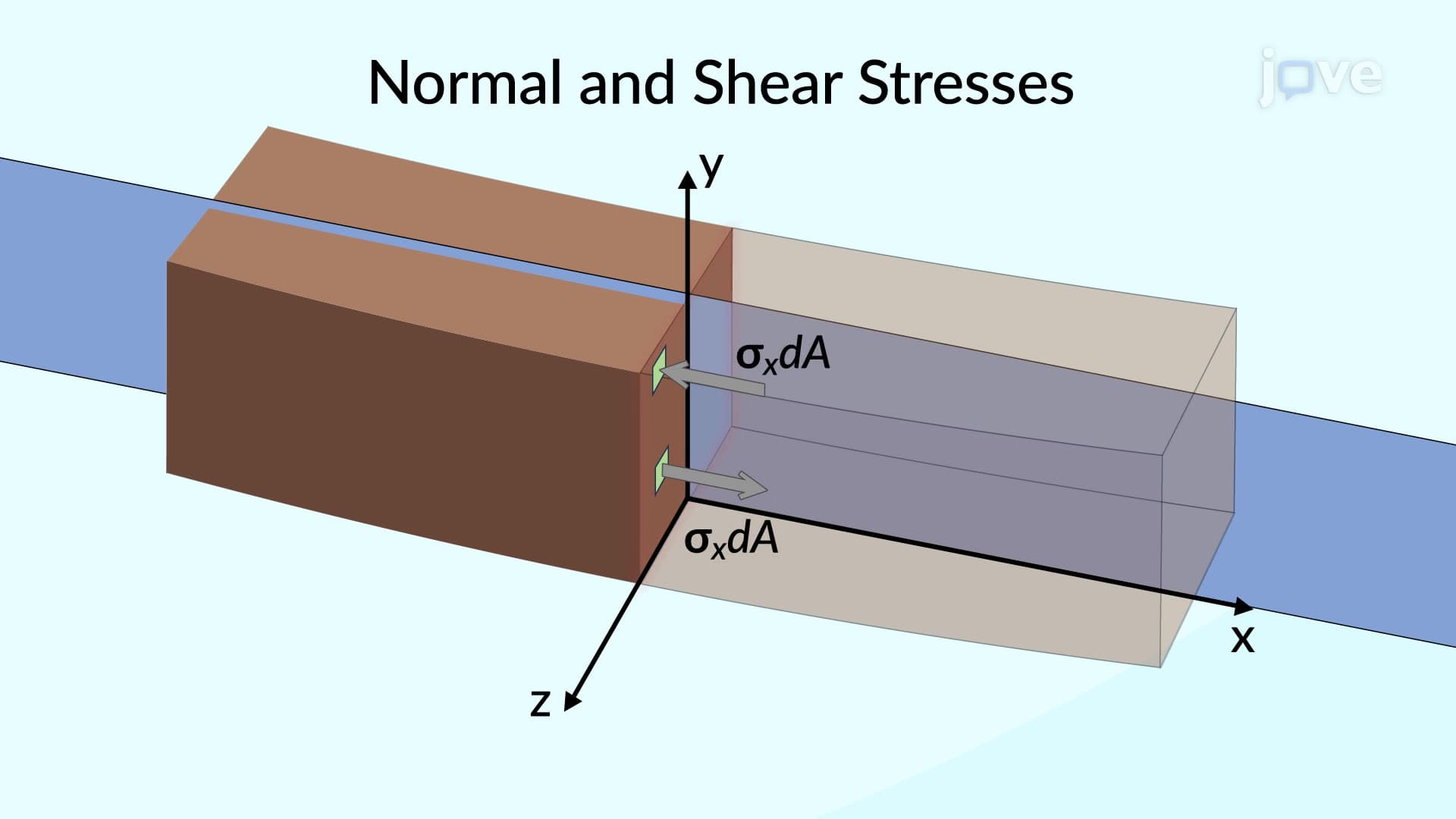
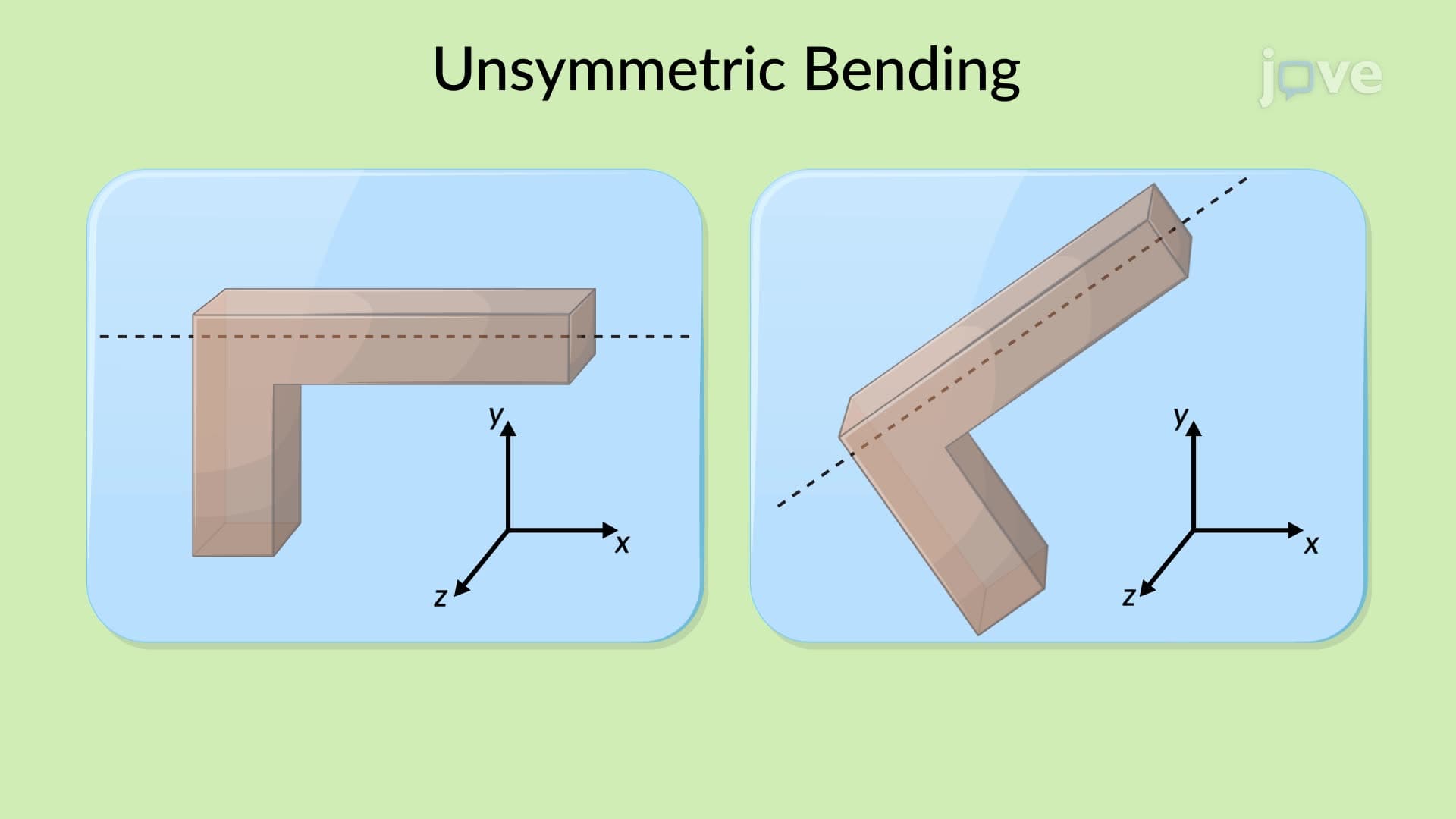
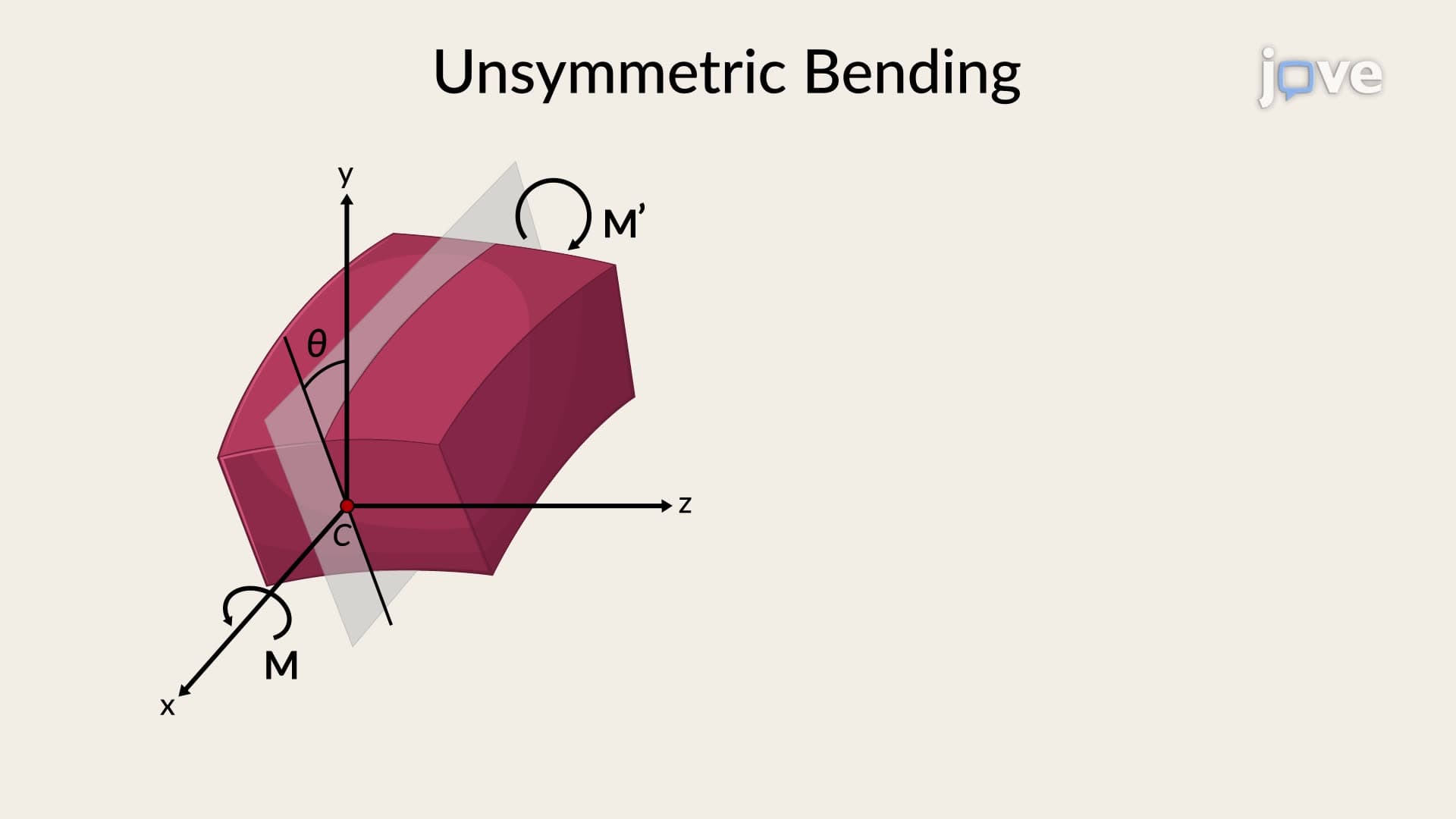
Unsymmetric bending occurs when applied moments don't align with a cross-section's principal centroidal axes. Unlike simple bending where loads act perpendicular to one principal axis, unsymmetric bending involves oblique loading that creates complex stress patterns. The neutral axis-traditionally horizontal in simple beam bending-rotates to a new angle determined by the interaction between applied moments and sectional properties.
The analysis begins by resolving the applied bending moment vector into components along the principal y and z axes. If a moment M acts at angle α to the z-axis, the components become:
Each component creates its own stress distribution: σz = (Mz × y)/Iz and σy = (My × z)/Iy. Using superposition, the total stress becomes: σ = (Mz × y)/Iz - (My × z)/Iy. The neutral axis exists where this combined stress equals zero.
Setting the stress equation to zero and solving for the neutral axis slope reveals: tan(θ) = (Iz/Iy) × tan(α), where θ represents the neutral axis angle and α represents the applied moment angle. This fundamental relationship shows that the neutral axis angle differs from the loading angle unless Iz equals Iy (circular sections).
For typical structural shapes like I-beams or rectangular sections, Iz ≠ Iy, causing significant neutral axis rotation. When Iz > Iy (common in wide-flange beams), the neutral axis angle θ exceeds the loading angle α, concentrating maximum stresses away from the loading direction.
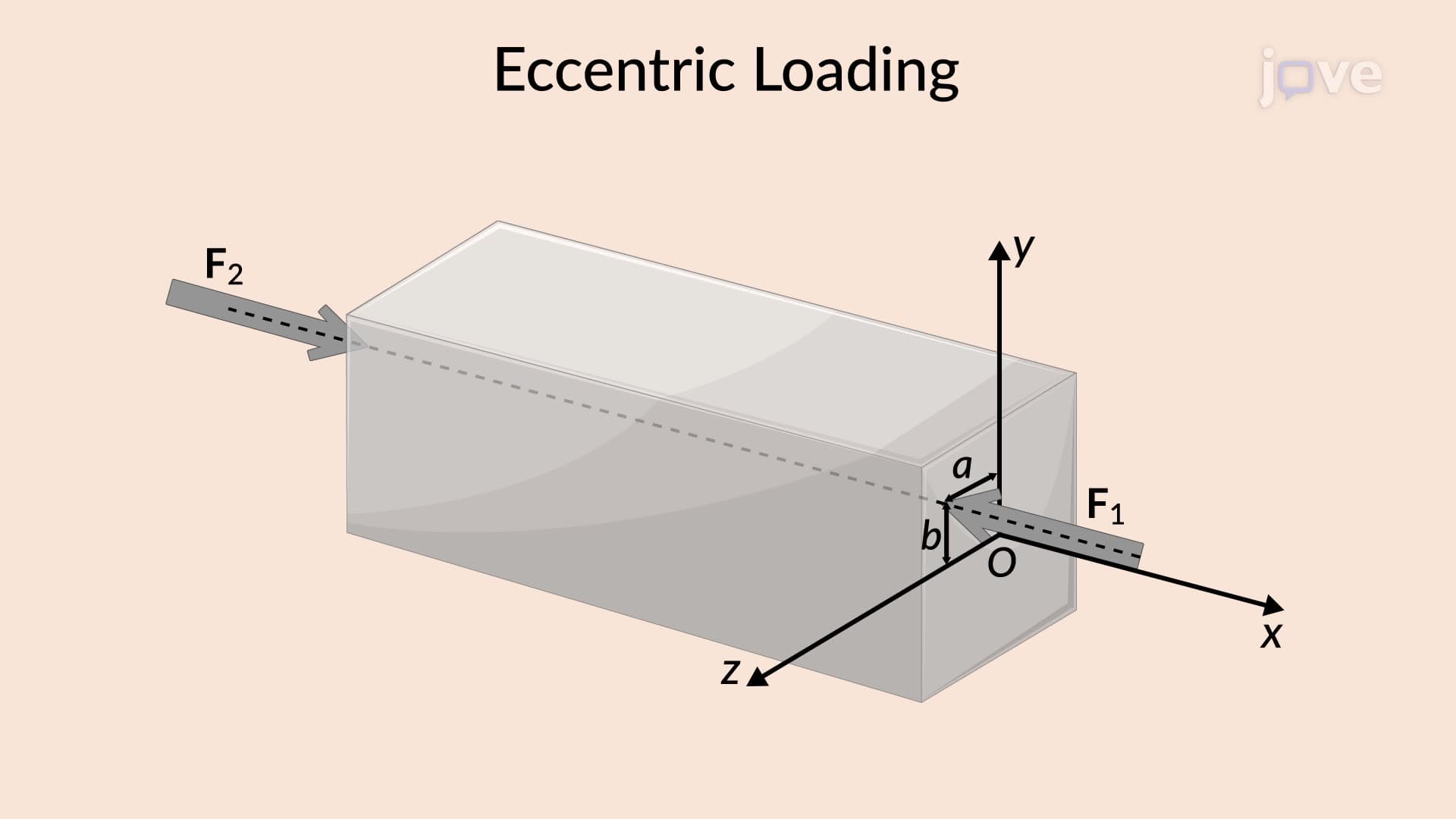
This concept proves critical in designing structures subject to wind, seismic, or eccentric loading. The Millau Bridge in France (though the principle applies to US structures like the Mackinac Bridge) demonstrates how engineers must account for unsymmetric bending in cable-stayed designs. In the US, building codes like AISC 360 require unsymmetric bending analysis for steel structures under combined loading.
Students preparing for the Fundamentals of Engineering (FE) exam frequently encounter problems involving unsymmetric bending calculations. The concept also appears in advanced structural analysis courses at institutions like MIT, UC Berkeley, and Georgia Tech, where students learn to design safe, efficient structures under complex loading conditions.
Related Micro-courses