Loading video…


 18 Concepts
 6.9K views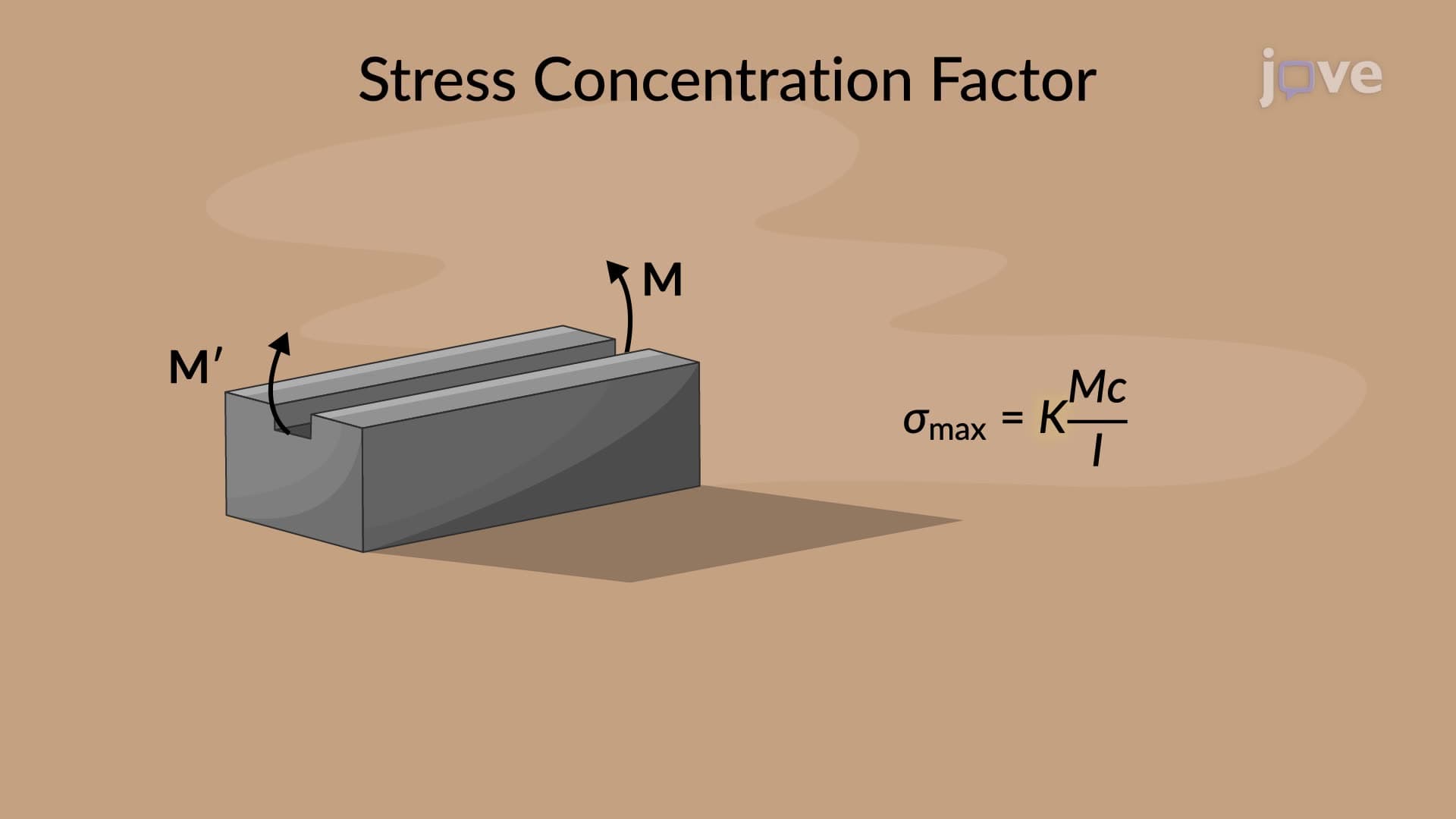

Video Summary: What Is Stress Concentrations
Ever wonder why airplane wings don't snap despite extreme forces? Stress concentrations occur when geometric features like holes, notches, or grooves cause stress to intensify at specific points rather than distribute evenly across a material's cross-section. Boeing engineers must carefully calculate these concentration factors when designing aircraft components to prevent catastrophic failure. The stress concentration factor quantifies how much the maximum stress exceeds the nominal stress in these critical areas. Watch the full video on JoVE Coach to master this concept with expert-led visuals and step-by-step explanations.
Stress concentrations represent one of the most critical concepts in materials science and mechanical engineering. When engineers assume uniform stress distribution across a material's cross-section, they're working with an idealized scenario. In reality, any geometric discontinuity-whether intentional like bolt holes or unintentional like manufacturing defects-creates localized areas where stress becomes significantly amplified.
The fundamental principle behind stress concentrations lies in how forces flow through materials. Think of stress lines like water flowing through a pipe: when the pipe suddenly narrows or encounters an obstacle, the water must squeeze through, creating higher pressure. Similarly, when stress encounters a geometric irregularity, it must "flow around" the discontinuity, resulting in higher stress values at specific locations.
The stress concentration factor (K) provides engineers with a quantitative tool to predict these stress amplifications. This dimensionless ratio compares the maximum stress occurring at a discontinuity to the nominal stress calculated using standard formulas for uniform cross-sections:
K = Maximum Stress / Nominal Stress
For a flat plate with a circular hole under tensile loading, the stress concentration factor can reach values of 3.0 or higher, meaning the actual stress is three times greater than the calculated nominal stress. This knowledge proves essential for AP Physics students tackling mechanics problems and college engineering majors preparing for materials science exams.
American infrastructure provides countless examples of stress concentration management. The Golden Gate Bridge's cable anchorages feature carefully designed transitions to minimize stress concentrations where cables attach to concrete structures. Similarly, aerospace manufacturers like Lockheed Martin must account for stress concentrations around rivet holes and access panels in aircraft fuselages.
In the automotive industry, Detroit's Big Three automakers extensively analyze stress concentrations in engine components. Connecting rods, for instance, feature carefully designed fillet radii at geometric transitions to prevent fatigue failures that could cause catastrophic engine damage.
Successful stress concentration management involves several strategies. Engineers can modify geometric features by adding fillet radii to sharp corners, gradually transitioning between different cross-sectional areas, or strategically placing reinforcement materials around high-stress regions. These principles appear frequently in MCAT physics sections and college-level statics courses, where students must demonstrate understanding of how geometric modifications affect structural performance.
Related Micro-courses