Loading video…


 19 Concepts
 17.8K views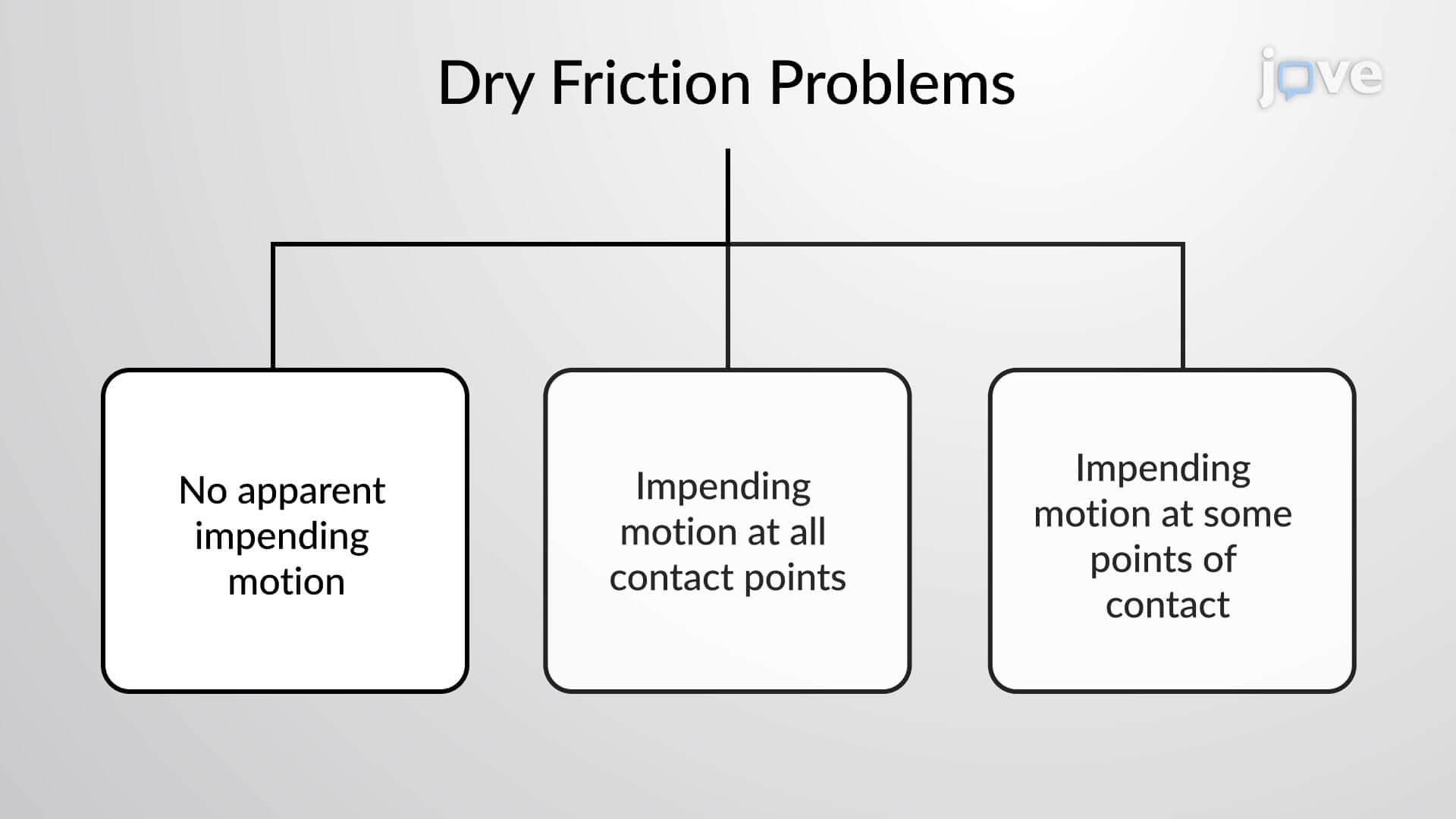

Video Summary: What are Types of Friction Problems
Ever wonder why a ladder doesn't slip when leaning against your house wall, or what force is needed to move a heavy crate? Understanding the types of friction problems is crucial for solving real-world engineering challenges, from calculating the grip needed for car tires on wet roads to designing safe construction equipment. The three main types of friction problems involve scenarios with no impending motion, motion at all contact points, and motion at some contact points. Watch the full video on JoVE Coach to master this concept with expert-led visuals and step-by-step explanations.
When engineers and physicists analyze static systems involving contact forces, they encounter three distinct types of friction problems that require different analytical approaches. Each type presents unique challenges in terms of unknown variables and the equations needed for solution.
The first category involves objects in complete static equilibrium where no motion is anticipated. Consider a shipping crate sitting on a warehouse floor with workers applying various forces to test its stability. In these scenarios, the friction force develops naturally to maintain equilibrium, limited only by the maximum static friction available (μ(static) × Normal force).
For Type 1 problems, engineers typically have three unknowns that can be solved using three equilibrium equations: sum of forces in x-direction equals zero, sum of forces in y-direction equals zero, and sum of moments about any point equals zero. The actual friction force developed will be less than the maximum available static friction, making these problems straightforward to analyze using standard statics principles.
The second type involves critical conditions where the entire system is on the verge of motion. A classic example is determining the minimum angle for a ladder leaning against a smooth exterior wall of a building before it begins to slip. This scenario is crucial for OSHA safety regulations in construction.
These problems require four equations to solve four unknowns: the three standard equilibrium equations plus one additional equation stating that the friction force equals its maximum value (F(friction) = μ(static) × N). This additional constraint reflects the impending motion condition, where static friction reaches its limit at all contact surfaces simultaneously.
The most complex category involves systems where some contact points reach the verge of slipping while others remain stable. Consider a two-member structural frame supporting a building load, where increasing horizontal forces (like wind loads) might cause slipping at one support before affecting others.
These problems challenge students on AP Physics exams and college statics courses because they require careful analysis of which contact points will slip first. Engineers must evaluate multiple scenarios: slipping at point A but not B, slipping at B but not A, or simultaneous slipping. This analysis is essential for designing earthquake-resistant structures in California, where differential motion at foundation points is a critical safety consideration.
Understanding these types of friction problems is fundamental for students preparing for the Fundamentals of Engineering (FE) exam and practicing engineers designing everything from automotive braking systems to building foundations. The concepts appear regularly on AP Physics C: Mechanics exams and form the foundation for advanced courses in structural and mechanical engineering at universities nationwide.
Related Micro-courses