Loading subject page…

- Analytical Chemistry
- Principles of Chromatography
- Column Efficiency: Rate Theory
Micro-course: Principles of Chromatography
42,891 views
Learn key concepts and earn your certificate.










Column Efficiency: Rate Theory


00:00
01:12
Video Summary: What Is Column Efficiency Rate Theory
Ever wonder why some pharmaceutical drugs are purified perfectly while others contain impurities? Column efficiency rate theory explains how the speed of liquid flowing through chromatography columns affects separation quality. Unlike simpler plate models, this theory reveals what actually happens inside columns used by companies like Pfizer and Merck to purify medications. The van Deemter equation shows that faster isn't always better-there's an optimal flow rate for maximum efficiency. Watch the full video on JoVE Coach to master this concept with expert-led visuals and step-by-step explanations.
- Understand what column efficiency rate theory reveals about chromatographic separations that plate theory cannot explain
- Identify the three key factors (A, B, and C terms) in the van Deemter equation and their physical meanings
- Analyze how mobile phase flow rate affects band broadening and column performance
- Compare the effects of multiple pathways, longitudinal diffusion, and mass transfer on separation quality
- Evaluate optimal flow rate conditions using HETP (Height Equivalent to Theoretical Plate) calculations
- Apply rate theory principles to predict and improve chromatographic separations in laboratory settings
- Recognize real-world applications in pharmaceutical purification and environmental testing
- Explore the relationship between column packing, flow velocity, and separation efficiency
Understanding Column Efficiency Rate Theory Fundamentals
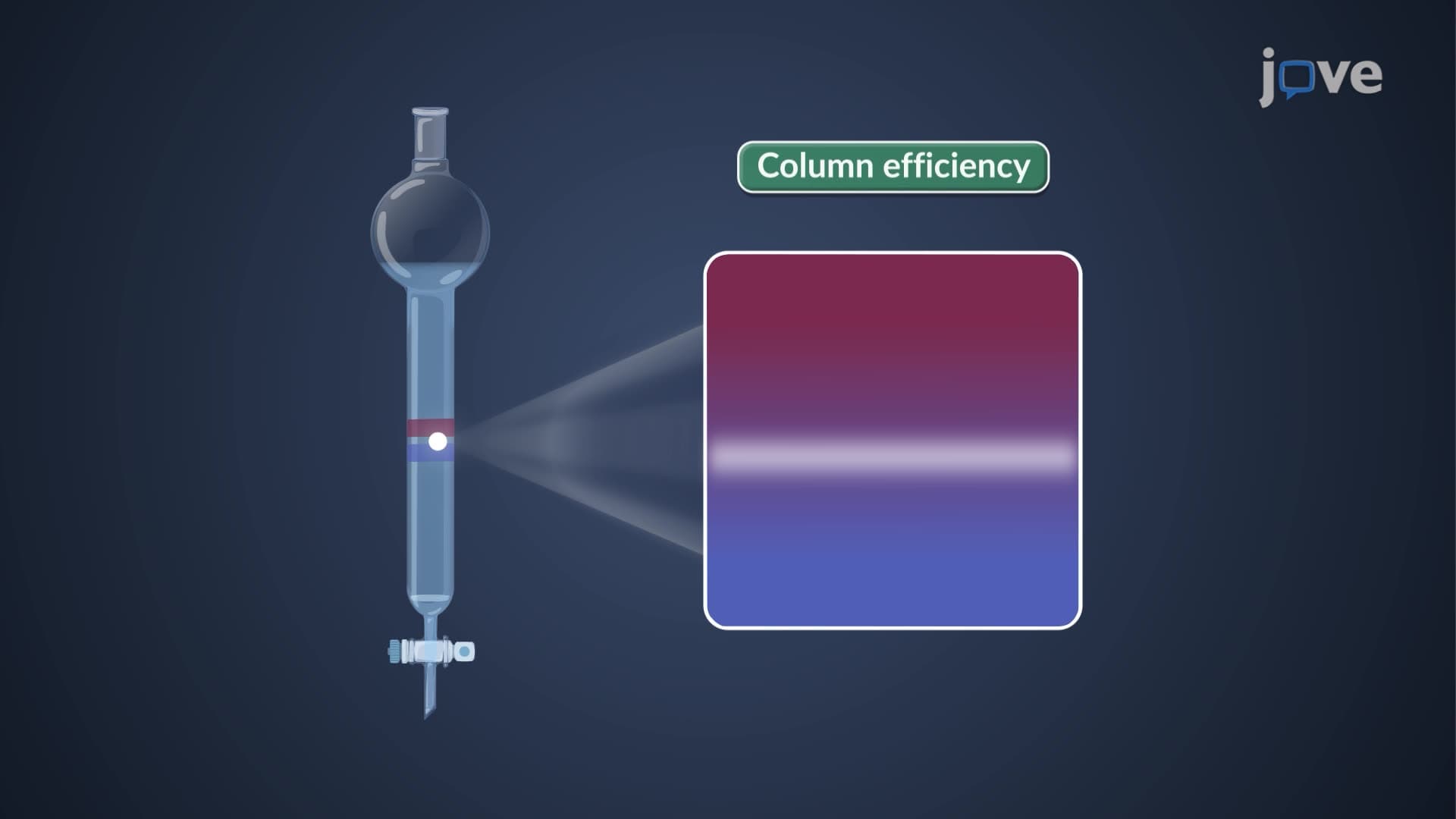
Column efficiency rate theory represents a revolutionary advancement over traditional plate theory by providing a realistic model of chromatographic processes. While plate theory treats the column as discrete theoretical stages, rate theory acknowledges the continuous nature of molecular interactions within packed columns. This approach proves essential for understanding modern analytical techniques used in FDA drug testing laboratories and EPA environmental monitoring facilities.
The theory's core principle centers on how mobile phase velocity affects band broadening-the spreading of sample peaks as they travel through the column. Unlike the idealized plate model, rate theory recognizes that real columns contain irregularities and that molecular diffusion occurs continuously during separation.
The Van Deemter Equation: A Mathematical Framework
The van Deemter equation serves as the mathematical foundation of rate theory: H = A + B/u + Cu, where H represents the Height Equivalent to Theoretical Plate (HETP), and u indicates the linear velocity of the mobile phase. This equation appears frequently on AP Chemistry exams and college analytical chemistry tests, making it crucial for student success.
Each term addresses specific physical phenomena. The A term accounts for eddy diffusion-the multiple pathways available to solute molecules as they navigate around irregularly packed particles. The B term describes longitudinal diffusion, where molecules naturally spread from high to low concentration regions. The C term represents mass transfer kinetics, reflecting the time required for molecules to equilibrate between mobile and stationary phases.
Practical Applications in US Industries
American pharmaceutical companies like Johnson & Johnson utilize rate theory principles daily. When developing new medications, scientists optimize column conditions to achieve baseline separation of drug compounds from impurities. Environmental testing laboratories, including those contracted by the EPA, apply these concepts when analyzing water samples for pollutants. The theory helps predict optimal flow rates that balance analysis time with separation quality.
Exam Relevance and Study Strategies
Rate theory concepts frequently appear on standardized exams. The MCAT includes questions about chromatographic efficiency, while AP Chemistry students encounter van Deemter plots in their coursework. Understanding the physical meaning behind each equation term proves more valuable than memorizing formulas. Students should focus on how changing flow rate affects each broadening mechanism differently-knowledge that directly applies to laboratory practicum components of college chemistry courses.
Frequently Asked Questions
Column efficiency rate theory provides a realistic model of chromatographic separations by considering continuous processes within the column, unlike plate theory's discrete stage approach. It explains how flow rate affects band broadening through three mechanisms: multiple pathways (eddy diffusion), molecular diffusion, and mass transfer kinetics. This theory proves essential for optimizing real-world separations in pharmaceutical and environmental laboratories.
The van Deemter equation (H = A + B/u + Cu) shows how column efficiency changes with mobile phase velocity. By plotting HETP versus flow rate, scientists identify the optimal velocity that minimizes band broadening. This optimization proves crucial in pharmaceutical quality control and environmental analysis, where separation efficiency directly affects result accuracy and regulatory compliance.
Yes, rate theory frequently appears on AP Chemistry exams and college analytical chemistry courses. Expect questions about van Deemter equation components, optimal flow rate determination, and band broadening mechanisms. The MCAT also includes chromatography efficiency concepts. Focus on understanding physical meanings rather than just memorizing equations for better exam performance.
MCAT General Chemistry sections include chromatographic separation principles and efficiency concepts. You'll encounter questions about optimizing separation conditions, interpreting chromatograms, and understanding molecular behavior in different phases. Rate theory knowledge helps answer questions about analytical techniques used in biochemical research and pharmaceutical development.
Companies like Pfizer and Merck apply rate theory when purifying drug compounds and removing impurities. Scientists optimize column conditions to achieve required separation standards set by FDA regulations. Rate theory helps predict how changes in flow rate, temperature, and column dimensions affect separation quality, ensuring consistent pharmaceutical manufacturing processes.
No, you only need algebra and basic calculus concepts typically covered in high school. The van Deemter equation involves straightforward mathematical relationships that most students can handle with proper preparation. Focus on understanding the physical meaning of each term rather than complex mathematical derivations for introductory courses.
Create concept maps linking flow rate changes to each van Deemter term's effect on band broadening. Practice interpreting van Deemter plots and identifying optimal flow rates. Use real examples from pharmaceutical purification to make abstract concepts concrete. Form study groups to explain concepts aloud, which reinforces understanding for analytical chemistry exams.
Explore gradient elution techniques, two-dimensional chromatography, and mass spectrometry coupling methods. Study temperature programming effects and column selection strategies. These advanced topics build directly on rate theory foundations and prove valuable for students pursuing analytical chemistry careers or graduate school preparation.
Related Micro-courses

14 Concepts

19 Concepts

17 Concepts