Loading video…

 9 Concepts
 730 views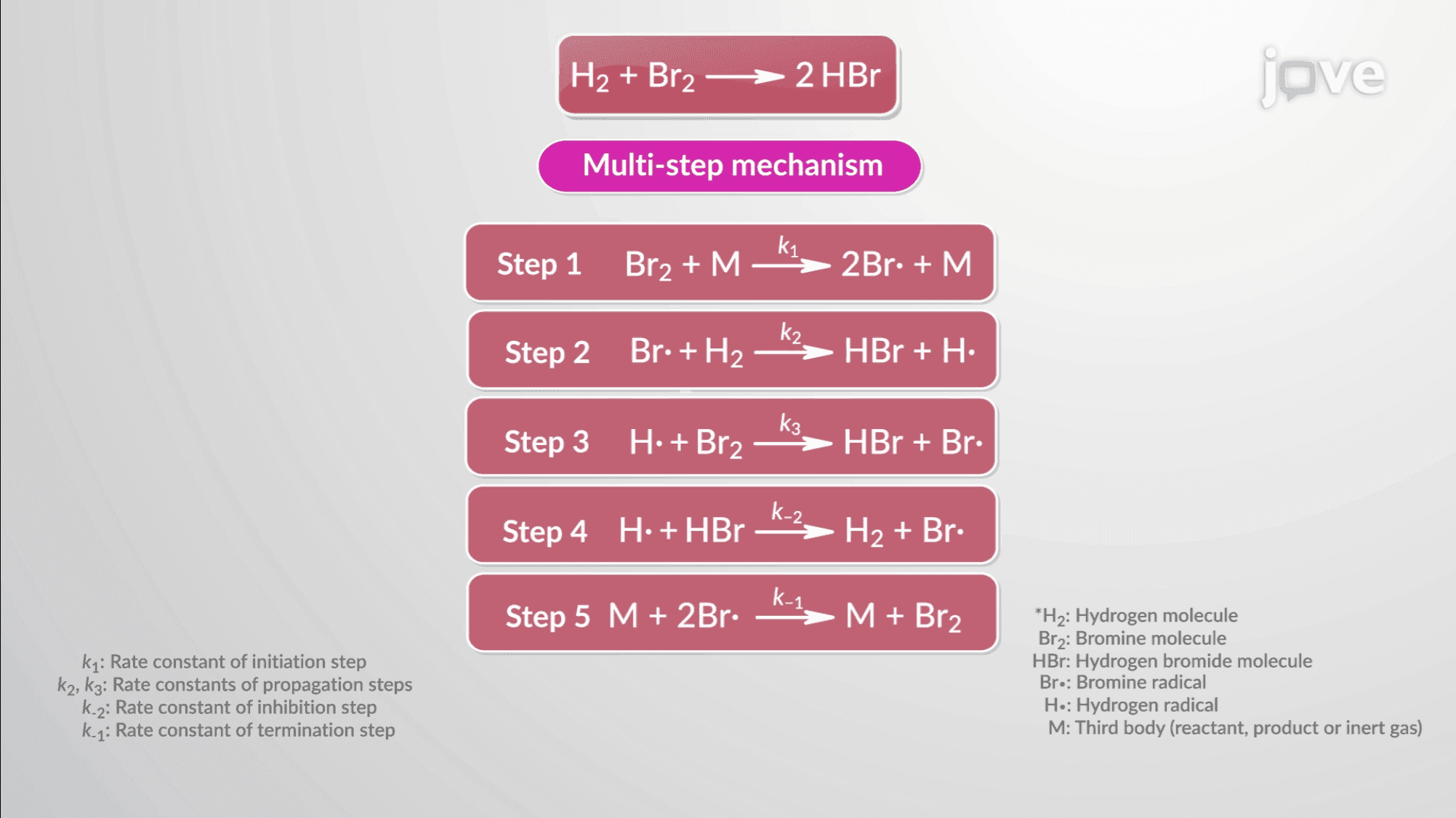

Video Summary: What are Chain Reactions
Did you know that a single spark can trigger millions of molecular reactions in milliseconds? That's the power of chain reactions. Chain reactions basics reveal how unstable radical species drive self-sustaining chemical processes, from nuclear power plants in the US to everyday combustion engines. The observed rate law depends only on stable species, making chain reactions both elegant and complex. Watch the full video on JoVE Coach to master this concept with expert-led visuals and step-by-step explanations.
Chain reactions are a class of chemical reactions where reactive intermediates, called radicals, are continuously produced and consumed in a self-sustaining cycle. Unlike simple one-step reactions, chain reactions proceed through a sequence of mechanistic steps, making them a central topic in chemical kinetics. Understanding chain reactions is essential for AP Chemistry students, college undergraduates in general or physical chemistry, and anyone preparing for the MCAT.
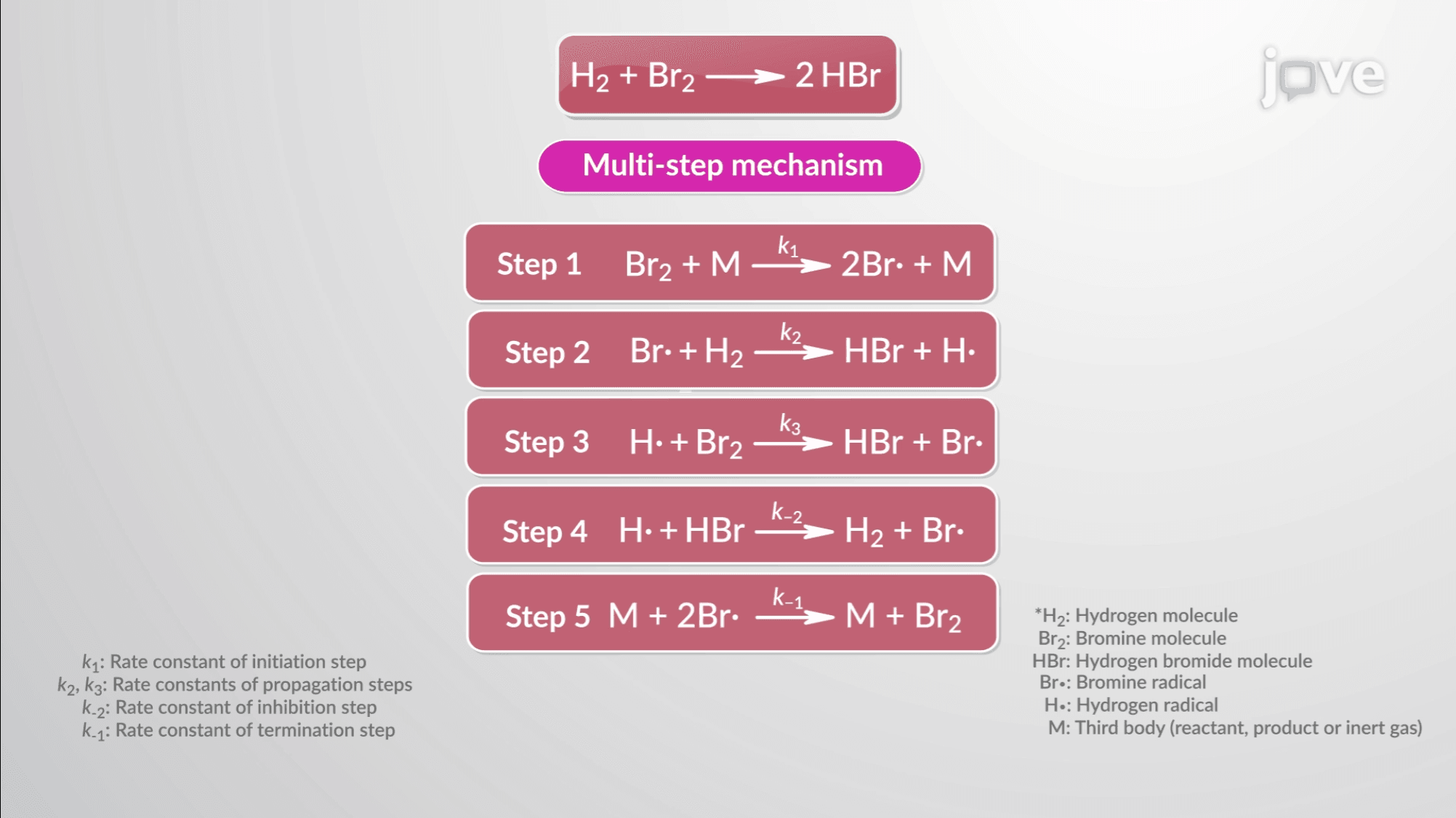
Every chain reaction follows a predictable four-stage framework, best illustrated by the reaction between hydrogen (H₂) and bromine (Br₂) to form hydrogen bromide (HBr).
Initiation is where the chain begins. A bromine molecule absorbs enough energy, often from heat or light, to break apart into two bromine radicals (Br•). This bond homolysis is highly endothermic and requires significant activation energy.
Propagation is the self-sustaining core of the chain. A bromine radical attacks a hydrogen molecule, forming HBr and a hydrogen radical (H•). That hydrogen radical then attacks another Br₂ molecule, regenerating a bromine radical. This loop repeats thousands of times per initiation event, amplifying product formation dramatically.
Inhibition is a crucial and often overlooked stage. When HBr, the product, reacts with a hydrogen radical, it consumes that radical without regenerating a bromine radical. This reduces the overall concentration of chain-carrying radicals, slowing the reaction. Product inhibition is why HBr appears in the denominator of the experimentally observed rate law.
Termination ends the chain entirely. Two bromine radicals recombine in the presence of a third body (M), which absorbs the excess kinetic energy released. Without this energy sink, the recombined molecule would simply re-dissociate. Once radicals are consumed without replacement, the chain collapses.
One of the most powerful insights from chain reactions is that the observed rate law reflects only stable, measurable species, not the short-lived radicals driving the mechanism. For the H₂/Br₂ system, the empirical rate law takes the form:
Rate = k × [H₂] × [Br₂]^(1/2) / (1 + k' × [HBr]/[Br₂])
The square-root dependence on [Br₂] is a direct fingerprint of the initiation step, where Br₂ dissociates into two radicals, a process that scales with the square root of concentration under steady-state approximation. The [HBr] in the denominator quantifies inhibition. This kind of rate law analysis is a staple of college physical chemistry exams and frequently appears on the MCAT in the context of reaction mechanisms.
Chain reactions are not just textbook abstractions. Nuclear fission reactors, like those operated by the US Nuclear Regulatory Commission at plants such as the Vogtle Electric Generating Plant in Georgia, rely on controlled neutron-induced chain reactions to generate electricity. In combustion chemistry, the chain-reaction mechanism of hydrocarbon oxidation explains how gasoline ignites in car engines. In the atmosphere, radical chain reactions involving chlorine atoms are responsible for ozone layer depletion, a topic studied extensively by the US Environmental Protection Agency (EPA). Connecting these real applications to the underlying chemistry deepens conceptual understanding and strengthens performance on both standardized tests and college coursework.
Related Micro-courses