Loading video…

 9 Concepts
 730 views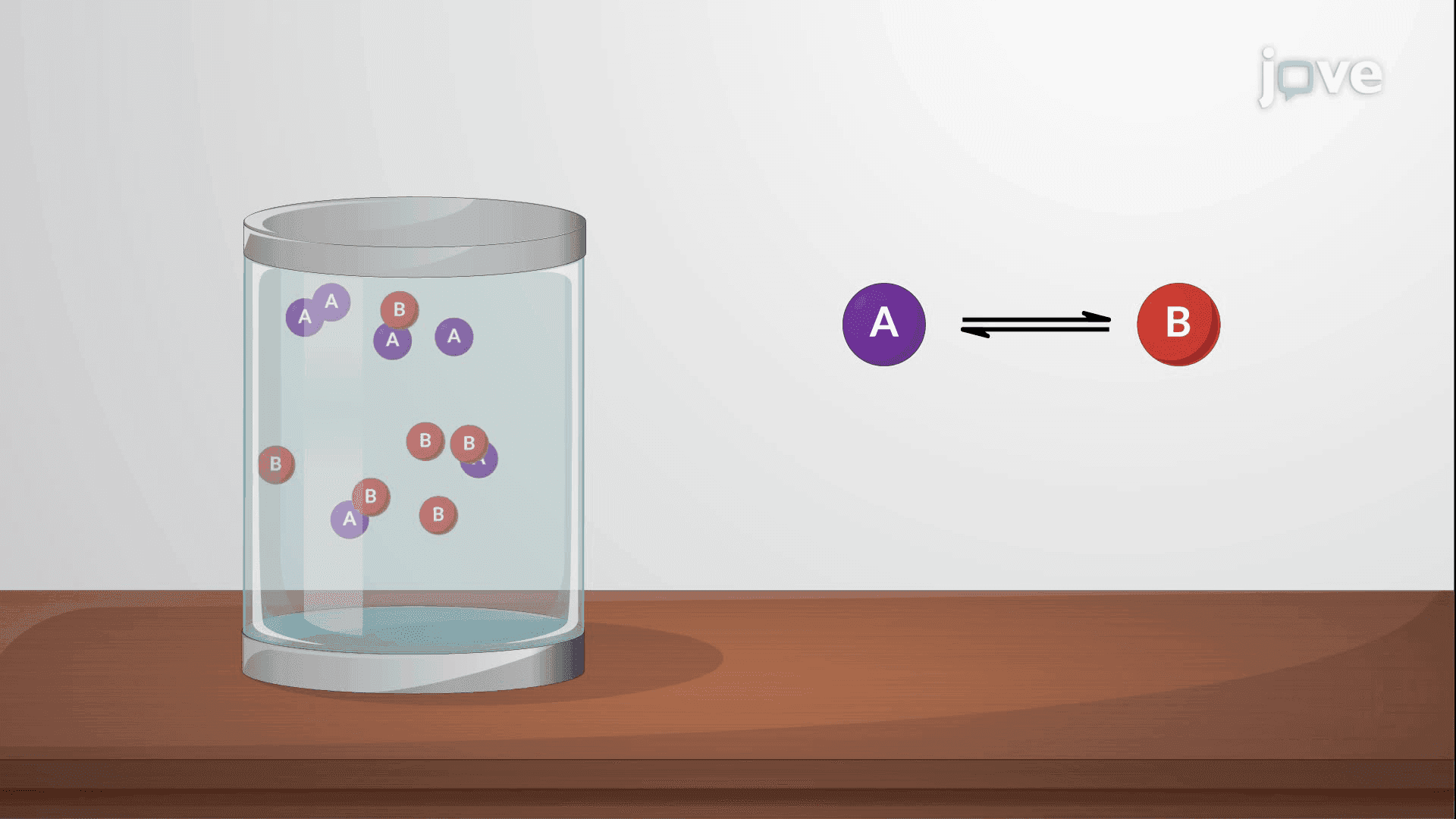

Video Summary: What are Reversible or Opposing Reactions
Did you know a chemical reaction can run in two directions simultaneously? Reversible or opposing reactions occur when reactants convert to products while products simultaneously regenerate reactants, like the oxygen-hemoglobin binding in human blood. Using forward rate constant kf and reverse rate constant kr, equilibrium concentration is mathematically derived by setting the net rate to zero. Watch the full video on JoVE Coach to master this concept with expert-led visuals and step-by-step explanations.
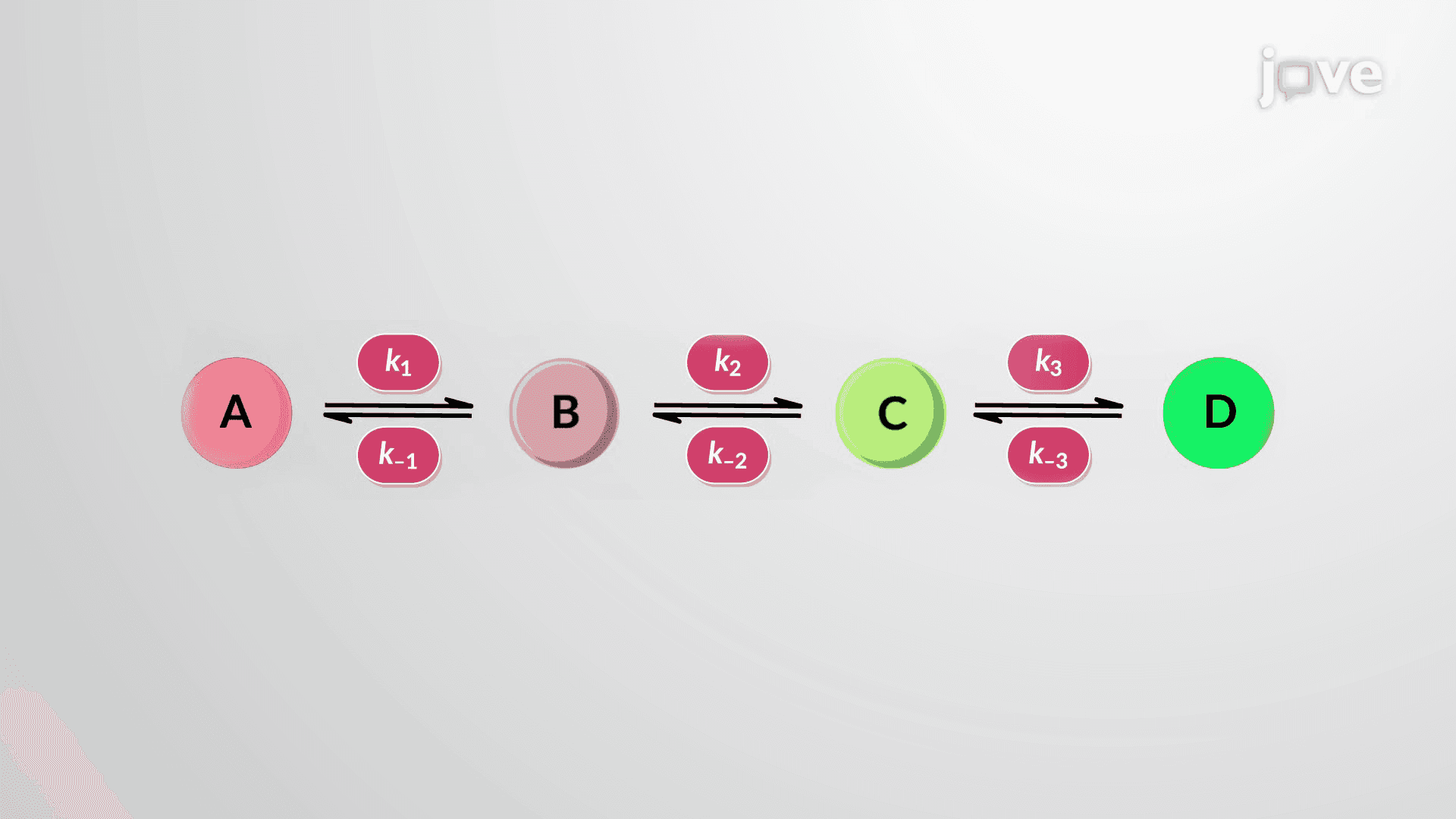
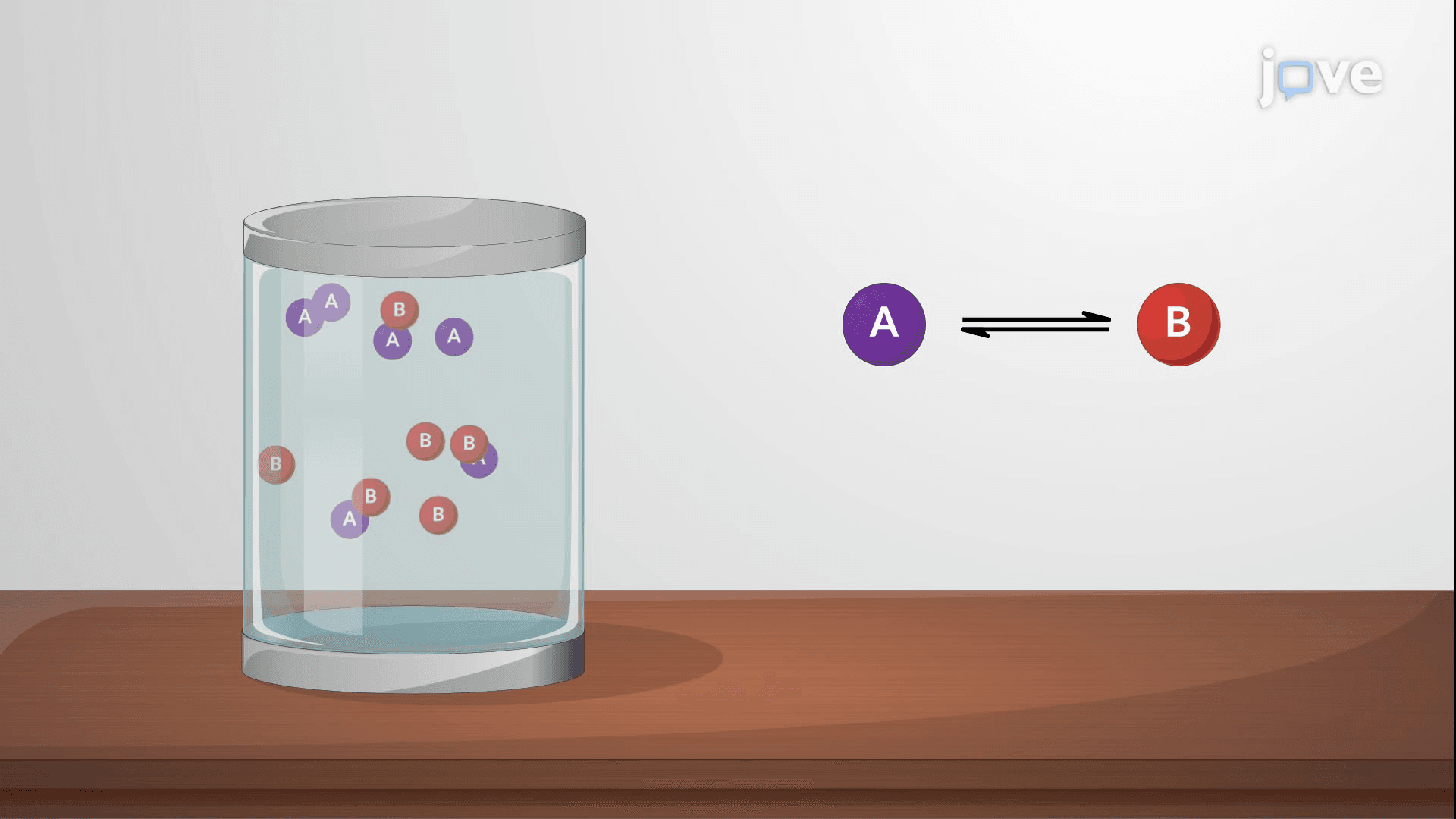
Most introductory chemistry courses present reactions as traveling in one direction, reactants become products and stop. But reversible or opposing reactions challenge that assumption. In these systems, the forward reaction (A → B) and the reverse reaction (B → A) occur simultaneously. The net behavior of the system reflects the competition between these two pathways, and understanding this competition is fundamental to chemical kinetics and equilibrium theory. This concept appears across AP Chemistry, college general chemistry, and MCAT preparation.
In a simple reversible reaction where A and B interconvert, both steps follow first-order kinetics. The forward rate depends on the concentration of A, written as kf[A], and the reverse rate depends on the concentration of B, written as kr[B]. The net rate of change of A combines both contributions:
Net rate = −kf[A] + kr[B]
This equation tells you that A is consumed in the forward direction and regenerated in the reverse direction. Understanding how to construct this net rate expression is a core skill tested in AP Chemistry free-response questions and college midterm exams.
The law of conservation of mass is a powerful tool here. If the reaction begins with only A at an initial concentration [A]₀, then at any point in time, the total concentration of A and B must equal [A]₀:
[A] + [B] = [A]₀
This allows you to express [B] as [A]₀ − [A] and substitute it into the net rate equation, eliminating [B] entirely. Now the rate expression depends only on [A], making it solvable using standard first-order integration methods, a technique heavily emphasized in university physical chemistry courses and MCAT biochemistry sections.
Equilibrium is reached when the net rate equals zero, meaning the forward and reverse reactions proceed at exactly the same speed. Setting the net rate to zero and solving for [A] at equilibrium yields an expression that, after dividing numerator and denominator by kr, naturally produces the ratio kf/kr. This ratio is defined as the equilibrium constant K:
K = kf / kr
A large K means products are favored at equilibrium; a small K means reactants dominate. This relationship connects directly to topics like activation energy, the Arrhenius equation (which explains how temperature affects kf and kr individually), and catalysis, since catalysts lower activation energy for both directions, increasing both rate constants without changing K. In the US, this relationship is tested extensively on the AP Chemistry exam, college biochemistry midterms, and the MCAT.
One of the most cited examples of reversible opposing reactions in US medical education is the binding of oxygen to hemoglobin. Oxygen binds hemoglobin in the lungs (forward reaction) and is released in body tissues (reverse reaction). The equilibrium between these two steps is governed by exactly the mathematics described above. Similarly, pharmacokinetics, a key MCAT topic, relies on reversible drug-receptor binding described by forward and reverse rate constants. Understanding these foundations gives students a direct bridge from abstract kinetics to real physiological systems.
Related Micro-courses