Loading video…


 15 Concepts
 203.3K views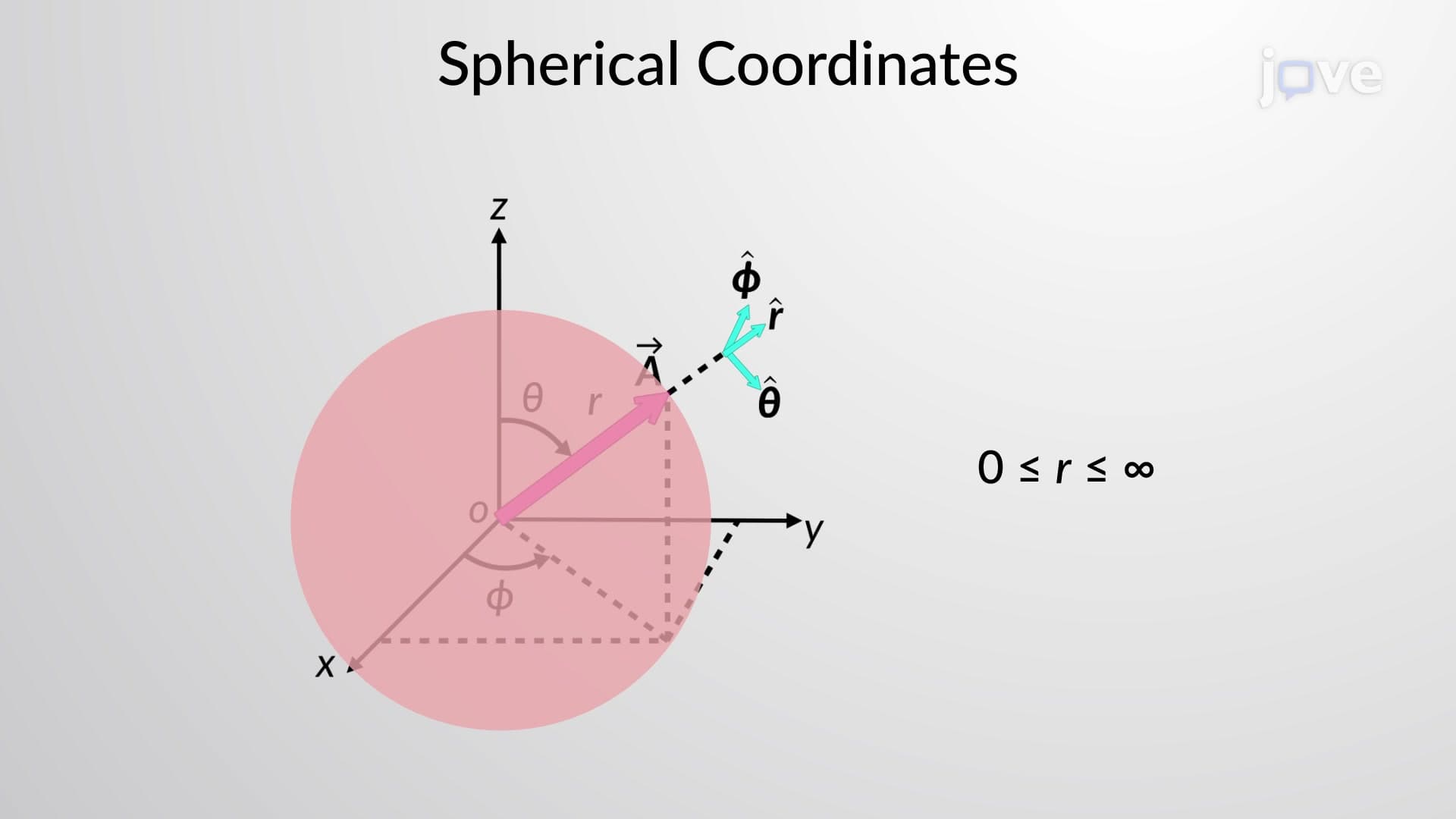

Video Summary: What are Spherical Coordinates
Ever wondered how GPS satellites pinpoint your exact location on Earth's curved surface? Spherical coordinates provide the mathematical framework for this three-dimensional positioning system, extending beyond simple flat-plane measurements. NASA's Deep Space Network uses spherical coordinate systems to track spacecraft missions like the Mars Perseverance rover across vast distances. Unlike other coordinate systems, what are spherical coordinates becomes clear when you consider how they naturally describe positions on spheres, cones, and curved surfaces using three key components: radial distance, polar angle, and azimuthal angle. Watch the full video on JoVE Coach to master this concept with expert-led visuals and step-by-step explanations.
Spherical coordinates represent one of the most powerful mathematical tools for describing three-dimensional space, particularly when dealing with systems exhibiting spherical symmetry. While Cartesian coordinates use perpendicular axes (x, y, z) and cylindrical coordinates combine linear and angular measurements, spherical coordinates embrace the natural curvature of three-dimensional space through three distinct parameters.
The types of spherical coordinates consist of three components that work together to pinpoint any location in 3D space. The radial component (r) measures the straight-line distance from the origin to the point, ranging from zero to infinity. The polar angle (θ, pronounced "theta") measures the angle from the positive z-axis down to the vector, constrained between 0 and π radians. Finally, the azimuthal angle (φ, pronounced "phi") measures the angle in the xy-plane from the positive x-axis, ranging from 0 to 2π radians.
A spherical coordinates overview reveals how constant values create predictable geometric shapes. When the radial distance remains constant, all points form a perfect sphere centered at the origin-imagine the surface of a basketball or the Earth's atmosphere at a specific altitude. Constant polar angles generate half-cones extending from the origin, similar to the beam pattern from a flashlight. Constant azimuthal angles create half-planes, like vertical slices cutting through space from the z-axis.
These geometric relationships make spherical coordinates invaluable for solving problems involving planetary motion, electromagnetic radiation patterns, and quantum mechanical wave functions. For instance, MIT's physics department extensively uses spherical coordinates when teaching students about hydrogen atom electron orbitals, where the natural spherical symmetry simplifies complex calculations.
The spherical coordinates concept becomes practically useful through transformation equations that convert between coordinate systems. Converting from spherical to Cartesian coordinates follows: x = r sin(θ) cos(φ), y = r sin(θ) sin(φ), and z = r cos(θ). These transformations appear frequently on AP Physics C exams and college-level multivariable calculus courses.
Understanding spherical coordinates basics proves essential for students pursuing STEM careers. Aerospace engineers at companies like Boeing use spherical coordinates for satellite trajectory calculations, while seismologists at the United States Geological Survey apply them to model earthquake wave propagation through Earth's spherical layers. Weather forecasters rely on spherical coordinate systems to track hurricane paths across the curved Earth's surface, making this mathematical tool directly relevant to daily life and public safety.
Related Micro-courses