Loading video…

 11 Concepts
 3.3K views

Video Summary: Applications of Integration to Probability Density Functions Explained
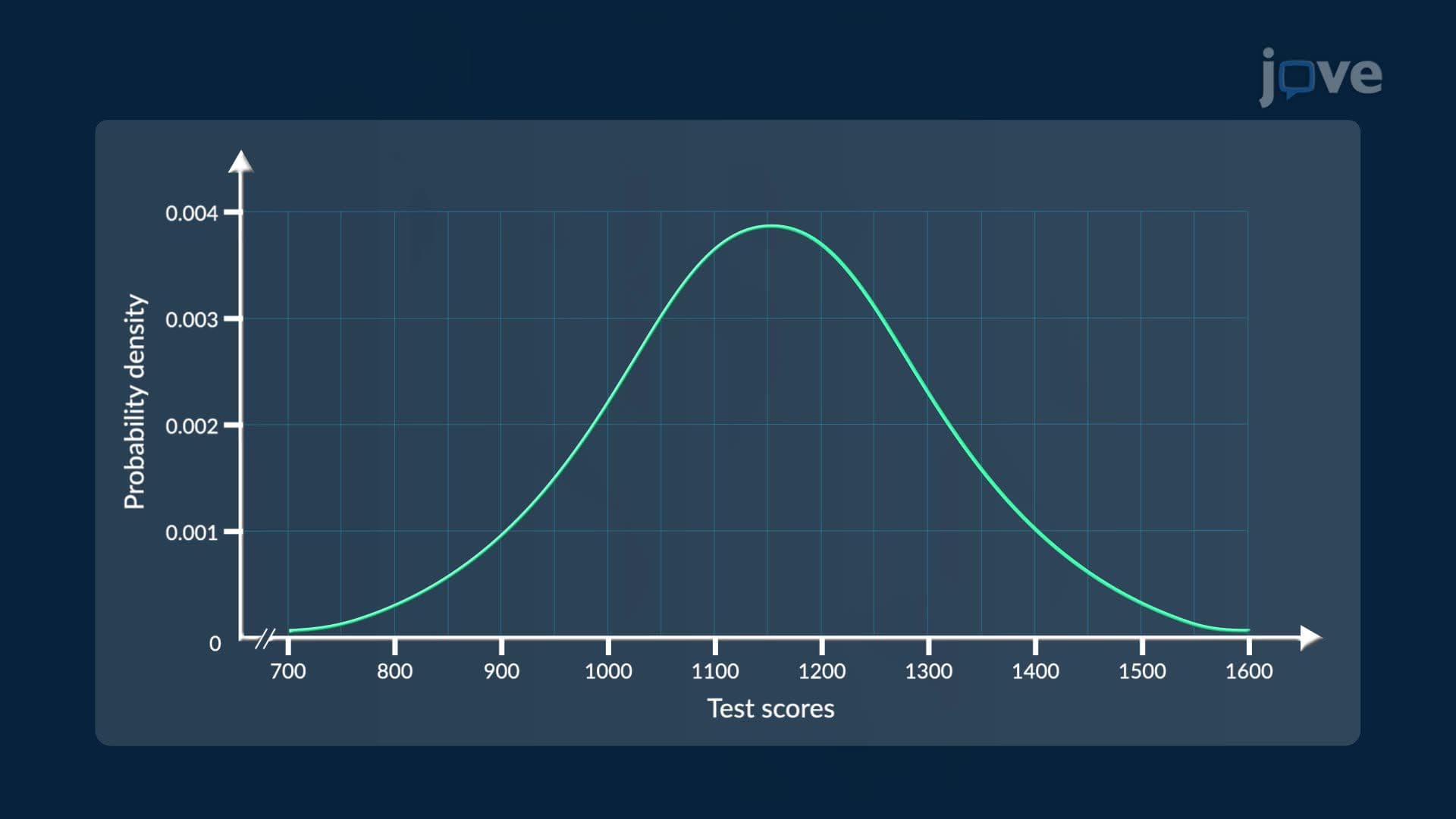
Did you know that measuring the exact probability of a person being *precisely* 5'7" tall is mathematically zero? Understanding the applications of integration to probability density functions unlocks why, and how statisticians model real-world uncertainty. In the US, researchers use this framework to analyze everything from patient blood pressure ranges to SAT score distributions. Applications of Integration to Probability Density Functions Explained reveals how smooth curves, called probability density functions, replace simple counting with powerful calculus-based area calculations. Watch the full video on JoVE Coach to master this concept with expert-led visuals and step-by-step explanations.
Calculus becomes powerfully practical the moment you connect integration to probability. The Applications of Integration to Probability Density Functions sit at the intersection of two major mathematical disciplines, and they appear throughout AP Calculus, college statistics, and professional licensing exams. The core idea is elegant: instead of listing every possible outcome, you model randomness as a continuous curve and use integration to measure how much of that curve falls within any interval you care about.
A continuous random variable can take any value within a range, not just whole numbers or a fixed list of outcomes. US examples include a newborn's birth weight recorded at a hospital, the duration of a patient's surgery, or the concentration of a medication in the bloodstream at a given hour. Because there are infinitely many possible values, traditional probability (adding up fractions for each outcome) breaks down entirely. Integration steps in as the only valid tool for measuring probability across an interval. The probability that the variable X falls between values *a* and *b* is written as the definite integral of f(x) from *a* to *b*, where f(x) is the probability density function.
Not every smooth curve qualifies as a probability density function. Two non-negotiable conditions must hold. First, f(x) must be greater than or equal to zero for all values of x, negative probability is meaningless. Second, the integral of f(x) over its entire domain must equal exactly 1, reflecting the certainty that the variable takes *some* value. In practice, verifying these properties is a standard task on AP Calculus BC free-response questions and college midterms. Students are frequently asked to determine a constant *k* that makes a given function a valid PDF, which requires setting the total integral equal to 1 and solving algebraically.
Once a valid PDF is established, calculating the probability that X falls between two values is straightforward in concept: evaluate the definite integral of f(x) from the lower bound to the upper bound. For example, if a university health center models student resting heart rates using a PDF and wants to know what percentage of students have a heart rate between 60 and 80 beats per minute, they integrate f(x) from 60 to 80. If the result is 0.68, exactly 68% of the sampled population falls in that range. This connects directly to the well-known 68-95-99.7 rule in the normal distribution, one of the most tested PDFs on the MCAT and AP Statistics exams. When standard antiderivatives are not accessible, numerical integration methods such as Simpson's Rule provide accurate approximations, a technique explicitly covered in AP Calculus BC and college calculus courses.
Many practically important distributions, including the normal distribution and the exponential distribution used to model wait times at US emergency rooms, extend across an infinite domain. Computing total probability for these functions requires improper integrals, where one or both limits of integration approach infinity. Evaluating these limits rigorously reinforces why the integral converges to 1 despite the infinite range. Other distributions involve techniques like integration by parts or partial fractions during derivation. Understanding these tools in the probability context transforms them from abstract drill problems into meaningful analytical methods used by biostatisticians, engineers, and data scientists across American research institutions.
Related Micro-courses