Loading video…

 11 Concepts
 3.3K views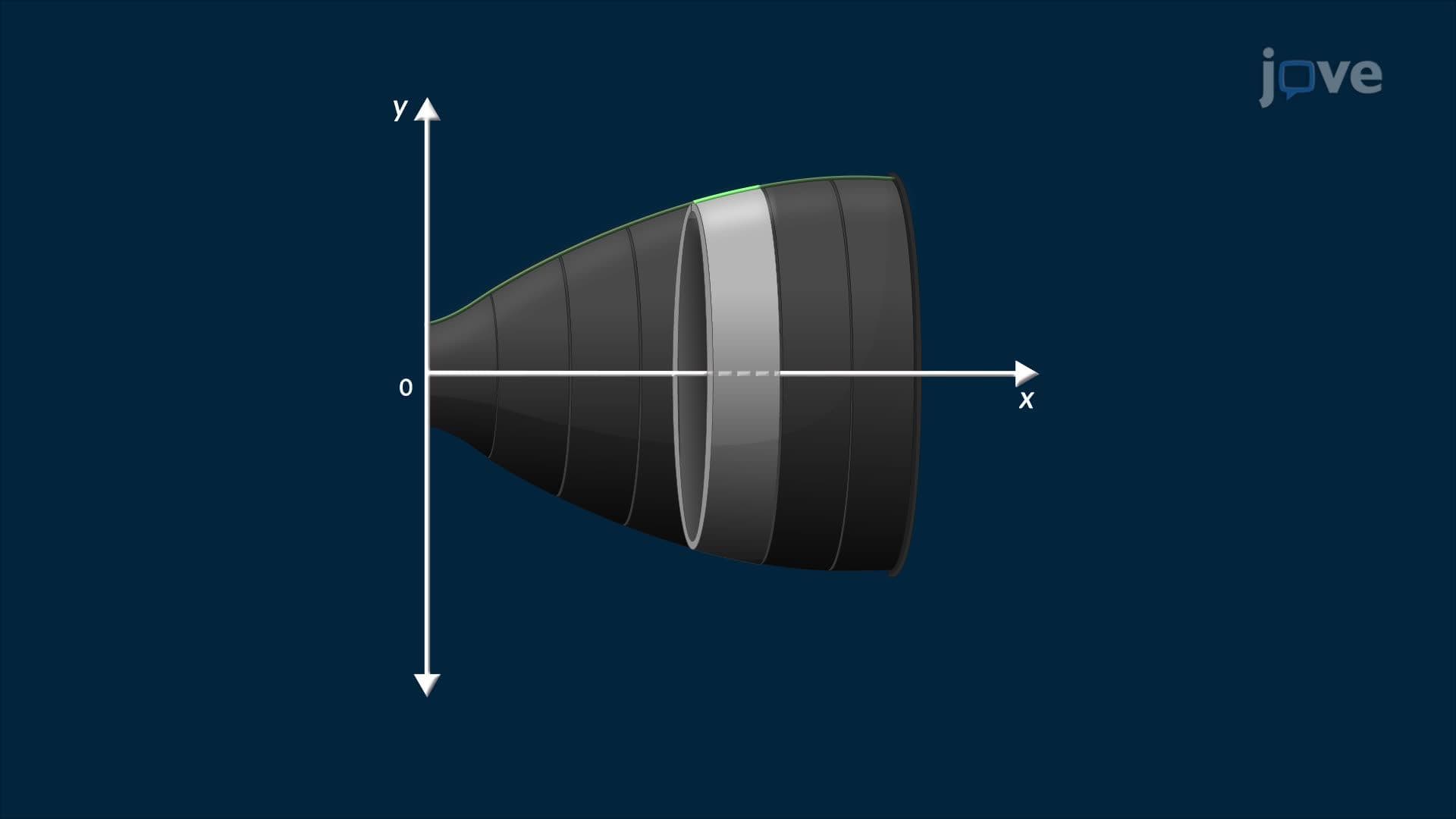

Video Summary: Area of a Surface of Revolution Explained
How do aerospace engineers at NASA calculate exactly how much heat-resistant coating a rocket nozzle needs? The answer lies in the area of a surface of revolution. This concept, a cornerstone of area of a surface of revolution basics, transforms a 2D curve into a 3D surface by rotation, then uses calculus to measure it precisely. Understanding this unlocks real engineering and design applications. Watch the full video on JoVE Coach to master this concept with expert-led visuals and step-by-step explanations.
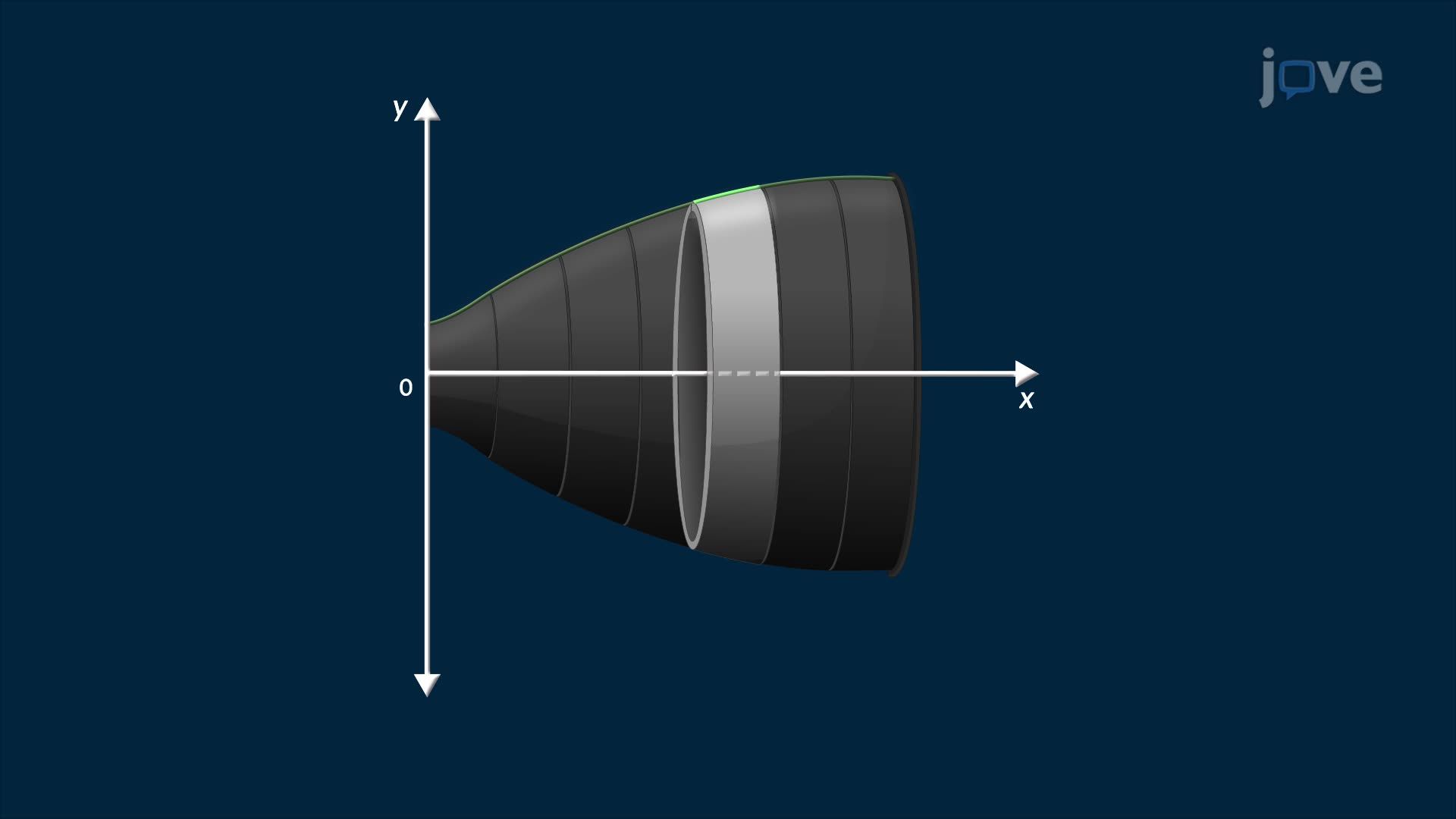
The Area of a Surface of Revolution is the total surface area generated when a curve is rotated about a line, typically the x-axis or y-axis. Imagine taking the profile of a satellite dish, a wine glass, or a rocket nozzle and spinning it 360 degrees. The swept-out surface is the surface of revolution, and calculus gives us the tools to measure it exactly. This concept appears in AP Calculus BC, college Calculus II courses, and engineering design curricula across the United States.
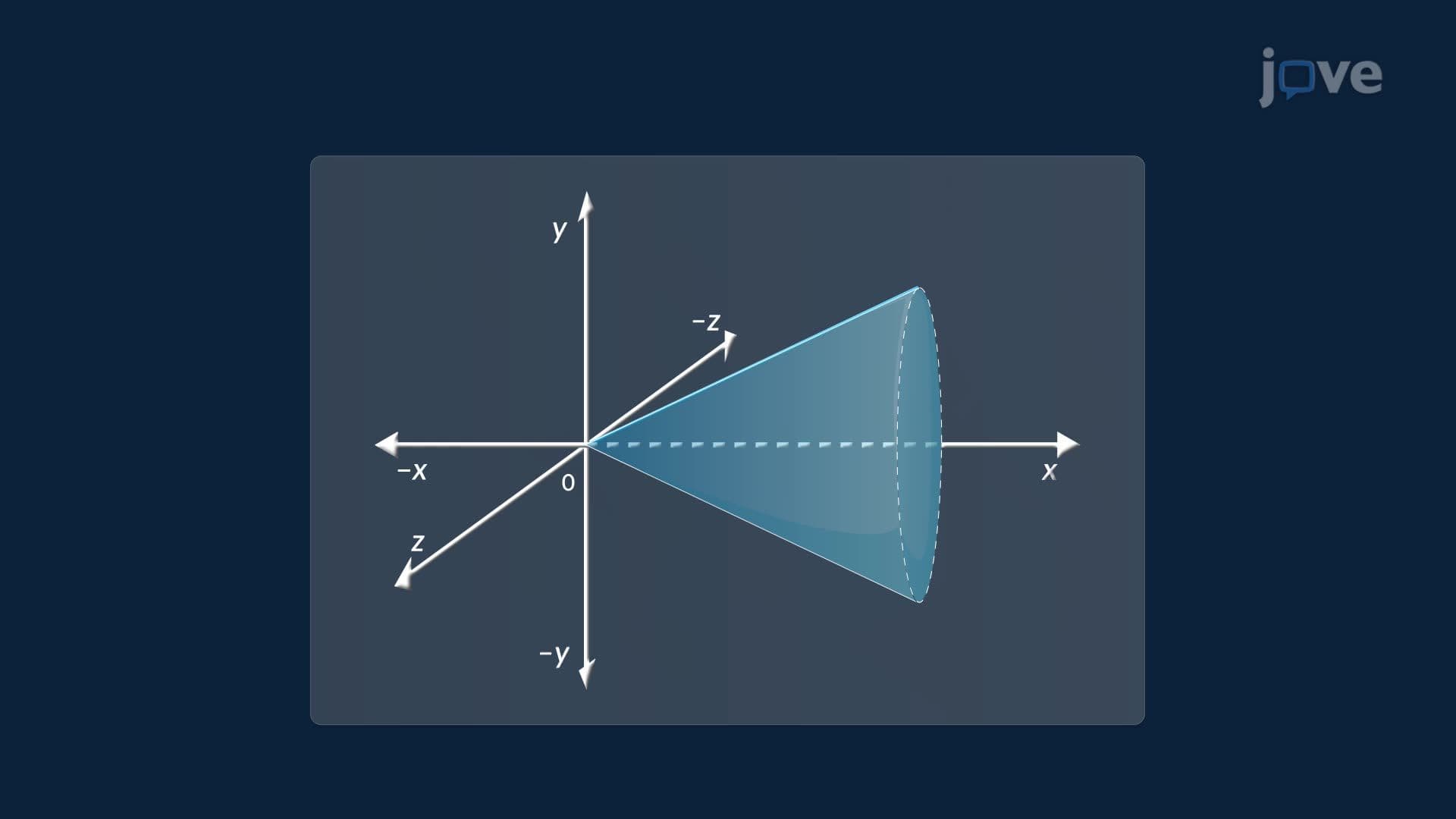
To derive the formula, the curve is divided into tiny segments, each approximated by a straight line, a method grounded in Riemann sum logic. When each segment is rotated around the axis, it sweeps out a narrow frustum (a truncated cone). The lateral surface area of a frustum equals 2π times the average radius times the slant height. As the number of segments approaches infinity, the average radius converges to the actual function value f(x), and the slant height is captured by the arc length element, the expression √(1 + [f'(x)]²) dx. This yields the standard formula:
S = 2π ∫[a to b] f(x) · √(1 + [f'(x)]²) dx (rotation about the x-axis)
Or, when rotating about the y-axis:
S = 2π ∫[a to b] x · √(1 + [f'(x)]²) dx
Understanding why the formula takes this form, not just memorizing it, is critical for success on AP Calculus BC free-response questions and college midterms.
Evaluating these surface area integrals often demands a toolkit of techniques. Many curves produce integrands that require trigonometric integrals or integration by parts to simplify. For example, rotating the curve f(x) = √x about the x-axis produces an integrand involving a square root of a polynomial, often resolved through substitution. When algebraic manipulation is complex, partial fractions may help decompose rational expressions. In cases where no exact antiderivative exists, common in real engineering applications, numerical integration methods like Simpson's rule step in to approximate the result to a desired degree of accuracy.
Beyond the classroom, the area of a surface of revolution is a foundational calculation in several American industries. At Boeing and SpaceX, engineers use this principle to estimate coating and material requirements for axially symmetric components like nozzles, fuel tanks, and turbine blades. In architecture, firms designing dome structures, like the geodesic domes at Epcot Center in Orlando, Florida, rely on related surface calculations. Civil engineers designing water storage tanks and silos also apply this concept when specifying materials. Understanding how to apply integration to find volume and surface area bridges pure mathematics to tangible, cost-critical engineering decisions. These real-world applications of integration techniques reinforce why this topic appears not just in exams but in professional practice.
Related Micro-courses