Loading subject page…


3,311 views


Video Summary: What Is Arc Length Function
How do engineers know exactly how much fencing to order for a winding highway? The arc length function solves this precisely, it calculates the true ground distance along any smooth curve from a fixed starting point to a moving endpoint using calculus. This concept, also called the arc length function basics, powers real decisions in US infrastructure projects. Watch the full video on JoVE Coach to master this concept with expert-led visuals and step-by-step explanations.
The arc length function is one of the most elegant applications of integral calculus. While most students first learn to integrate to find areas or volumes, the arc length function shifts the focus to *distance along a curve*. Ordinary distance formulas work perfectly for straight lines, but a curved road, a suspension cable, or a roller coaster track requires something more sophisticated. The arc length function provides exactly that, a mathematically rigorous way to measure the true length of a curve, not just the straight-line gap between two endpoints.
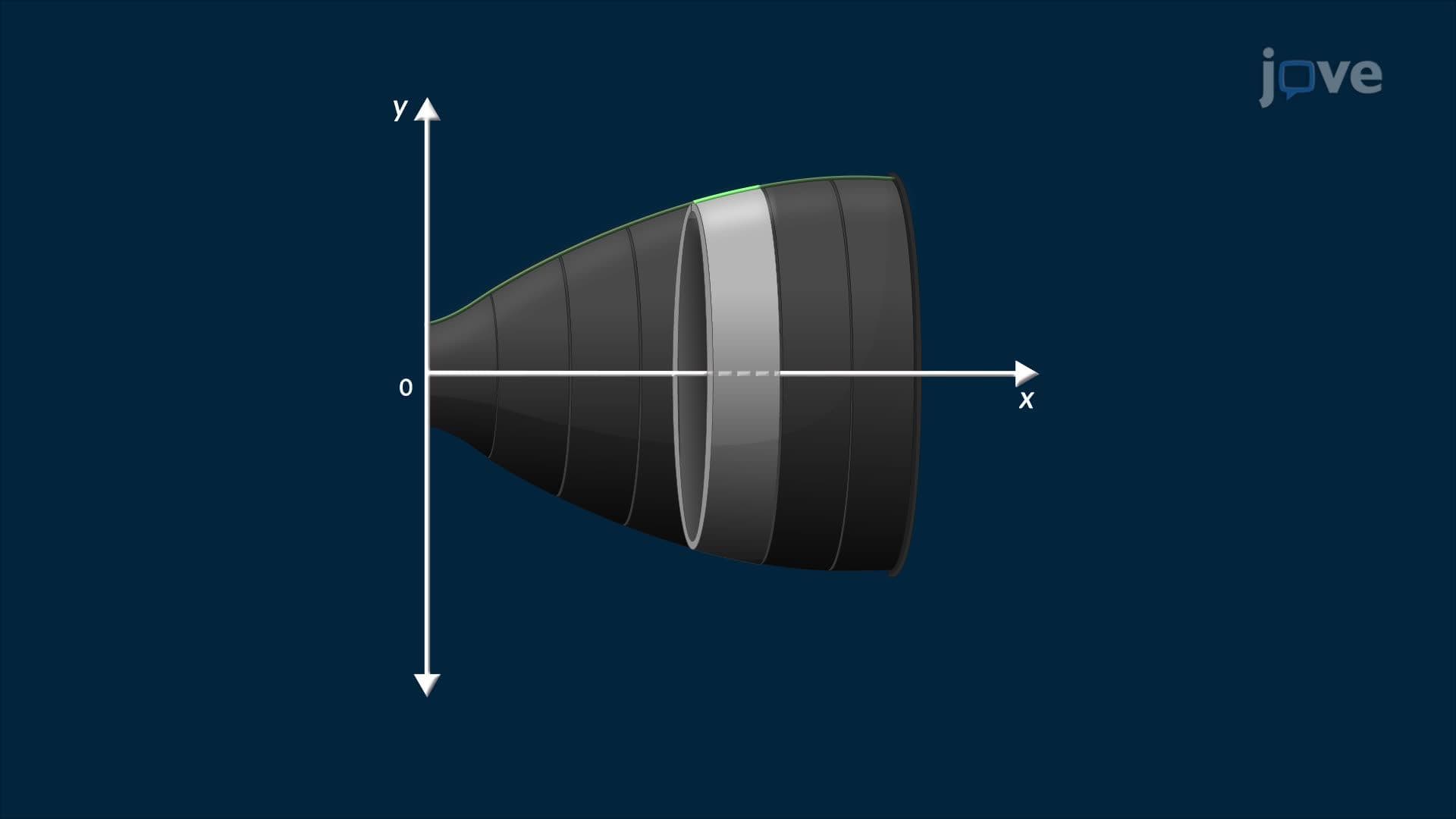
The derivation of the arc length function mirrors the logic behind the definite integral itself. Imagine slicing a smooth curve into many tiny segments. Each segment is nearly straight, so its length can be approximated using the Pythagorean theorem, combining a small horizontal change (Δx) and a small vertical change (Δy). When these segment lengths are summed, the result resembles a Riemann sum. As the segment width shrinks toward zero, the sum converges to a definite integral. The integrand, the expression inside the integral, becomes the square root of the quantity (1 plus the square of the derivative dy/dx). This integrand is always greater than or equal to one, meaning arc length always meets or exceeds the horizontal distance covered, growing faster as the curve steepens.
What distinguishes the *arc length function* from a simple arc length calculation is the use of a dummy variable inside the integral. The lower limit is fixed at a chosen starting point, but the upper limit is left as the variable *x*. Inside the integral, an intermediate variable (often written as *t*) replaces *x* to avoid notational conflict. This construction transforms a static number into a true function of *x*, written as *s(x)*. This technique appears across calculus whenever a definite integral is used to define a new function, a pattern reinforced directly by the Fundamental Theorem of Calculus.
Differentiating the arc length function using the Fundamental Theorem of Calculus yields ds/dx = sqrt(1 + (dy/dx)^2). This result confirms that the rate at which arc length accumulates equals the integrand evaluated at *x*. For AP Calculus BC students, this connection is explicitly tested, expect free-response problems asking you to set up arc length integrals, interpret ds/dx, or apply numerical integration methods like Simpson's rule when the integrand has no clean antiderivative. College-level Calculus II courses at US universities such as UCLA, UT Austin, and Penn State build on this concept toward surface area of revolution, parametric arc length, and eventually improper integrals for unbounded curves.
The arc length function is far from purely academic. Transportation engineers with the US Federal Highway Administration use arc length calculations when designing guardrail systems along curved mountain roads, underestimating the true ground distance means ordering too little material, causing dangerous gaps. Civil engineers computing the cable length for suspension bridges like the Golden Gate rely on arc length integrals for parabolic or catenary curves. In robotics and animation at US tech firms, arc length parameterization ensures that a character or robotic arm moves at a consistent speed along a curved path, a direct application of the ds/dt relationship derived from the arc length function.
Related Micro-courses