Loading subject page…

3,311 views

Video Summary: What Is Theorem of Pappus
Ever wonder how engineers calculate the fuel capacity of a donut-shaped tank without solving complex integrals? The theorem of pappus makes this surprisingly simple. This foundational concept in calculus, also called the theorem of pappus basics, links a flat region's area and its centroid's path to the volume of the solid it creates when rotated. NASA and aerospace engineers use this principle when designing toroidal fuel tanks for spacecraft. Watch the full video on JoVE Coach to master this concept with expert-led visuals and step-by-step explanations.
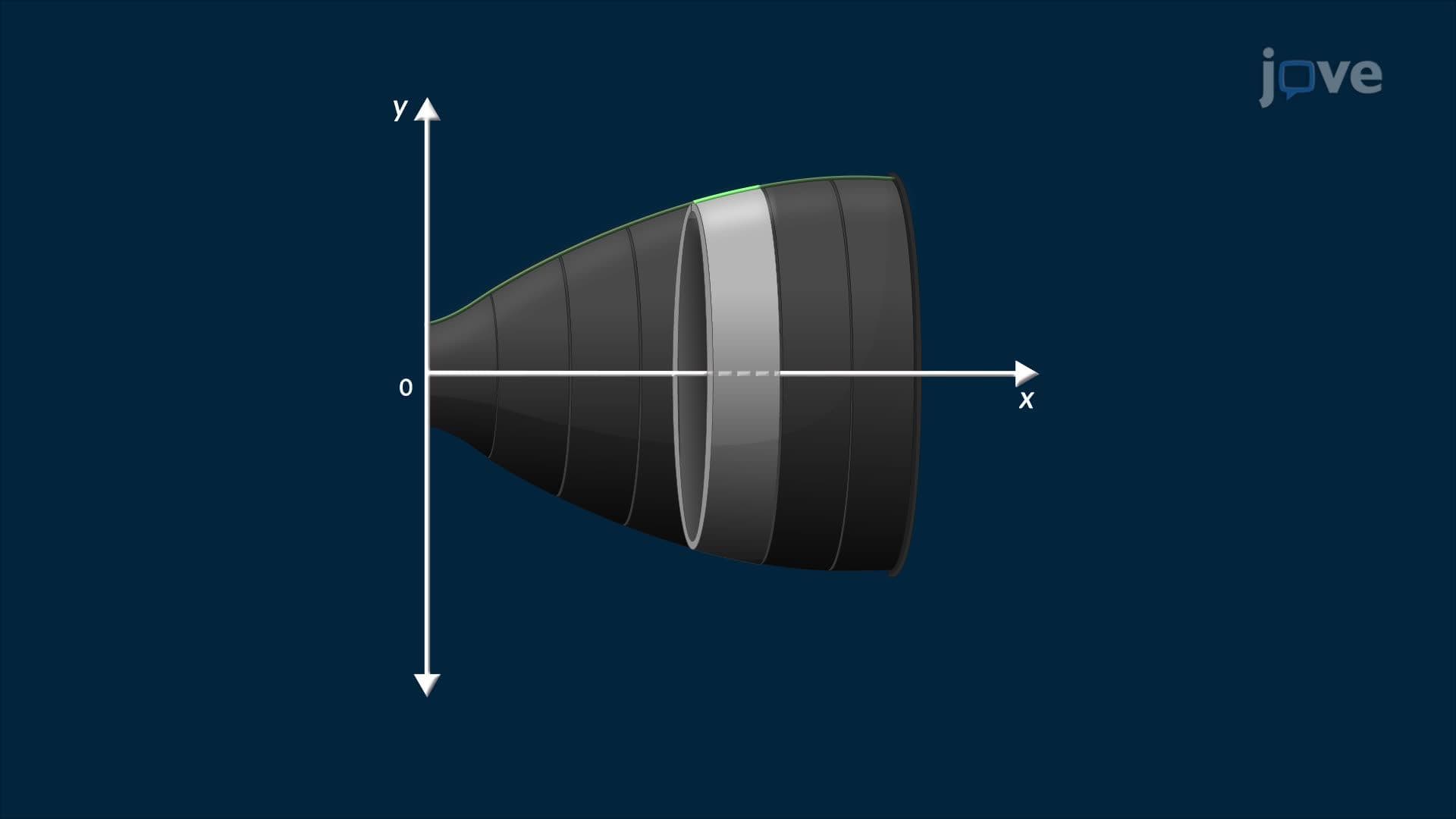
The theorem of pappus is one of calculus's most elegant results: it allows you to find the volume of a solid of revolution using just two simple values, the area of the rotating region and the distance its centroid travels. Formally, the theorem states:
Volume = Area × Distance traveled by the centroid
Or in plain terms: V = A × (2π × R), where R is the distance from the centroid to the axis of rotation, and 2πR is the circumference of the circular path the centroid follows. This approach sidesteps complex integration techniques like the disk method, the shell method, or even numerical integration methods such as Simpson's rule, making it an incredibly efficient tool when the centroid location is already known.
To use the theorem of pappus correctly, you must first understand the centroid. The centroid of a plane region is its geometric center, the point where the region would perfectly balance if placed on a pin. For a circle, this is simply its center. For more complex shapes like triangles or semicircles, the centroid is found using integration or standard reference tables.
The critical condition is that the axis of rotation must not intersect the plane region. If the axis passes through the shape, the theorem does not apply cleanly, and techniques like integration by parts or trigonometric integrals may be needed instead.
The most widely used example of the theorem of pappus explained is calculating the volume of a torus, the mathematical name for a donut-shaped solid. A torus is created by rotating a circle of radius r around an external axis at distance R from the circle's center.
Using the theorem:
This formula is elegant and fast. Compare this to deriving the same result using partial fractions, improper integrals, or cylindrical shell integration, the theorem of pappus reduces pages of work to a single multiplication.
In the United States, toroidal tanks are used in spacecraft fuel systems, hydrogen fuel cell vehicles, and submarine ballast systems, where space efficiency is critical. Engineers at companies like SpaceX and Boeing rely on these geometric principles when estimating storage volumes during early design stages.
In the US academic landscape, the theorem of pappus appears most prominently in AP Calculus BC, college-level Calculus II, and engineering statics courses. While the AP Calculus exam more frequently tests disk/washer and shell methods, understanding Pappus's theorem demonstrates a deeper conceptual grasp of how integration connects geometry and volume, a skill that distinguishes high-scoring students.
In college multivariable calculus and physics courses, the theorem bridges into concepts like centers of mass, moment calculations, and real-world applications of integration techniques across mechanical and civil engineering. If you can quickly identify a centroid and compute an area, you can solve volume problems that would otherwise require setting up and evaluating a full definite integral. That efficiency is invaluable under timed exam conditions.
Related Micro-courses