Loading video…


 11 Concepts
 3.3K views

Video Summary: Arc Length of a Curve Explained
Ever wonder how engineers at Six Flags calculate the exact length of a twisting roller coaster track? That's where the arc length of a curve becomes essential. The arc length of a curve basics start with breaking a curve into tiny straight-line segments, then using calculus to sum them precisely into a definite integral. From cable bridges to pipeline routing across uneven US terrain, this concept powers real engineering decisions. Watch the full video on JoVE Coach to master this concept with expert-led visuals and step-by-step explanations.
The arc length of a curve measures the true distance along a curved path, not just the straight-line distance between two endpoints. While finding the length of a straight line is straightforward, curved paths require calculus. This concept is one of the most elegant applications of integration, bridging geometry and real-world problem solving. Students encounter it in AP Calculus BC, college-level Calculus II courses, and STEM programs across the United States.
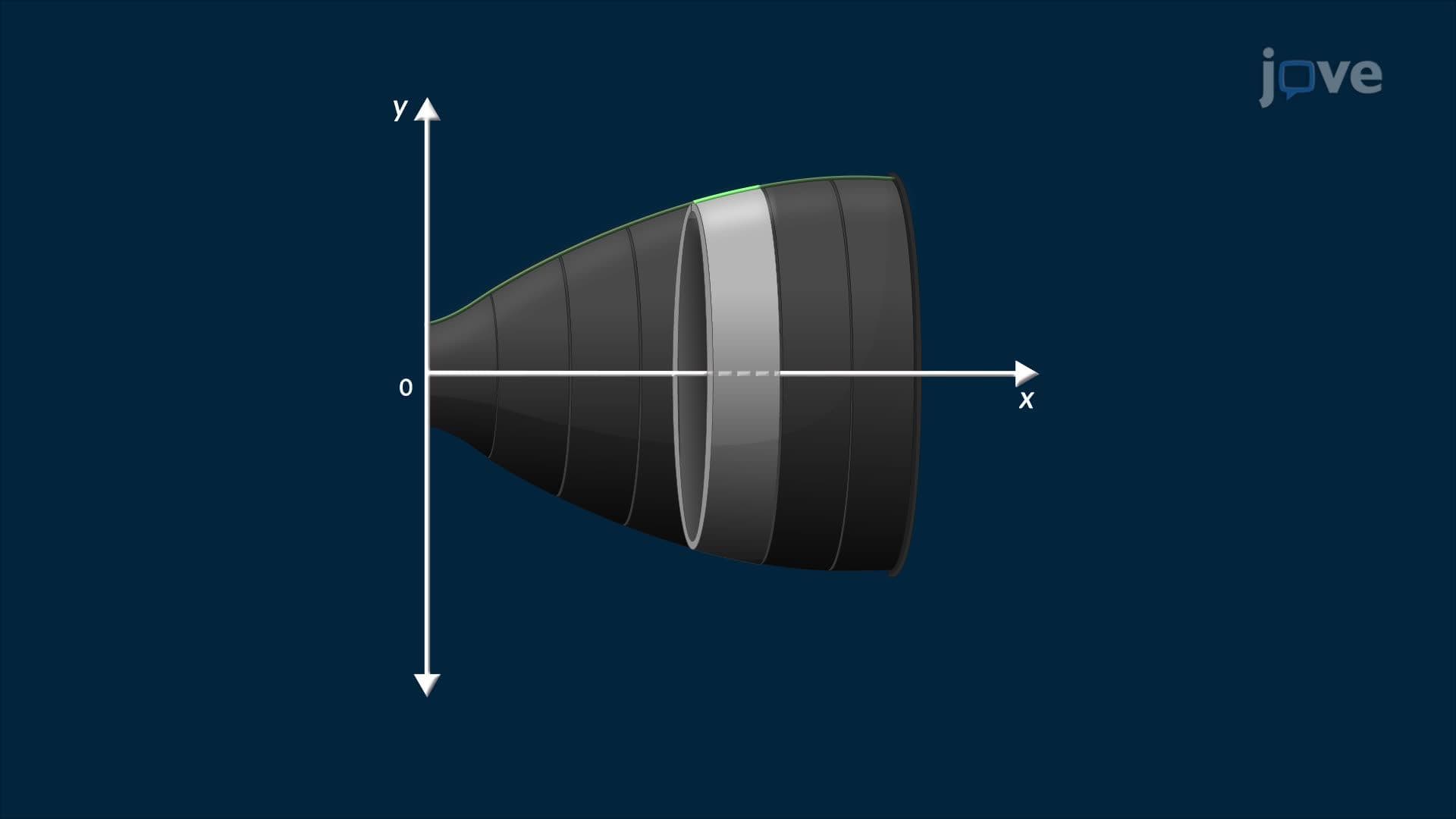
The derivation begins with a familiar strategy, approximation. A smooth curve defined by a function f(x) on an interval [a, b] is divided into n small subintervals. Over each subinterval, the curve is replaced by a straight line segment connecting two nearby points. The length of each segment is estimated using the distance formula: sqrt((delta x)^2 + (delta y)^2).
Here is where the Mean Value Theorem becomes critical. It guarantees that within each subinterval, there is a point where the instantaneous rate of change, the derivative f'(x), equals the average rate of change. Substituting this into the distance formula gives each segment's length as sqrt(1 + [f'(c)]^2) times delta x, where c is a point in the interval.
Summing across all n segments produces a Riemann sum. As n approaches infinity and the width of each segment shrinks toward zero, this Riemann sum converges to a definite integral. The result is the arc length formula:
L = integral from a to b of sqrt(1 + [f'(x)]^2) dx
This transition from discrete summation to continuous integration is the same logical structure seen throughout Calculus II topics, including integration by parts, trigonometric integrals, and numerical integration methods like Simpson's rule.
Calculating arc length is rarely just plugging values into a formula. The expression under the square root, 1 + [f'(x)]^2, often produces integrands that require advanced techniques. Students may encounter:
This is why arc length serves as an excellent capstone topic, it ties together nearly every major integration technique covered in a full semester of calculus.
Arc length is not an abstract classroom exercise. Civil engineers designing the Appalachian Trail's elevated boardwalks, pipeline planners routing natural gas lines through the Rocky Mountains, and electrical engineers calculating cable lengths for suspension bridges like the Golden Gate all rely on arc length principles. Railway systems across the US use these calculations to determine the precise amount of track needed around curves, ensuring safe construction and accurate material estimates. Understanding how to apply integration to find arc length is directly transferable to these industries, and to solving volume and surface area problems that build on the same integral framework.
In AP Calculus BC, arc length appears as a free-response and multiple-choice topic, often paired with parametric equations. In college Calculus II courses, it is a standard unit that follows techniques of integration. Students are expected to set up the integral correctly, apply appropriate techniques, and sometimes use numerical methods when exact integration is not possible. Mastering this topic also strengthens performance on college midterms and final exams where conceptual derivation, not just formula memorization, is rewarded.
Related Micro-courses