Loading video…


 8 Concepts
 3K views

Video Summary: Finding Volume Using Cross Sectional Area Explained
How do engineers estimate the volume of a massive, irregular gravel pile on a construction site? The answer lies in *Finding Volume Using Cross-Sectional Area Explained*, a powerful integration technique that slices a solid into measurable pieces. By integrating known cross-sectional areas along a perpendicular axis, any solid's volume becomes calculable. US surveyors rely on this exact method for accurate material estimates. Watch the full video on JoVE Coach to master this concept with expert-led visuals and step-by-step explanations.
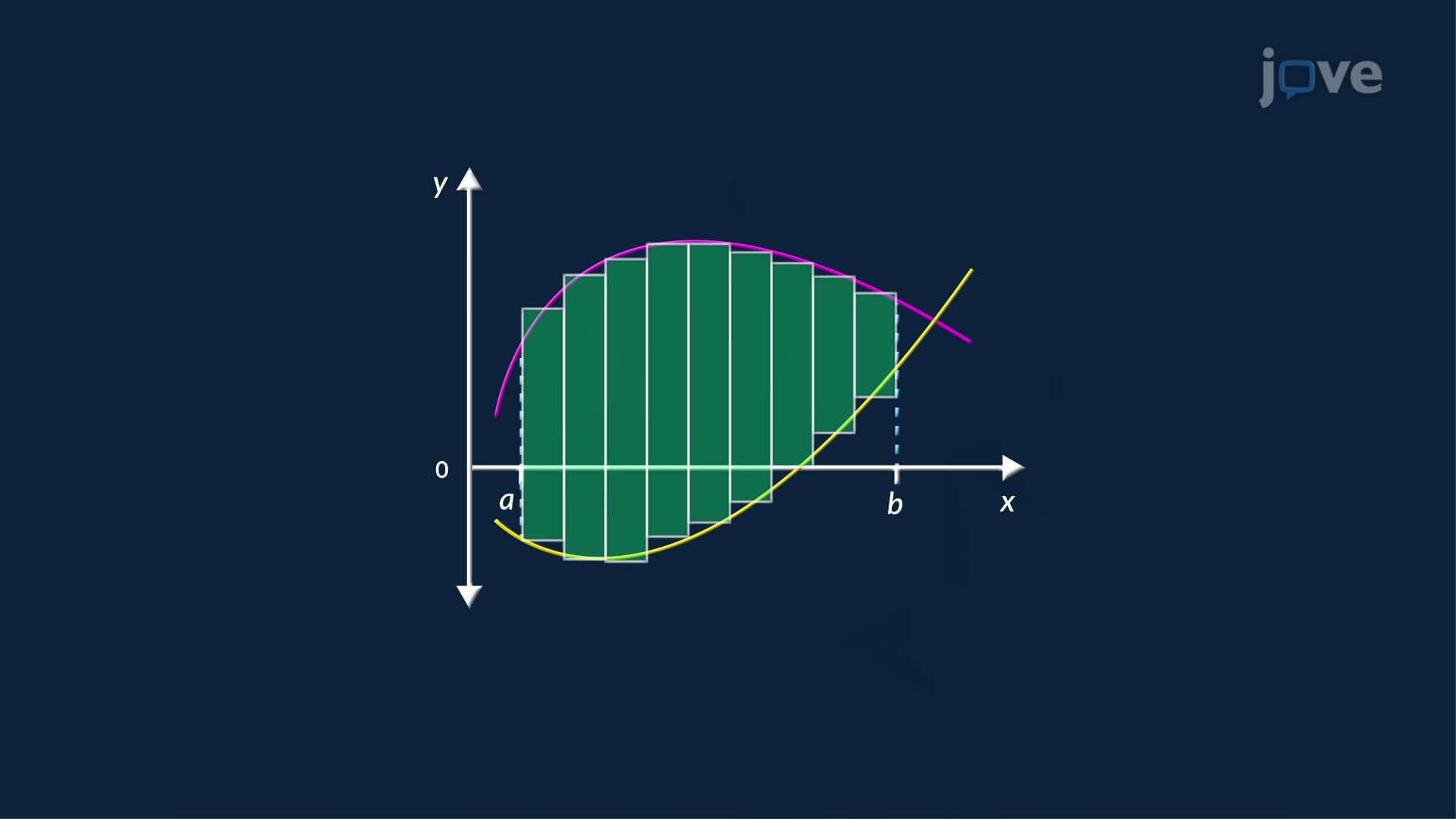
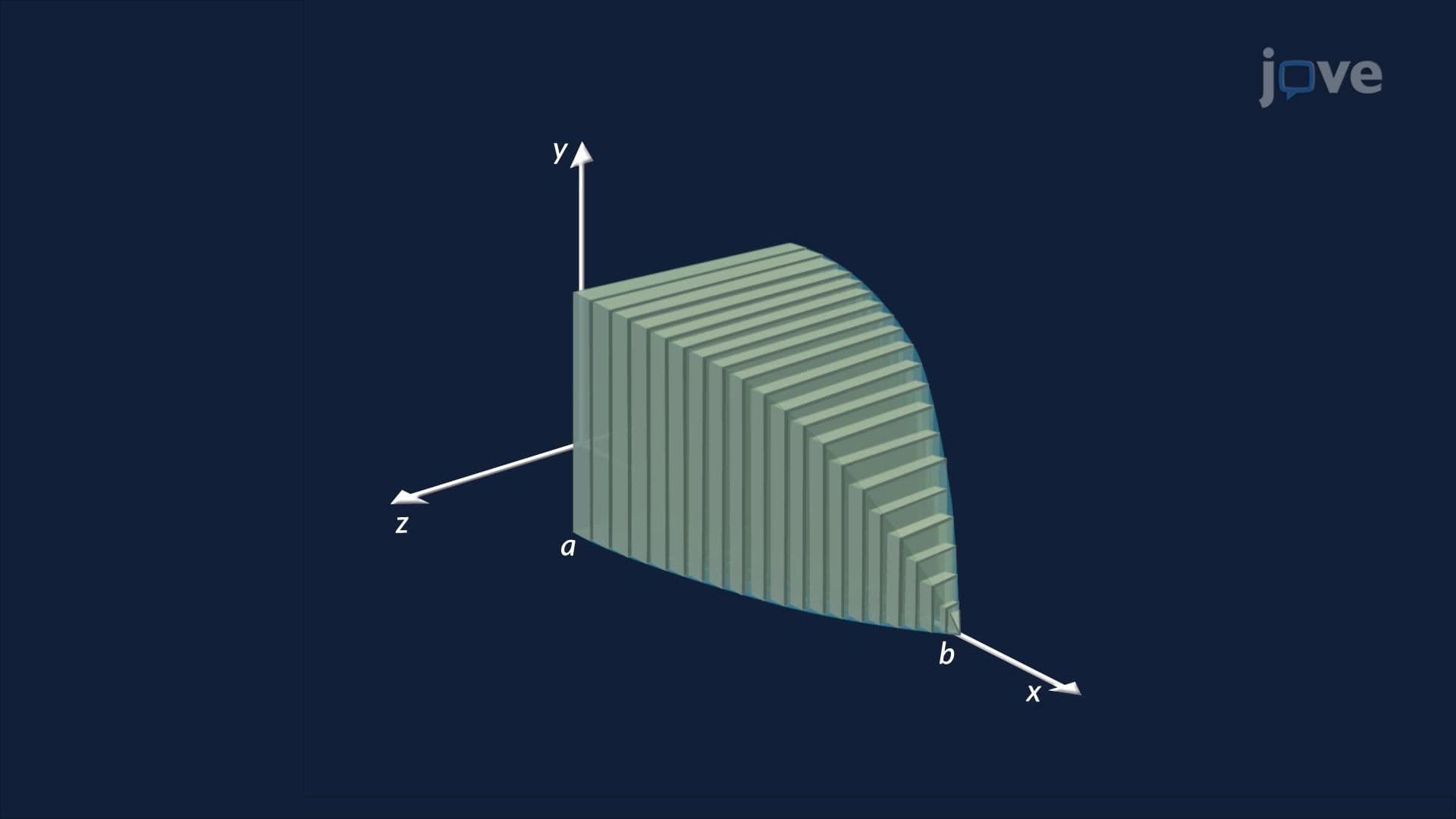
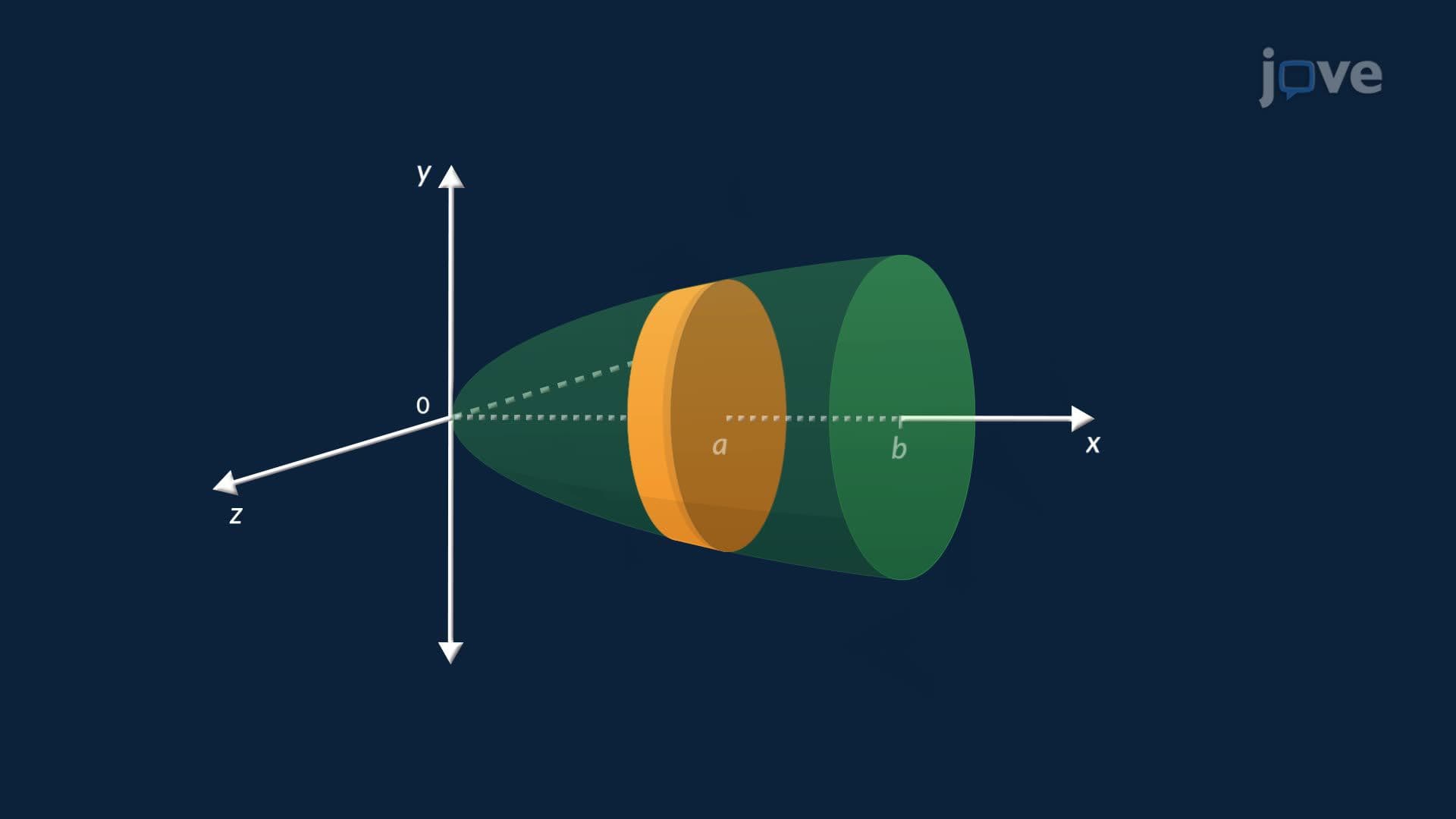
When a solid has a shape too irregular or complex for a standard formula, integration steps in as the universal tool. *Finding volume using cross-sectional area* means slicing a three-dimensional object into infinitely thin, flat cross-sections, expressing each slice's area as a function of position, and then integrating that function over the length of the solid. The result is exact, no approximation needed. This is one of the most important real-world applications of definite integration covered in AP Calculus AB/BC and college-level Calculus II courses across the United States.
The first step is choosing the axis of integration, typically the axis perpendicular to the cross-sections. For a tetrahedron with height *h* and an equilateral triangular base with side *a*, placing the origin at the top vertex and running the y-axis downward toward the base is a natural choice. At any position *y* along this axis, the cross-section is a smaller equilateral triangle. Using the principle of similar triangles, its side length scales proportionally: side(y) = (y/h) × a. This scaling relationship is the mathematical bridge between geometry and calculus, and it appears frequently on AP Calculus free-response questions.
Once the side length is expressed as a function of position, the area of each triangular cross-section follows directly from the equilateral triangle area formula: A(y) = (√3/4) × side². Substituting the scaled side length gives A(y) = (√3/4) × (ay/h)². This produces a parabolic area function, meaning the cross-sections grow quadratically from zero at the vertex to maximum area at the base. Understanding how a geometry formula transforms into an integrable function is a skill directly tested on AP Calculus BC exams and college midterms.
The volume is found by integrating A(y) from y = 0 (the vertex) to y = h (the base): V = ∫₀ʰ (√3/4)(a²y²/h²) dy. Evaluating this integral gives V = (√3/12) × a² × h, a result proportional to the product of the base area and height, consistent with the general pyramid volume formula V = (1/3) × base area × height. This confirmation builds conceptual trust in the method.
In practice, US land surveyors and civil engineers use this exact approach to estimate stockpile volumes of gravel, sand, or coal. Instead of a clean formula, they measure cross-sectional profiles at regular intervals using laser scanning or GPS equipment, then numerically integrate those measurements using tools like Simpson's Rule. The same logic connects to other integration applications: center of mass calculations use weighted area integrals, fluid force problems integrate pressure over cross-sectional area, and surface area of revolution extends the slicing concept into curved surfaces. Mastering this one technique unlocks an entire family of calculus applications tested from AP exams through engineering licensure.
Related Micro-courses