Loading video…


 8 Concepts
 3K views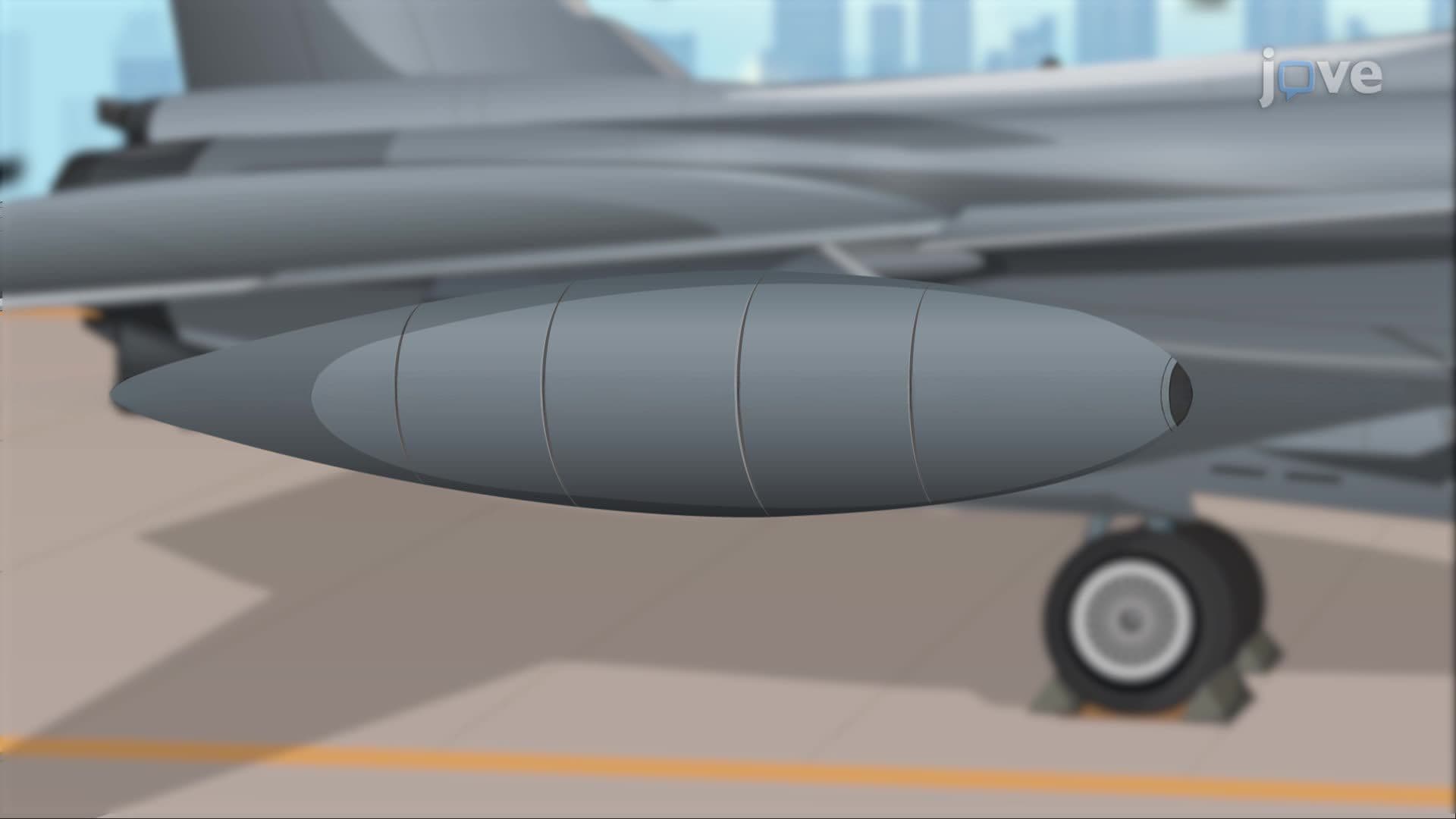

Video Summary: Volume Problem Solving
How does a jet aircraft store fuel in its wing? Volume problem solving makes it possible, engineers use calculus to design curved fuel tanks with precise capacities. Using the disk method, a rotating mathematical region from 0 to 2 meters is integrated to find a tank volume of approximately 1 cubic meter. Watch the full video on JoVE Coach to master this concept with expert-led visuals and step-by-step explanations.
Volume problem solving is one of the most powerful applications of integral calculus. It bridges abstract mathematics and real engineering challenges, from designing fuel tanks on aircraft wings to calculating the capacity of curved industrial containers. Once you understand how integration generates volume from a simple function, you gain a tool used across physics, engineering, and medicine.
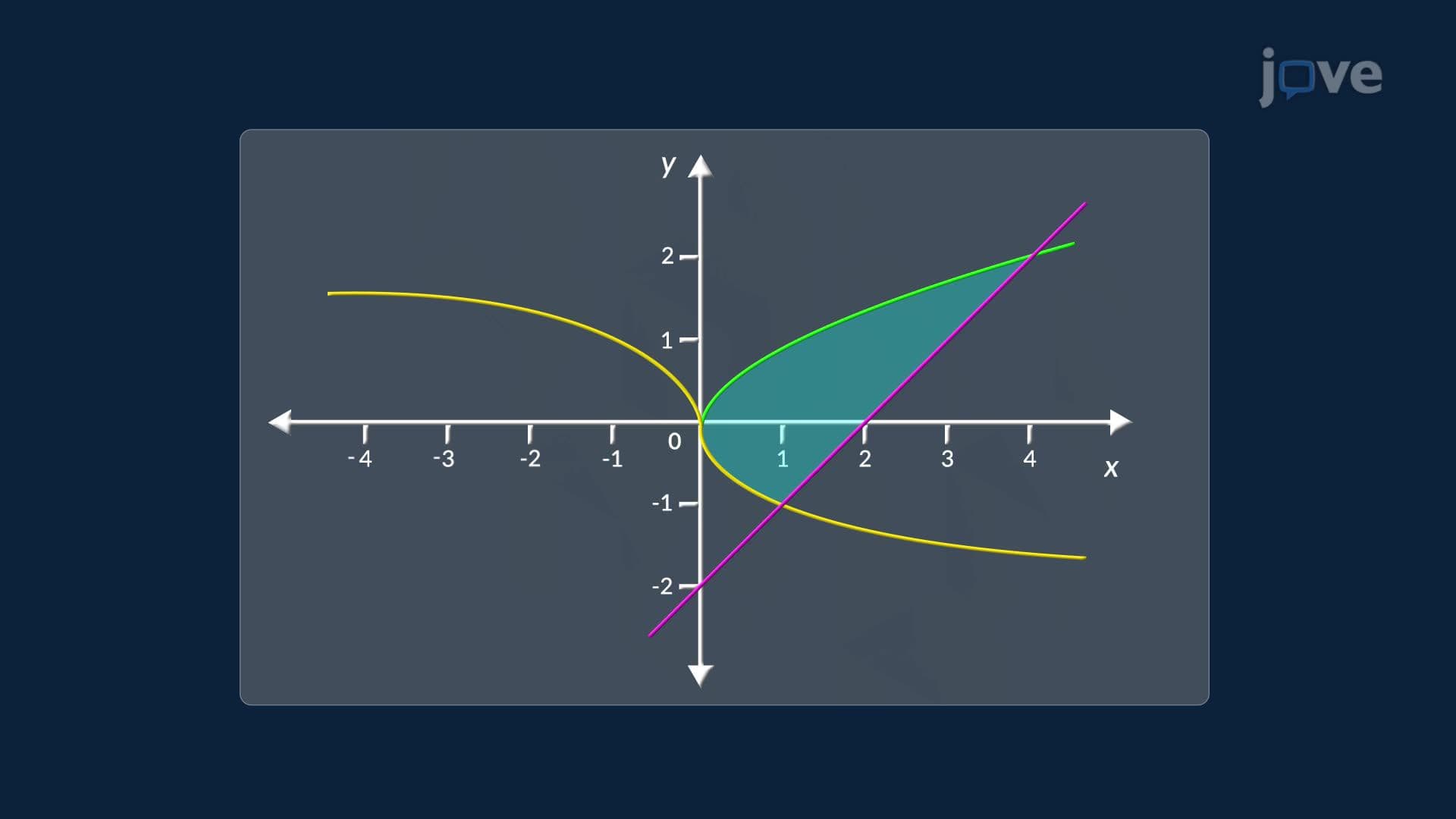
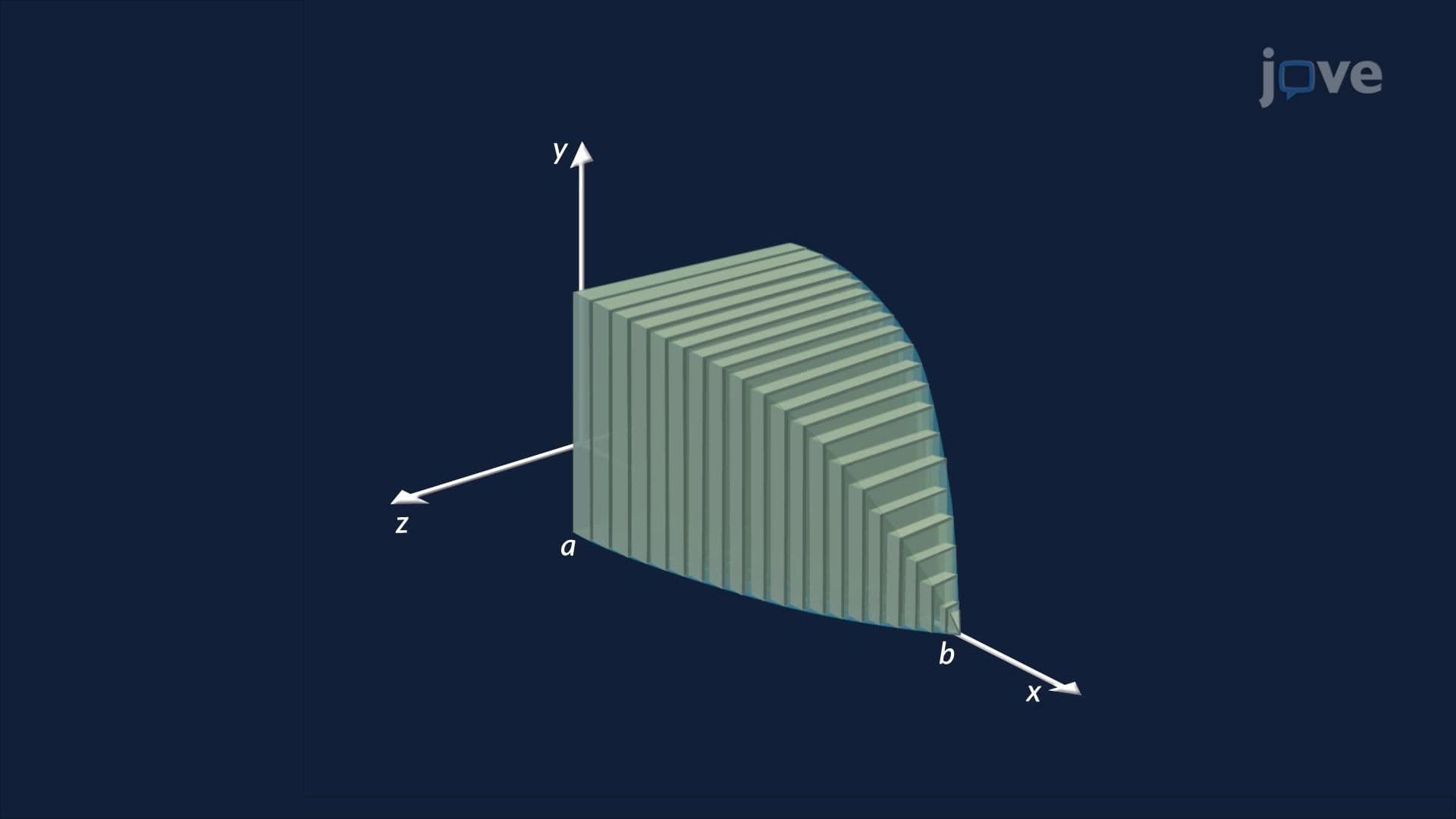
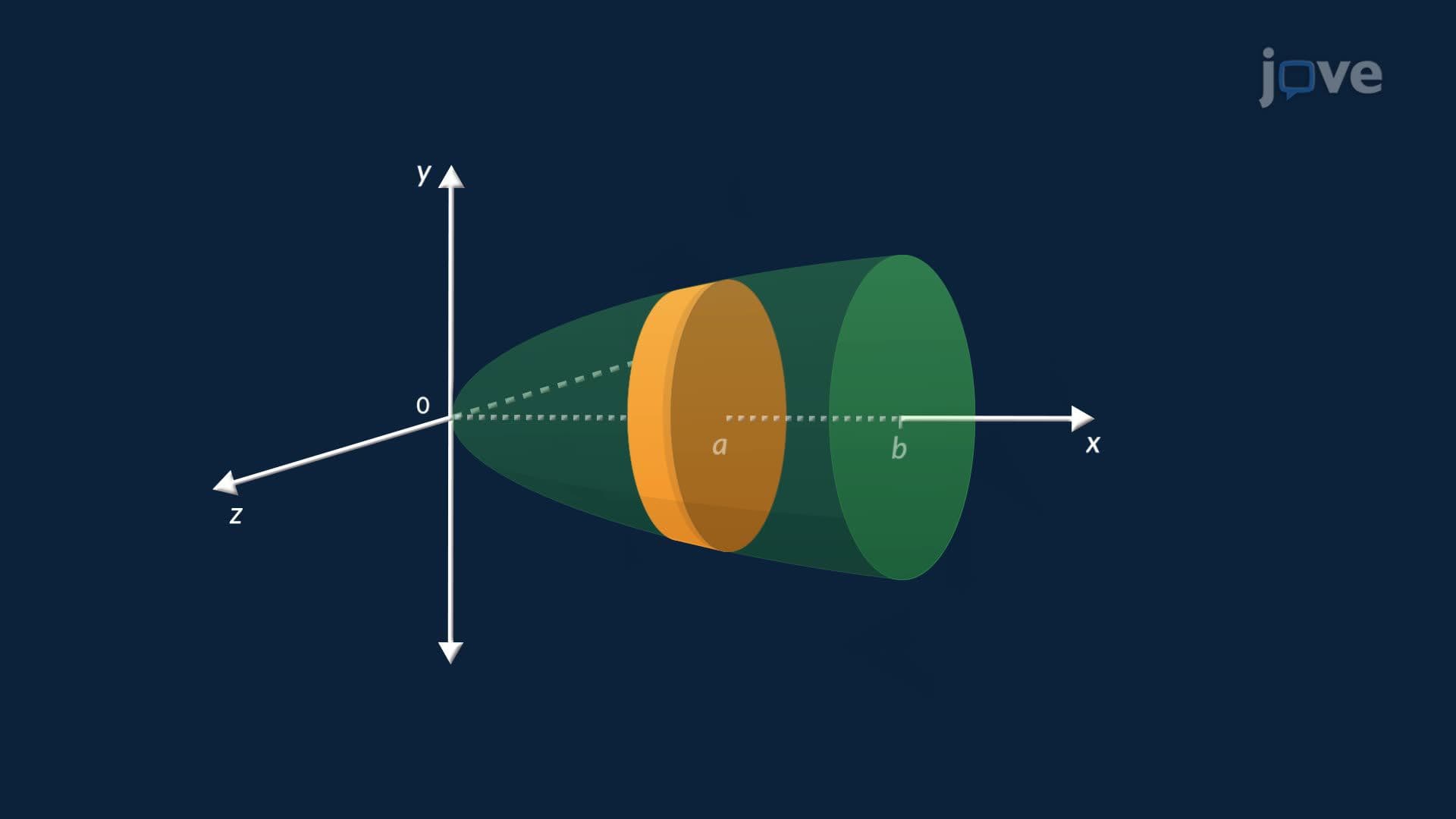
The disk method is the foundational strategy in volume problem solving for solids of revolution. When a curve f(x) is rotated around the x-axis, it sweeps out a three-dimensional shape. Imagine slicing that shape into thousands of extremely thin circular disks stacked along the x-axis. Each disk has a radius equal to f(x) at that point, so its area is π × [f(x)]². The volume of each infinitesimally thin disk is that area multiplied by its thickness dx. Integrating all those disk volumes over an interval [a, b] gives the total volume:
V = π ∫(from a to b) [f(x)]² dx
This approach is tested extensively in AP Calculus AB and BC, where students must set up and evaluate these integrals from scratch on free-response questions.
Once the integral is set up, volume problem solving becomes a matter of careful algebra. Squaring the function produces a polynomial expression. Expanding it term by term allows you to integrate each piece using the standard power rule: the integral of x^n is x^(n+1) / (n+1). For a function defined on the interval from 0 to 2, the antiderivative will involve third- and fourth-power terms of x. Substituting the upper limit (2) and lower limit (0) and subtracting gives the exact volume.
For the jet aircraft fuel tank problem, this process produces a volume of approximately 1 cubic meter, a result with immediate real-world meaning. NASA engineers and aerospace companies like Boeing and Lockheed Martin use exactly these types of calculations when designing fuel-efficient aircraft components.
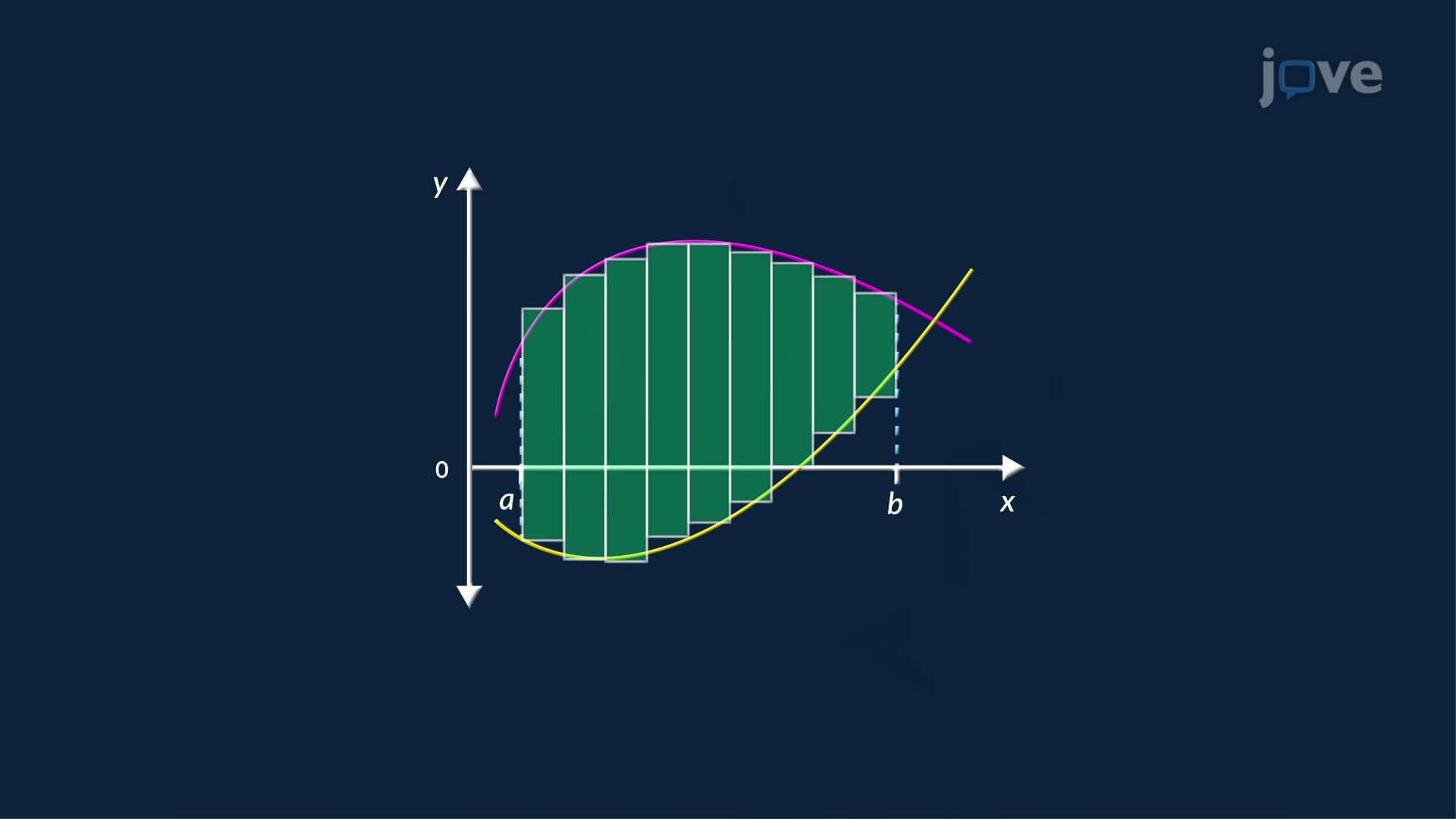
Volume by slicing is just one branch of a larger family of physical applications of integration. Once you're comfortable with the disk method, related techniques open up naturally:
These concepts appear in AP Physics C, college-level engineering courses, and even on the MCAT for problems involving pressure and fluid dynamics. The foundational skill connecting all of them is the same: setting up a definite integral that accumulates infinitely many small contributions into a measurable whole.
On the AP Calculus BC exam, volume problems typically appear in both the multiple-choice and free-response sections. Students must identify whether to use the disk, washer, or shell method, and accurately set up the integral before evaluating it. College courses in Calculus II at universities like MIT OpenCourseWare and Khan Academy Advanced Math treat this as a core unit. Mastering volume problem solving not only boosts your exam score but builds the mathematical intuition essential for STEM careers in aerospace, civil engineering, and biomedical device design.
Related Micro-courses