Loading video…


 17 Concepts
 6.5K views

Video Summary: What Is Security Market Line
When Goldman Sachs analysts evaluate whether Apple stock offers adequate returns for its risk profile, they rely on the security market line as their foundational framework. The security market line provides portfolio managers and corporate finance professionals with a precise method to assess whether investments deliver appropriate risk-adjusted returns. This graphical tool plots expected returns against beta coefficients, enabling systematic comparison of securities against market benchmarks. Understanding this relationship helps professionals make data-driven investment decisions and optimize portfolio performance. Watch the full video on JoVE Coach to master this concept with expert-led visuals and step-by-step explanations.
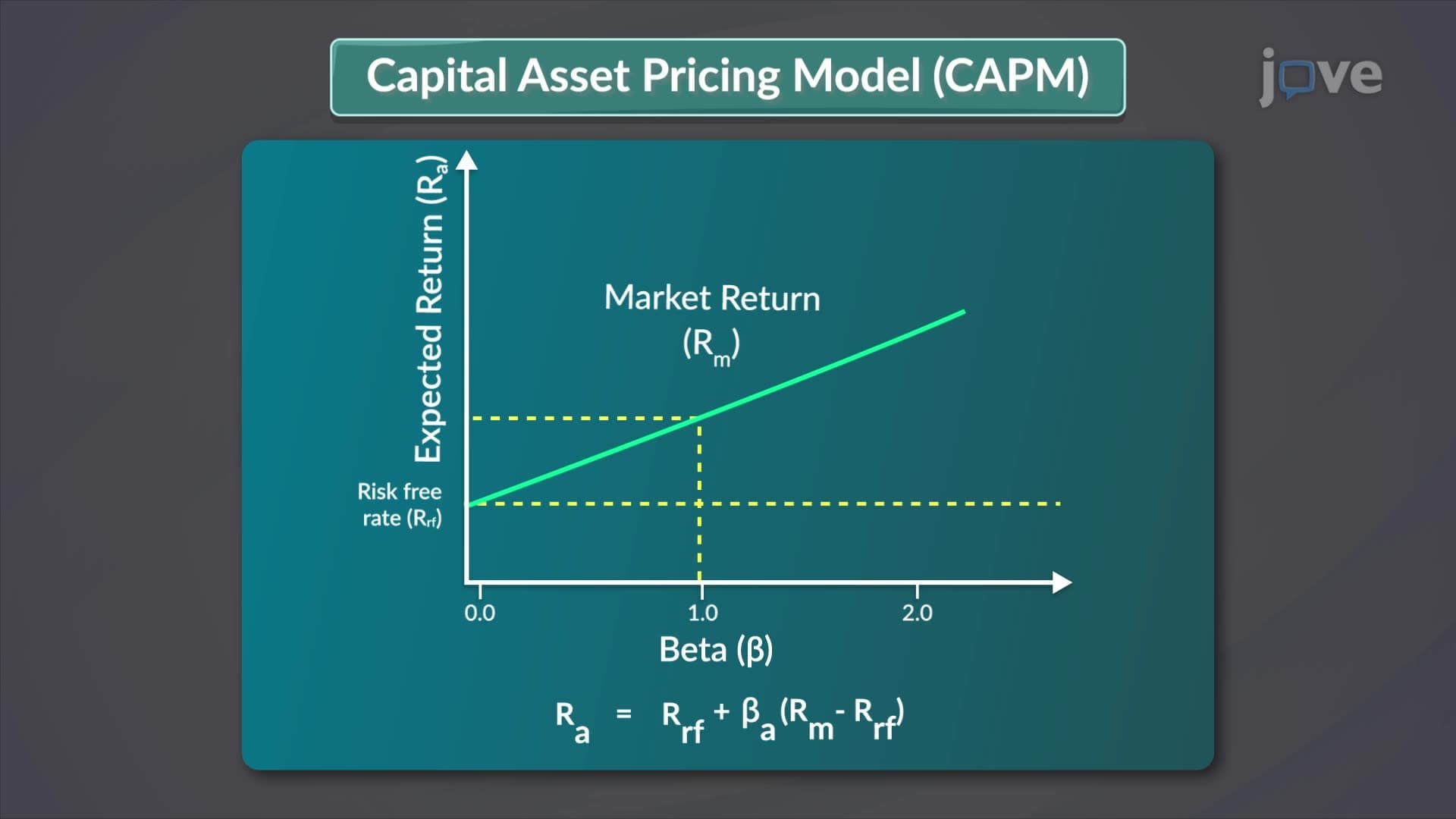
When Berkshire Hathaway's investment team evaluates potential acquisitions, they implicitly use security market line principles to determine fair valuations. The security market line represents the theoretical relationship between systematic risk and expected return, serving as a benchmark against which all investments can be measured. This powerful tool helps financial professionals distinguish between investments that adequately compensate for risk and those that don't.
The security market line formula combines three critical components: the risk-free rate (typically 10-year Treasury bonds), beta (systematic risk measure), and market risk premium. For instance, if Microsoft has a beta of 1.2, the risk-free rate is 3%, and the market risk premium is 6%, the expected return would be 10.2%. This calculation provides portfolio managers with objective criteria for investment decisions, removing emotional bias from the evaluation process.
Investment banks like JPMorgan Chase use security market line analysis for multiple strategic purposes. During IPO valuations, they assess whether proposed pricing adequately reflects systematic risk. In merger and acquisition scenarios, they evaluate whether target companies offer appropriate risk-adjusted returns. Corporate treasury departments apply these principles when allocating capital between projects, ensuring shareholders receive adequate compensation for assumed risks.
Professional portfolio managers at firms like Fidelity utilize the security market line to construct optimal asset allocations. Securities plotting above the line represent potentially undervalued opportunities, while those below may be overvalued. This systematic approach enables consistent decision-making across diverse investment committees and client portfolios, providing defensible rationale for investment selections and maintaining fiduciary responsibility standards.
Related Micro-courses