Loading subject page…


169,800 views

Video Summary: Equilibrium Binding Constant Determinants of Binding Strength
Did you know that your body's insulin must bind to specific receptors with just the right strength-not too weak to be ineffective, not too strong to cause dangerous hypoglycemia? Understanding equilibrium binding constant binding helps explain how proteins like insulin achieve this perfect molecular recognition. In pharmaceutical companies across the US, scientists use equilibrium binding constant and binding strength principles to design life-saving drugs that target specific proteins with precise affinity. Watch the full video on JoVE Coach to master this concept with expert-led visuals and step-by-step explanations.
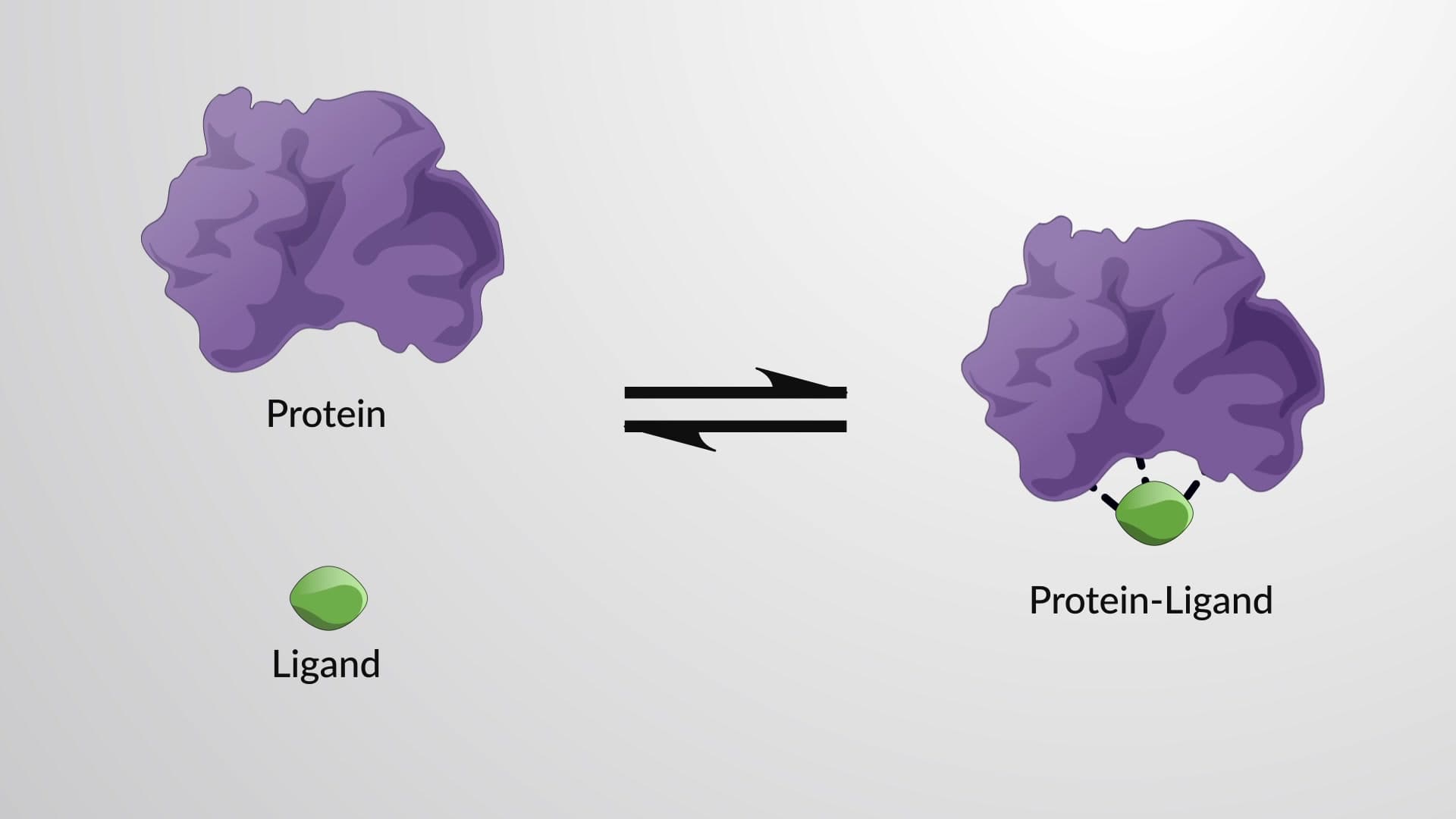
The equilibrium binding constant and binding strength concept forms the foundation of molecular recognition in biological systems. When molecules interact, they can form either weak, transient associations or strong, stable complexes depending on their structural complementarity and binding affinity.
The equilibrium binding constant (Kb) quantifies this interaction strength as a ratio: the concentration of bound protein-ligand complex divided by the product of unbound protein and ligand concentrations at equilibrium. A higher Kb value indicates stronger binding affinity and greater complex stability.
The relationship between binding strength and thermodynamics becomes clear through the connection to free energy change (ΔG). Large Kb values correspond to large negative ΔG values, indicating thermodynamically favorable binding reactions. This principle helps pharmaceutical researchers at companies like Pfizer and Merck design drugs with optimal binding properties.
Association kinetics involve two competing processes: the forward reaction (characterized by kon, the association rate constant) and the reverse reaction (characterized by koff, the dissociation rate constant). At equilibrium, these rates balance, establishing the relationship: Kb = kon/koff.
Understanding binding constants proves essential for drug development in the US pharmaceutical industry. For example, monoclonal antibody therapies used in cancer treatment require specific Kb values to ensure therapeutic effectiveness while minimizing side effects. The FDA evaluates these binding parameters during drug approval processes.
In clinical laboratory settings, binding constant principles govern immunoassay techniques like ELISA tests used for COVID-19 detection or hormone level measurements. These applications demonstrate how molecular binding strength directly impacts diagnostic accuracy and patient care.
Students preparing for the MCAT encounter equilibrium binding constant questions in the biochemistry section, particularly regarding enzyme-substrate interactions and drug mechanisms. AP Biology students explore these concepts when studying protein structure and function. College biochemistry courses at universities like Harvard Medical School and Johns Hopkins emphasize binding constant calculations as fundamental to understanding molecular biology and pharmacology.
Related Micro-courses