Loading video…

 9 Concepts
 2K views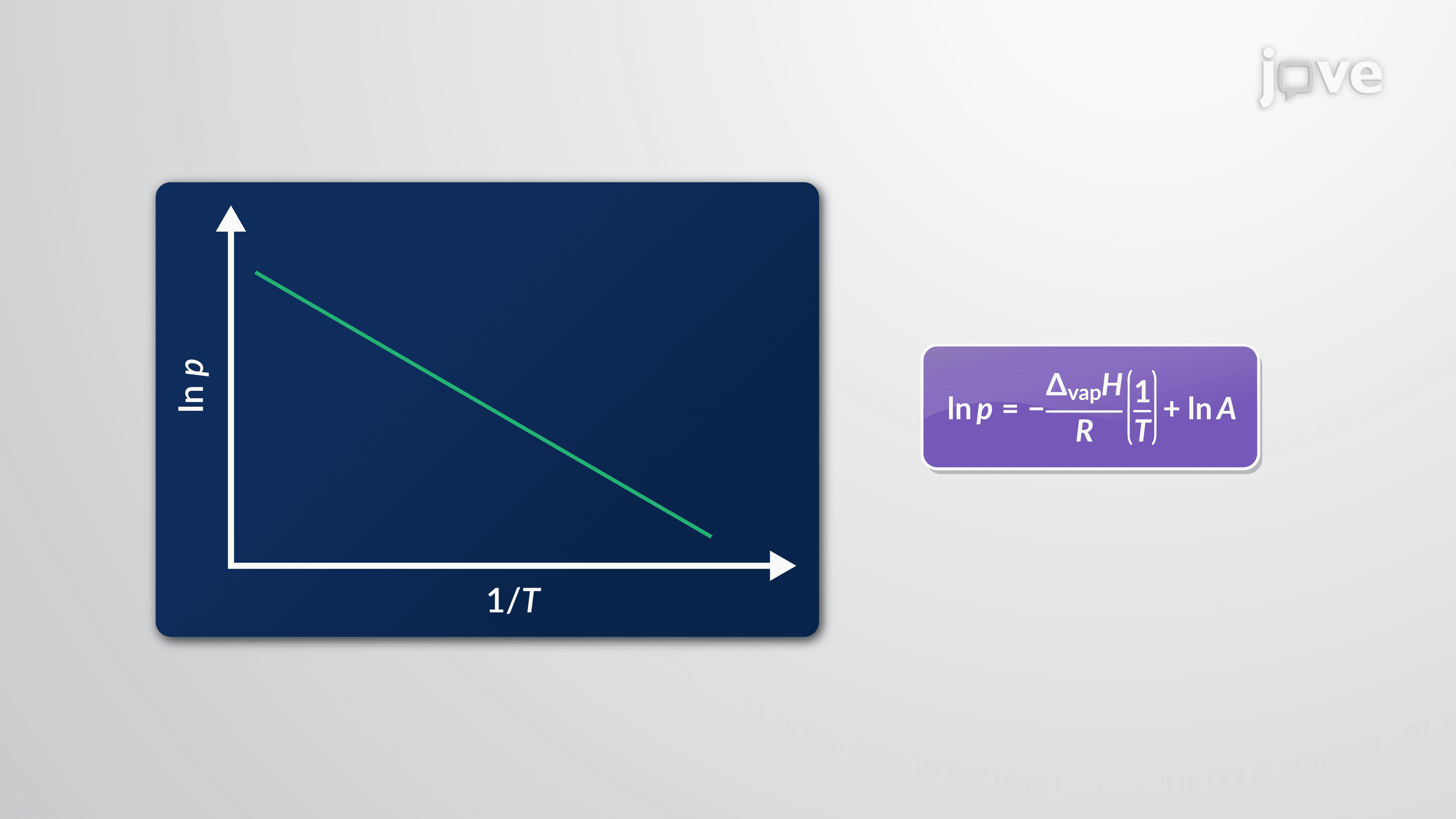

Video Summary: What Is the Clausius Clapeyron Equation
Why does water boil faster at lower air pressure in Denver, Colorado, compared to sea-level cities like Miami? The answer lies in the Clausius-Clapeyron equation basics, a powerful relationship describing how vapor pressure changes exponentially with temperature. Using the enthalpy of vaporization and the gas constant, this equation predicts boiling behavior across any two conditions. Watch the full video on JoVE Coach to master this concept with expert-led visuals and step-by-step explanations.
The Clausius-Clapeyron equation is one of the most practically useful relationships in physical chemistry and thermodynamics. It mathematically describes how the vapor pressure of a substance, the pressure exerted by its vapor when in equilibrium with its liquid or solid phase, changes as a function of temperature. Rather than a simple linear increase, vapor pressure rises exponentially with temperature, and this equation captures that behavior precisely.
The equation is expressed in its basic form as:
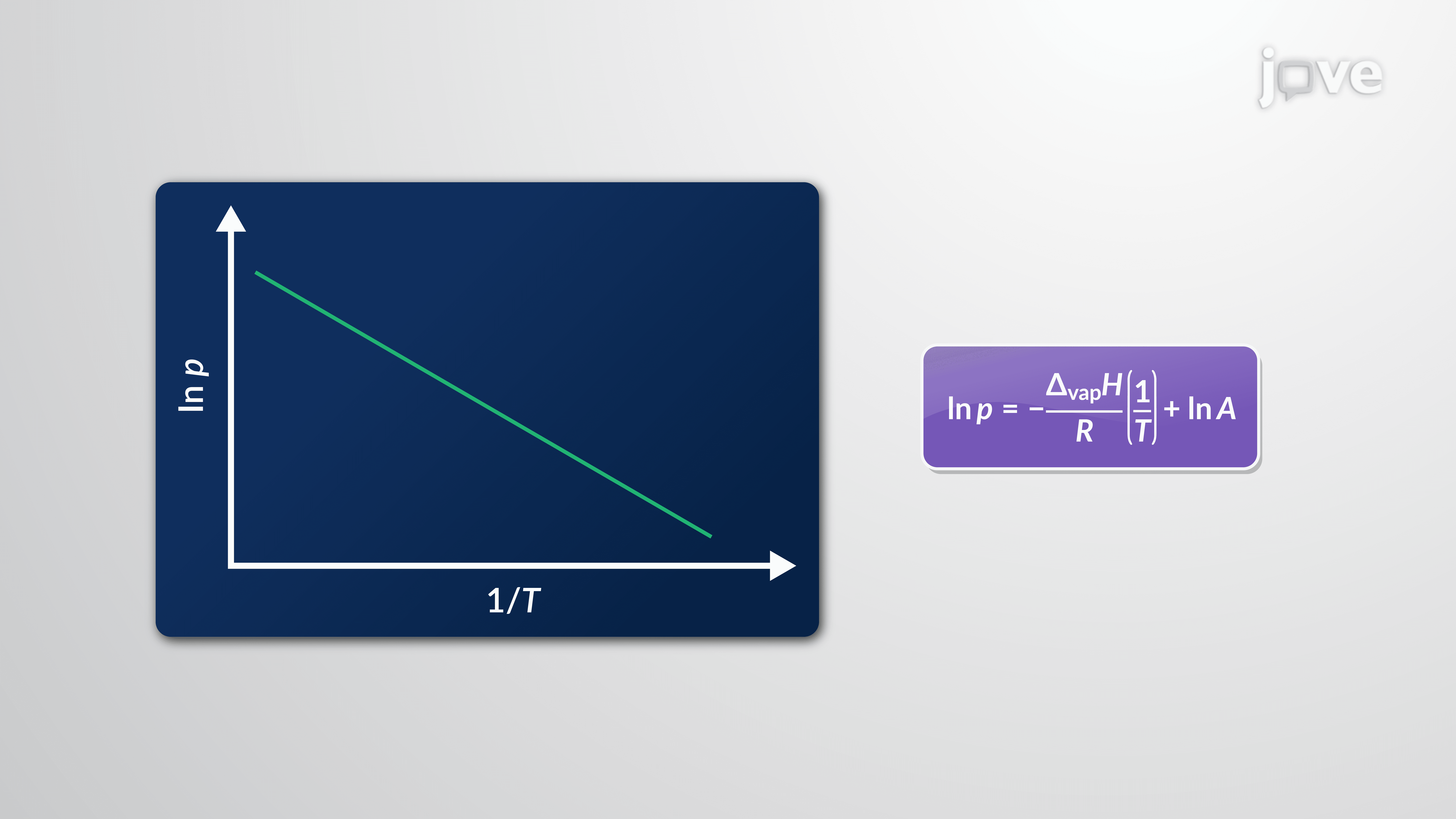
ln(P) = −(ΔHvap / R)(1/T) + A
Where P is vapor pressure, ΔHvap is the enthalpy of vaporization (in J/mol), R is the universal gas constant (8.314 J/mol·K), T is absolute temperature in Kelvin, and A is a substance-specific constant.
One of the most elegant features of the Clausius-Clapeyron equation is its logarithmic transformation. When you plot the natural logarithm of vapor pressure, ln(P), on the y-axis against the reciprocal of temperature, 1/T, on the x-axis, the result is a straight line. The slope of that line equals −ΔHvap / R. This is extraordinarily useful in the laboratory: by measuring vapor pressure at several temperatures and plotting the data, chemists can experimentally determine a liquid's enthalpy of vaporization without a calorimeter. This graphical interpretation is a frequent topic on AP Chemistry free-response questions and college general chemistry exams.
For most exam and application scenarios, the two-point form of the Clausius-Clapeyron equation is the go-to tool:
ln(P2 / P1) = −(ΔHvap / R)(1/T2 − 1/T1)
This form eliminates the substance-specific constant A entirely, because it cancels when two expressions for the same substance are equated. Given any three of the four variables, P1, T1, P2, T2, plus ΔHvap, you can solve for the unknown. For example, knowing that water has a ΔHvap of approximately 40,700 J/mol and boils at 100°C (373 K) at sea level, you can calculate its boiling point at Denver's elevation (~1,609 meters, atmospheric pressure ~630 mmHg), a classic real-world US application. This type of calculation appears regularly on the MCAT, AP Chemistry exams, and undergraduate physical chemistry midterms.
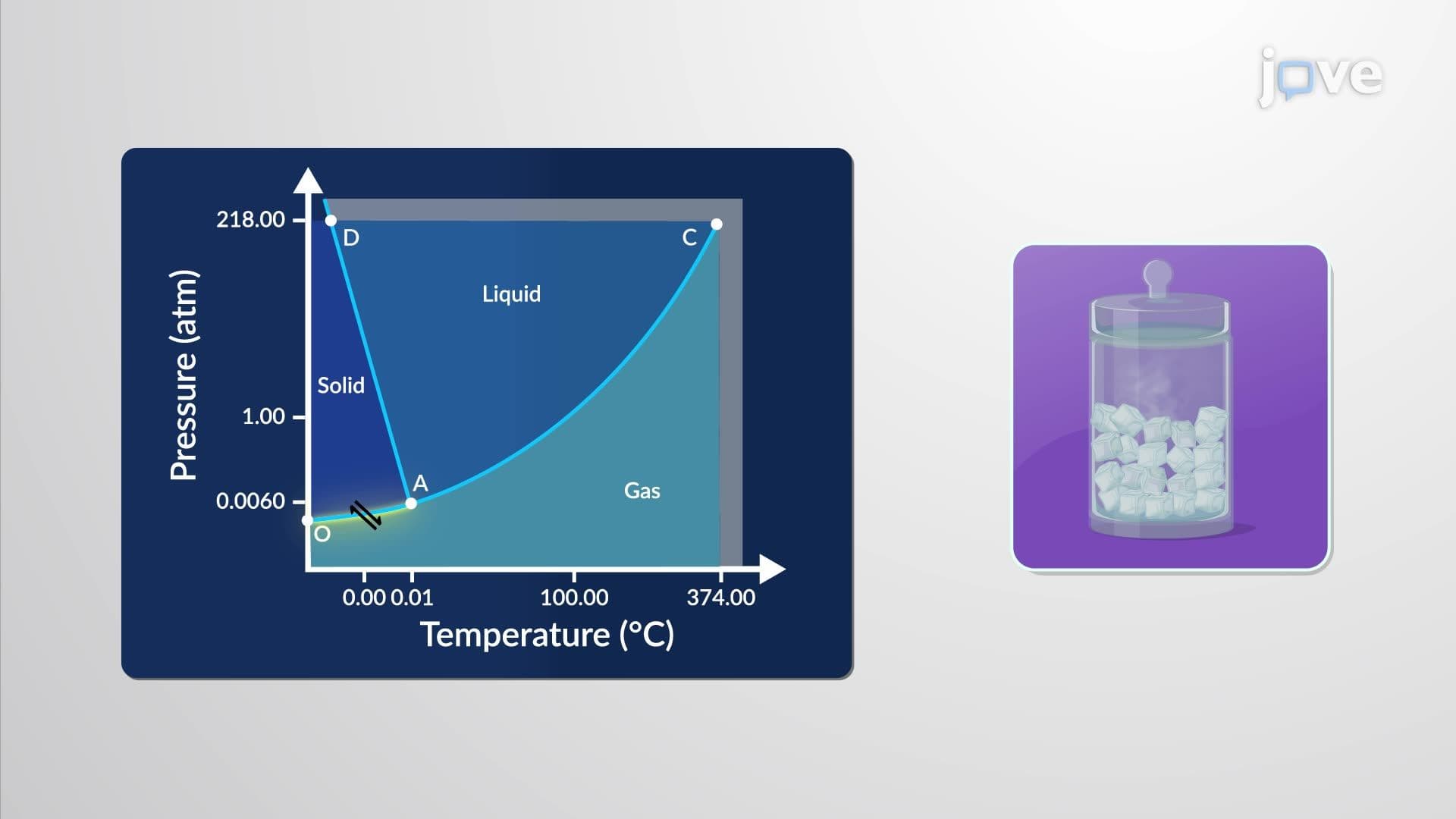
The Clausius-Clapeyron equation doesn't exist in isolation, it defines the liquid-vapor boundary curve on a phase diagram. Every point on that curve represents a temperature-pressure combination at which liquid and vapor coexist in equilibrium. The curve begins at the triple point, the unique condition where solid, liquid, and vapor all coexist, and ends at the critical point, beyond which the distinction between liquid and gas disappears entirely. For water, the critical point occurs at 374°C and 218 atm. A related version of the Clausius-Clapeyron equation also applies to sublimation, the direct solid-to-vapor transition, using the enthalpy of sublimation instead. Understanding these connections is essential for interpreting phase diagrams, a skill tested in AP Chemistry, college general chemistry, and physical chemistry courses alike.
Related Micro-courses