Loading video…


 18 Concepts
 52.4K views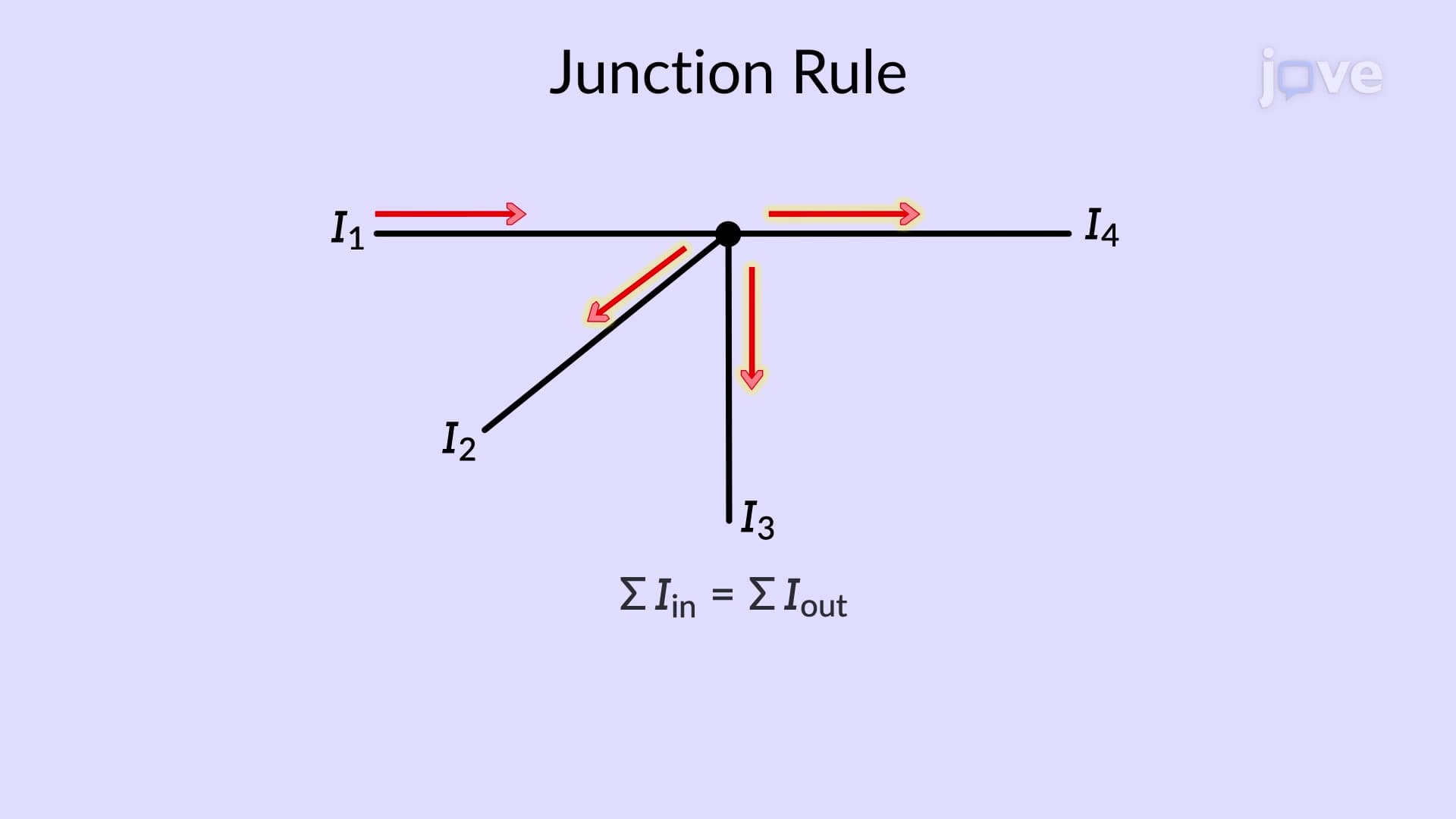

Video Summary: What Is Kirchhoffs Rules
Ever wonder how engineers ensure that smartphone chargers don't overload circuits or how electric cars distribute power efficiently? Kirchhoff's rules provide the fundamental framework for analyzing complex electrical circuits that power everything from Tesla's battery systems to the electrical grid serving NASA's Kennedy Space Center. These two essential principles-the junction rule and loop rule-form the backbone of circuit analysis in physics and engineering. What is Kirchhoff's Rules becomes clear when you understand how these conservation laws govern current flow and voltage distribution in any electrical network. Watch the full video on JoVE Coach to master this concept with expert-led visuals and step-by-step explanations.
Kirchhoff's rules definition encompasses two fundamental laws that German physicist Gustav Robert Kirchhoff established in 1845. These principles transformed electrical circuit analysis by providing systematic methods for solving complex networks that simple Ohm's Law applications cannot handle. Understanding what is Kirchhoff's rules in detail requires grasping how these laws emerge from fundamental conservation principles that govern all physical systems.
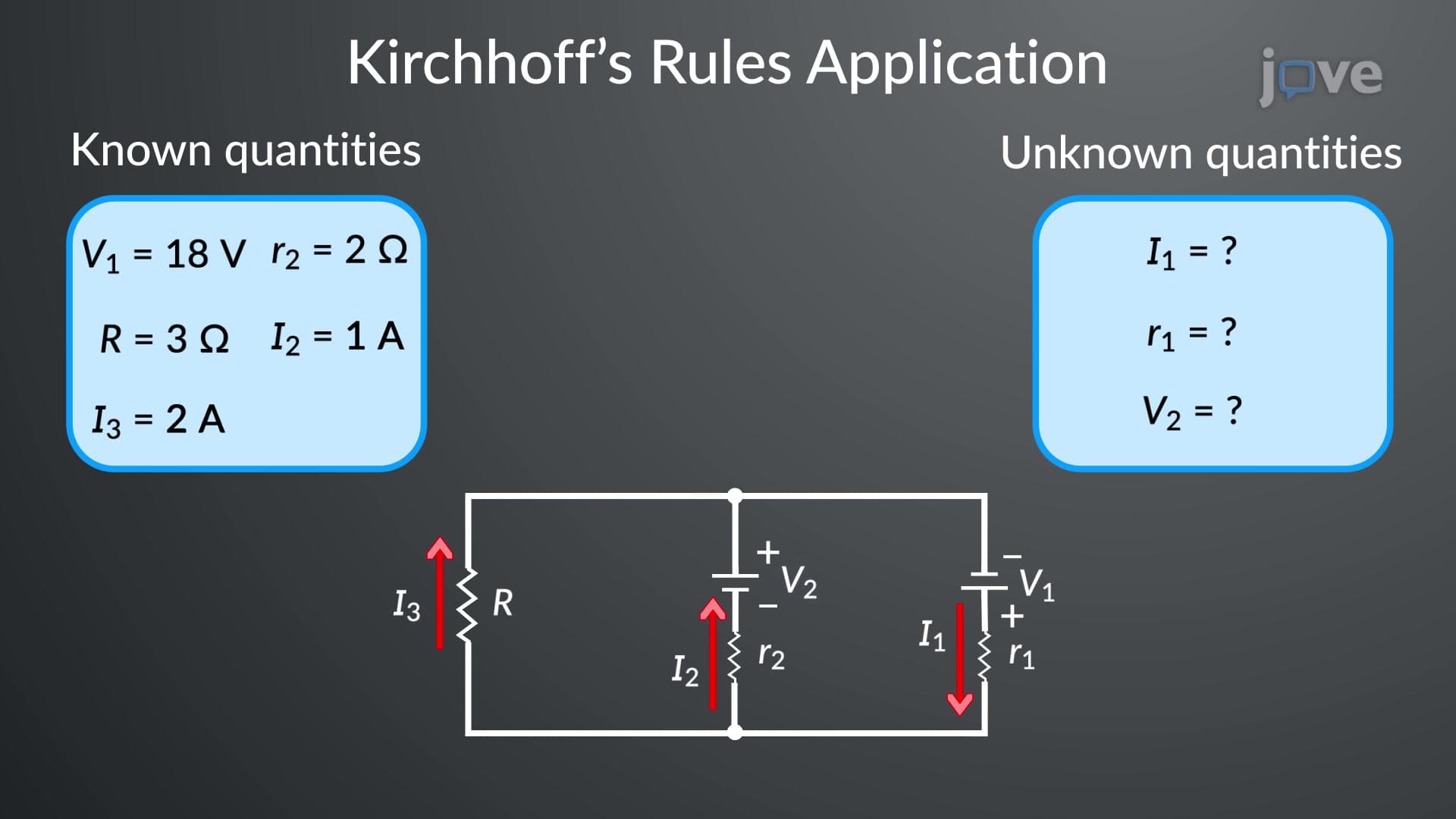
The junction rule, also known as Kirchhoff's Current Law (KCL), states that the algebraic sum of all currents entering any junction equals the sum of currents leaving that junction. This Kirchhoff's rules concept directly reflects charge conservation-since electric charge cannot accumulate at a junction, whatever flows in must flow out.
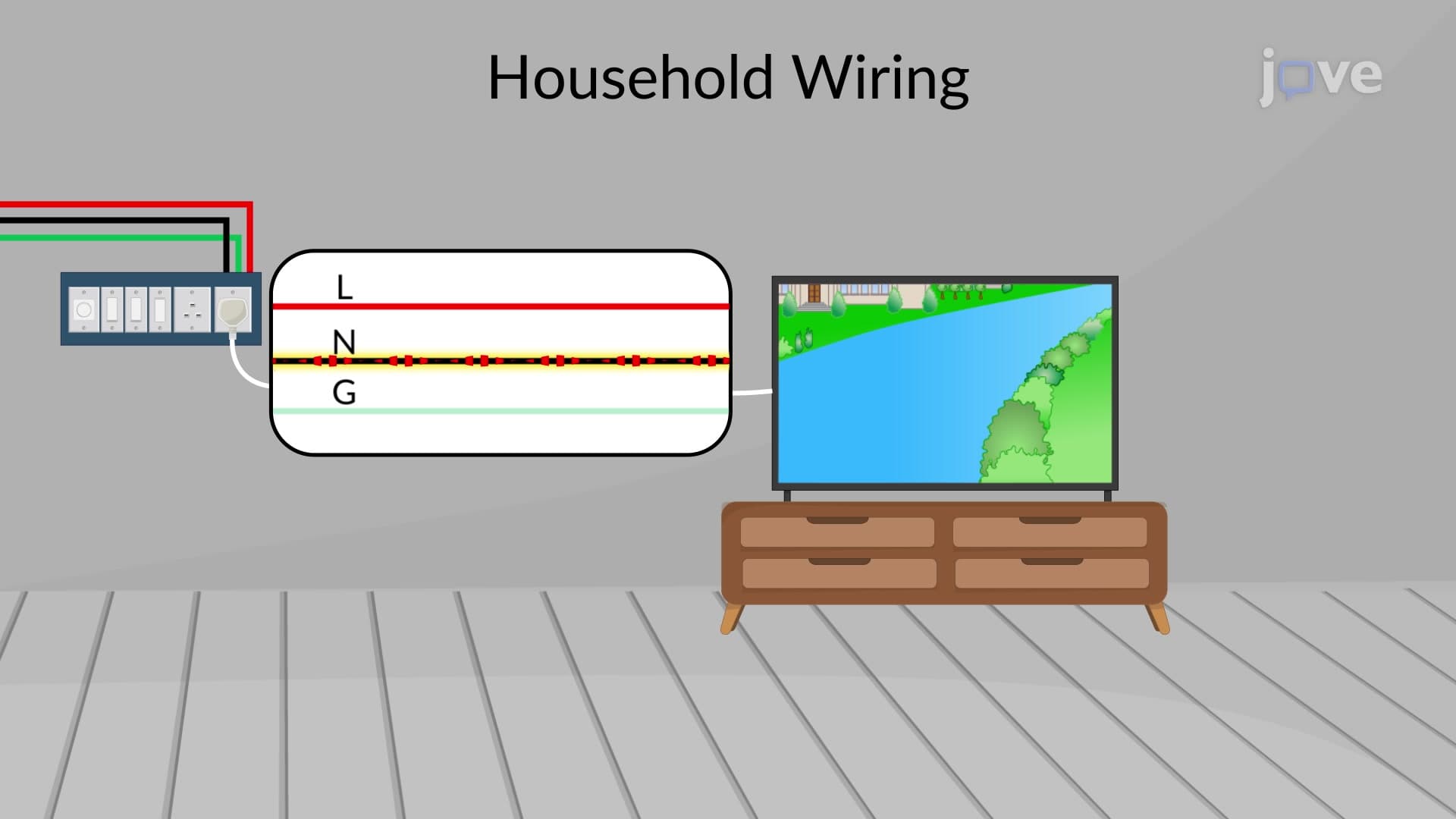
Consider a typical household electrical panel where multiple circuit breakers distribute power throughout a home. At each connection point, the total current entering equals the current leaving, ensuring no charge buildup occurs. This principle applies equally to complex integrated circuits in smartphones and massive power distribution networks serving cities like Los Angeles or New York.
Mathematically, for any junction: I(entering) = I(leaving), or ΣI = 0 when using proper sign conventions.
The loop rule, or Kirchhoff's Voltage Law (KVL), mandates that the algebraic sum of all potential differences around any closed loop equals zero. This Kirchhoff's rules basics principle stems from energy conservation-as charges complete a circuit loop, they must return to their original energy state.
When analyzing circuits, students apply specific sign conventions: voltage sources contribute positive potential when traversed from negative to positive terminal, while resistors create negative potential drops when traversed in the current direction. These conventions ensure consistent mathematical treatment across different circuit configurations.
Kirchhoff's rules study guide preparation proves essential for AP Physics exams, MCAT preparation, and college-level physics courses. Students typically encounter these concepts in introductory physics courses at institutions like MIT, Stanford, or state universities nationwide. The College Board's AP Physics C curriculum specifically emphasizes circuit analysis using Kirchhoff's rules, often presenting multi-loop problems requiring systematic equation setup and algebraic solution methods.
Professional applications span from automotive electrical systems-where engineers use these rules to design safe, efficient wiring harnesses-to renewable energy systems where solar panel arrays require careful circuit analysis to maximize power output while preventing component damage.
Related Micro-courses