Loading video…

 15 Concepts
 70K views

Video Summary: Choosing Between Z and T Distribution Explained
When analyzing ACT scores across US high schools, statisticians must decide: should they use a z-distribution or t-distribution? Choosing between z and t distribution depends on whether your population's standard deviation is known and your sample size. For instance, when the College Board analyzes SAT performance with known historical variance, they'd use z-distribution, but unknown variance requires t-distribution. Watch the full video on JoVE Coach to master this concept with expert-led visuals and step-by-step explanations.
The decision between z and t distributions forms a cornerstone of inferential statistics, particularly crucial for students preparing for AP Statistics exams or college-level research methods courses. Both distributions serve the same fundamental purpose: estimating population means from sample data. However, the choice hinges on specific dataset characteristics that determine statistical validity.
When working with datasets where the population standard deviation is known-such as standardized test scores where historical data provides established variance-the z-distribution becomes your tool of choice. This applies regardless of sample size, provided the population follows a normal distribution. For example, when analyzing MCAT scores, the Association of American Medical Colleges has decades of data establishing population parameters, making z-distribution appropriate.
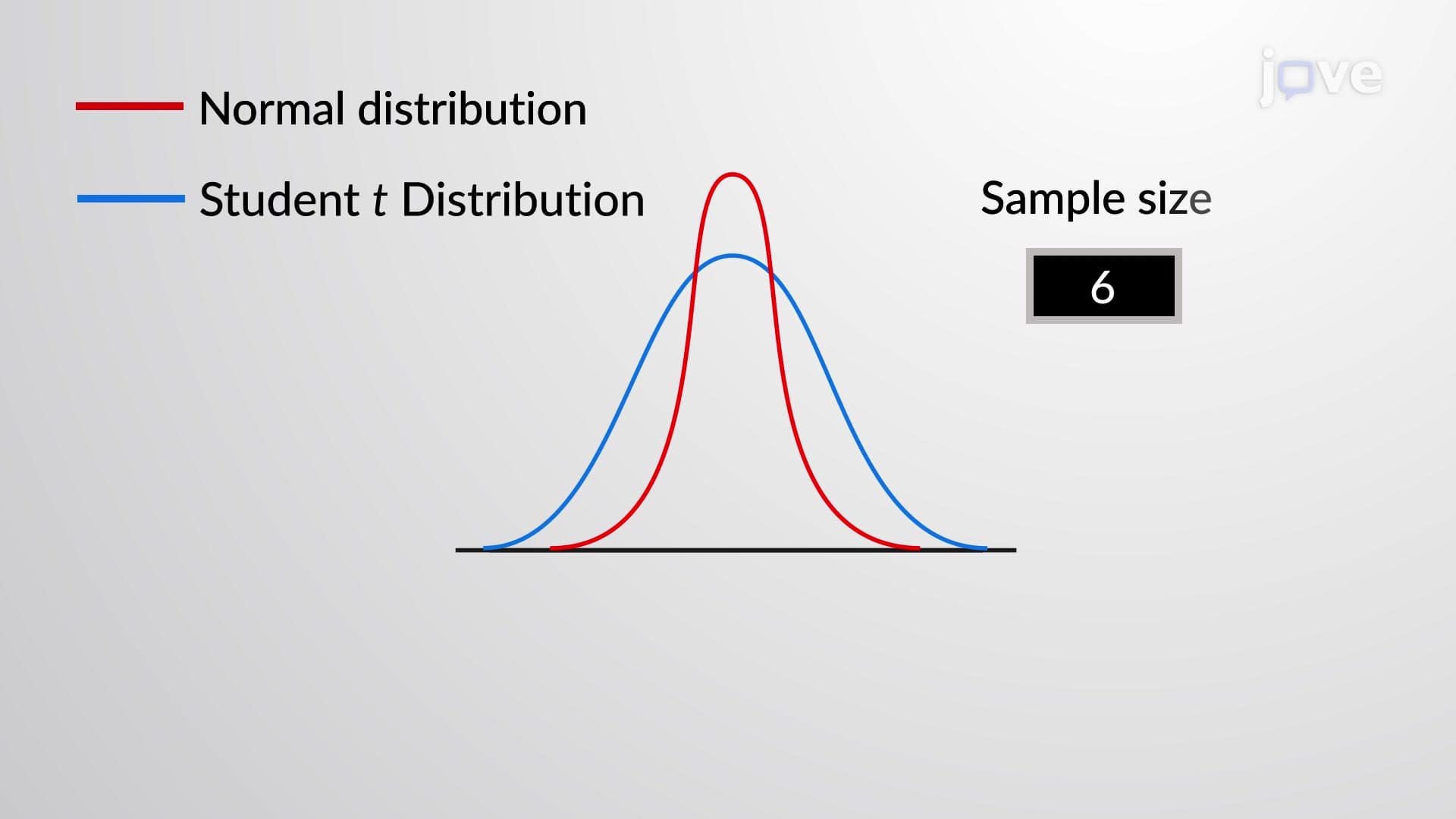
Conversely, when population standard deviation remains unknown-the more common scenario in real-world research-statisticians turn to the Student t-distribution. This applies to studies like analyzing average study hours among University of California students, where researchers must estimate both the mean and variance from sample data alone.
The Central Limit Theorem creates an important threshold at sample sizes exceeding 30. Beyond this point, both z and t distributions yield remarkably similar results for symmetrically distributed data. This convergence explains why many introductory statistics courses, including those preparing students for the MCAT or nursing entrance exams like HESI A2, emphasize this rule of thumb.
Both z and t distributions carry strict assumptions that limit their applicability. They require random sampling from normally distributed populations-conditions that eliminate their use with convenience samples, voluntary response surveys, or skewed distributions. When these assumptions fail, alternative approaches like nonparametric statistics or bootstrap methods become necessary. This distinction proves particularly important for students conducting research projects or preparing for advanced placement statistics examinations.
Related Micro-courses