Loading video…


 16 Concepts
 15.9K views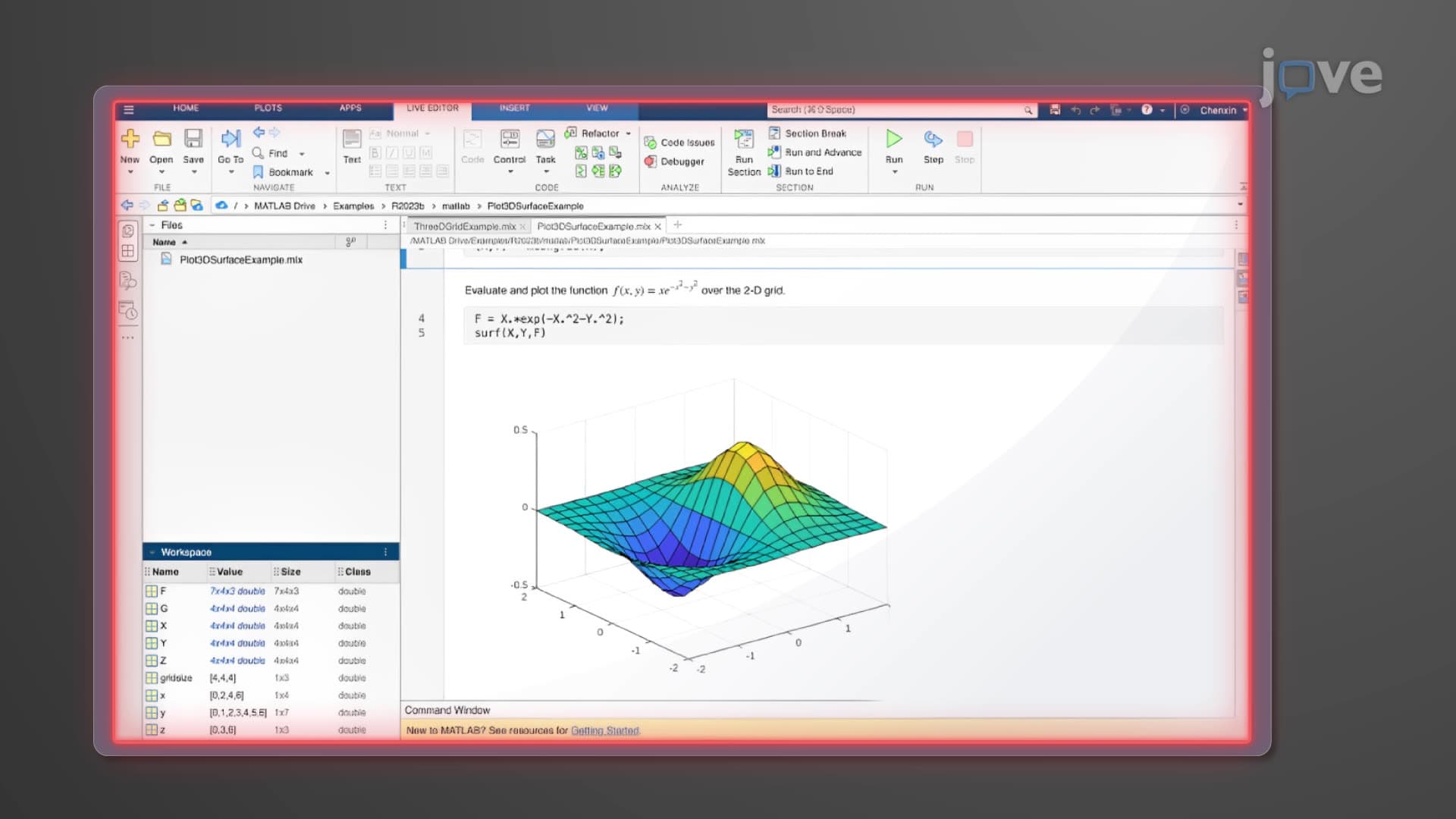

Video Summary: What Is Matlab
Did you know that the same software powering NASA's Mars rover navigation also helps high school students solve algebra problems? Matlab is a powerful programming language and computing platform that transforms complex mathematical calculations into visual, interactive solutions. From analyzing stock market trends on Wall Street to processing medical images at Johns Hopkins Hospital, this Matrix Laboratory tool has revolutionized how we approach numerical computation and data analysis. Watch the full video on JoVE Coach to master this concept with expert-led visuals and step-by-step explanations.
Matlab, an acronym for Matrix Laboratory, represents one of the most influential programming platforms in technical computing today. Developed by MathWorks, this specialized language was specifically designed to handle matrix operations and numerical computations with unprecedented ease. Unlike general-purpose programming languages such as Python or Java, Matlab's syntax closely mirrors mathematical notation, making it intuitive for students and professionals working with complex equations.
The platform's matrix-centric approach reflects its origins in linear algebra research. Every variable in Matlab is treated as a matrix, even single numbers (which are 1x1 matrices). This fundamental design choice allows users to perform operations on entire datasets with single commands, dramatically reducing code complexity compared to traditional programming approaches.
Matlab's architecture consists of several integrated components that work seamlessly together. The computing engine handles numerical calculations using optimized algorithms, while the graphics system provides sophisticated data visualization capabilities. Students preparing for AP Computer Science or engineering coursework will appreciate how Matlab's integrated development environment combines code editing, debugging, and visualization tools in one interface.
The platform includes an extensive mathematical function library covering everything from basic arithmetic to advanced signal processing. For college students taking calculus or statistics courses, functions like `diff()` for derivatives or `corrcoef()` for correlation analysis provide immediate computational power without requiring manual algorithm implementation.
Matlab's versatility shines across diverse industries throughout the United States. At Boeing, engineers use Matlab for aircraft control system design and testing. Financial institutions like Goldman Sachs employ it for risk analysis and algorithmic trading strategies. Medical device companies such as Medtronic rely on Matlab for signal processing in pacemaker development.
In academic settings, Matlab serves as a bridge between theoretical concepts and practical implementation. Students at institutions like MIT and Stanford use it for research projects ranging from climate modeling to artificial intelligence development. The platform's Statistics and Machine Learning Toolbox enables hypothesis testing and data modeling essential for AP Statistics and college-level research methodology courses.
Matlab's primary strength lies in its accessibility-complex mathematical operations that might require hundreds of lines in other languages often need just a few Matlab commands. The extensive user community provides abundant resources, tutorials, and pre-built functions that accelerate learning and development.
However, students should understand Matlab's limitations. As proprietary software, it requires licensing fees that may not be feasible for all educational institutions. Additionally, while excellent for prototyping and mathematical modeling, Matlab may face performance constraints with extremely large datasets compared to compiled languages like C++.
Related Micro-courses