Loading subject page…


5,979 views


Video Summary: What Is Truncation in Survival Analysis
Did you know that medical researchers studying cancer rates among US factory workers often miss critical data simply because some workers quit before studies begin? Truncation in survival analysis occurs when researchers exclude certain participants from their dataset entirely, unlike censoring where partial information is still available. For example, when studying occupational cancer risks at a manufacturing plant in Detroit, workers who left employment before the study started represent left truncation. What is Truncation in Survival Analysis becomes crucial for understanding why some survival studies may underestimate true disease rates. Watch the full video on JoVE Coach to master this concept with expert-led visuals and step-by-step explanations.
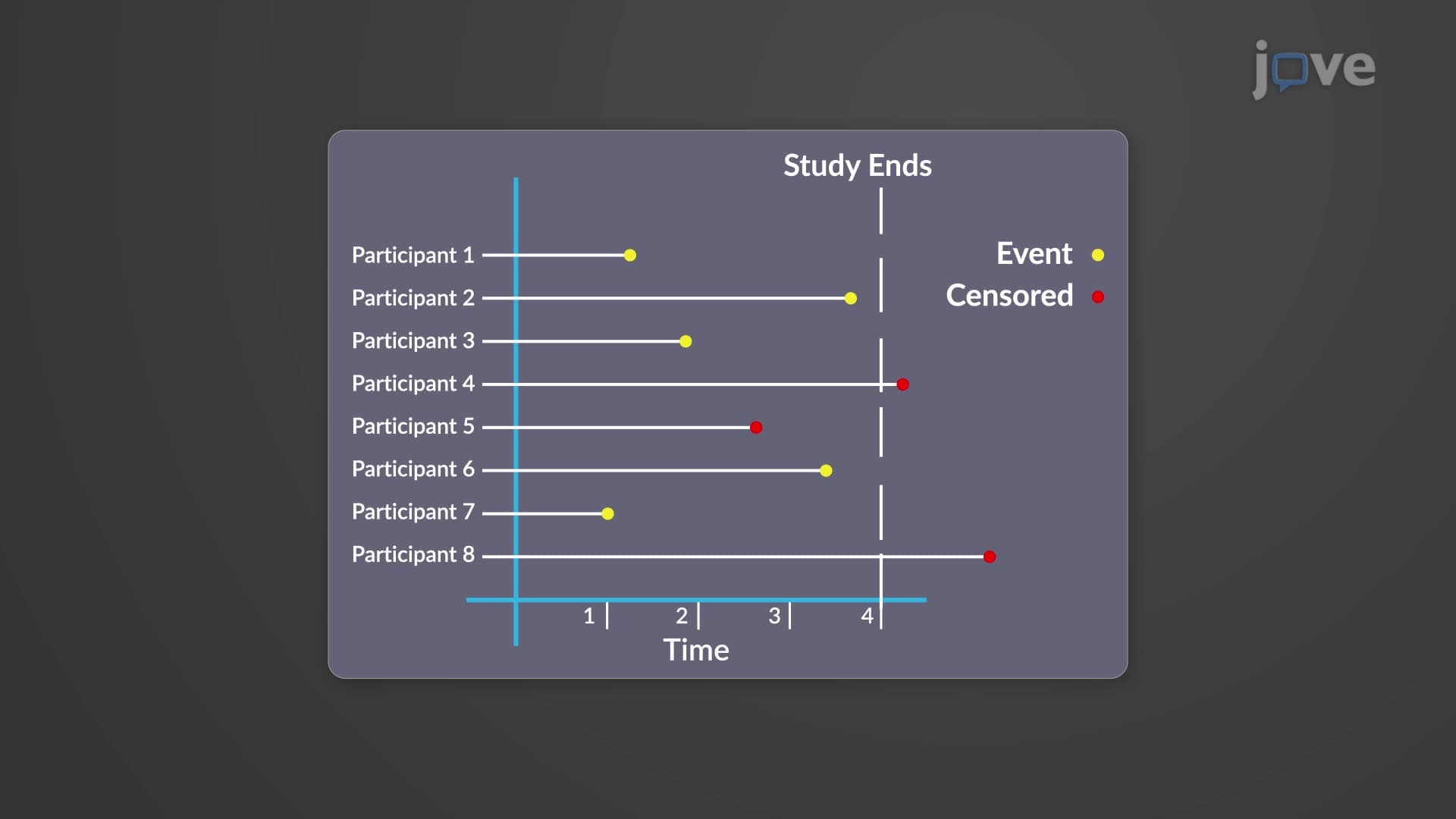
Truncation in survival analysis represents a fundamental data limitation where researchers completely exclude certain subjects from their dataset. Unlike censoring, where partial information remains available, truncation creates gaps in the data that can significantly impact study conclusions. This concept frequently appears on the MCAT and in undergraduate biostatistics courses, making it essential for pre-med students to master.
Left truncation occurs when subjects are excluded because their "time zero" precedes the study's observation period. Consider a landmark study examining lung cancer rates among shipyard workers exposed to asbestos at the Norfolk Naval Shipyard. If researchers begin collecting data in 2020 but only interview current employees, they miss workers who developed cancer and left employment in previous decades. This creates a truncation in survival analysis that potentially underestimates the true cancer incidence rate.
The mathematical implication involves conditional probability. Instead of observing the complete survival distribution, researchers only observe subjects who survived long enough to enter the study. This survival bias can lead to overly optimistic survival estimates, particularly relevant when analyzing occupational diseases with long latency periods.
Right truncation eliminates subjects whose event times exceed study boundaries. In clinical trials conducted by the National Cancer Institute, patients diagnosed after a specific cutoff date might be excluded to maintain consistent follow-up periods. While less common than left truncation, this truncation in survival analysis overview demonstrates how administrative decisions can create systematic data gaps.
AP Statistics students encounter truncation when analyzing real datasets, while MCAT test-takers must distinguish truncation from censoring in research interpretation questions. Understanding these concepts helps students critically evaluate published medical research and recognize potential biases in survival estimates. College biostatistics courses often use truncation examples from CDC epidemiological studies to illustrate how data collection methods influence statistical conclusions.
Related Micro-courses