Loading video…

 11 Concepts
 3.7K views

Video Summary: What Is Economic Order Quantity
Inventory costs quietly erode operational efficiency when ordering decisions lack a structured approach. Understanding economic order quantity and applying the EOQ formula gives managers a reliable method to determine the optimal order quantity, balancing ordering frequency against storage expenses. Stop guessing and start calculating the exact point where total inventory costs are lowest. Watch the full video on JoVE Coach to master this concept with expert-led visuals and step-by-step explanations.
Picture this: your team oversees product distribution, and every month there's a quiet argument brewing between two competing pressures. Place orders too frequently, and administrative and processing costs stack up. Order in bulk too aggressively, and your storage, insurance, and handling costs balloon. Neither camp wins, and without a disciplined framework, managers often default to gut feel or historical habit, neither of which holds up under scrutiny.
This is exactly the problem the Economic Order Quantity (EOQ) model was designed to solve.
Inventory decisions feel like they belong in the finance or procurement lane, not on a manager's radar. But mid-level managers who oversee operations, supply chains, or distribution teams are routinely expected to justify order volumes, explain cost variances, and optimize departmental budgets. Without a model like EOQ, those decisions become reactive.
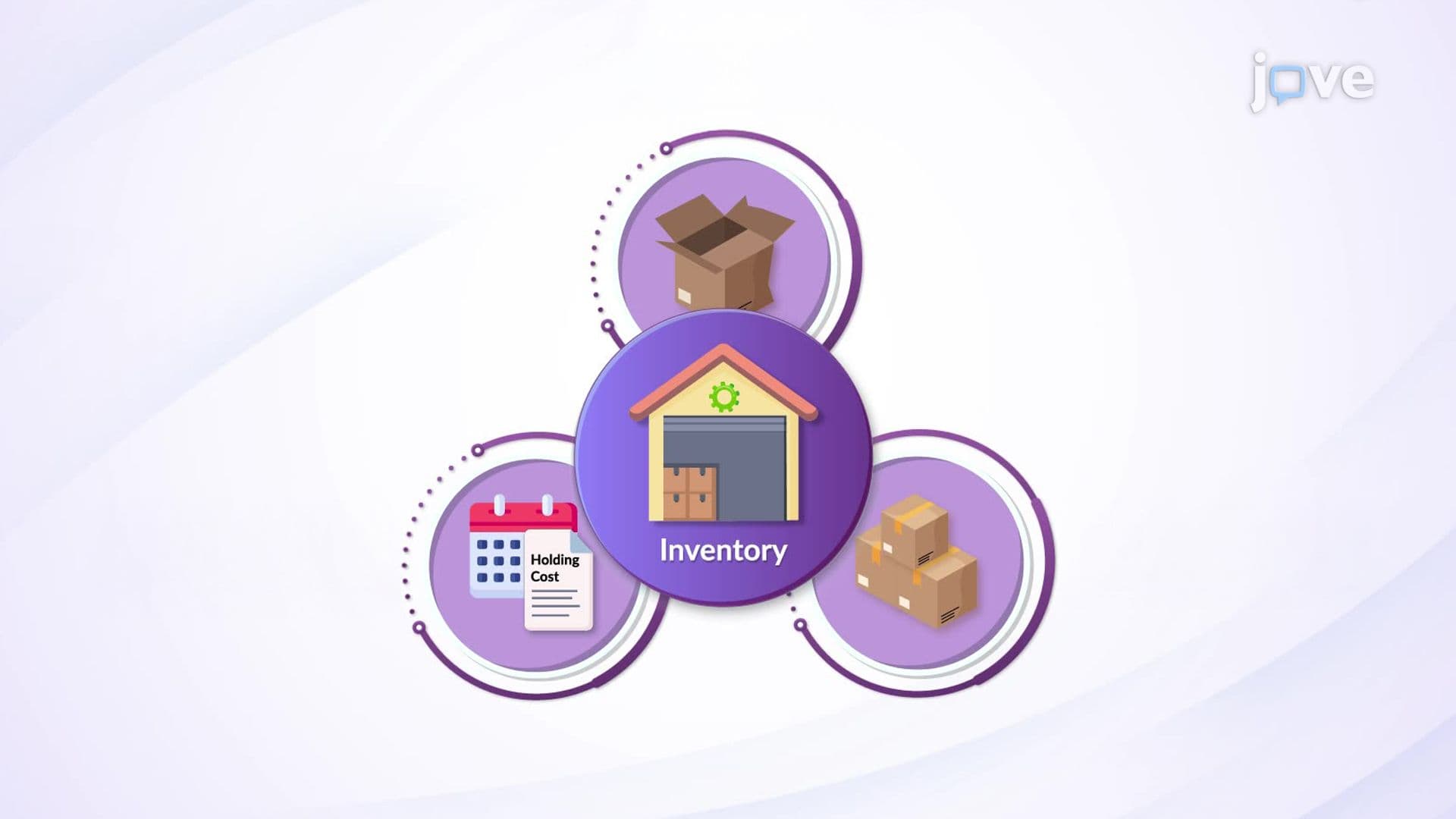
The deeper issue is that ordering costs and holding costs move in opposite directions. Reduce order frequency and holding costs rise. Increase order frequency and ordering costs rise. Most managers optimize for one and unknowingly worsen the other. The EOQ model makes this trade-off explicit and solvable.
The EOQ formula is straightforward:
EOQ = √(2 × Annual Demand × Ordering Cost per Order ÷ Annual Holding Cost per Unit)
To use it practically, you need three inputs your team should already have or can request from finance:
1. Annual demand, how many units your operation moves per year 2. Ordering cost, the fixed cost of placing a single order (admin, processing, shipping setup) 3. Holding cost per unit, the annual cost of storing one unit (warehousing, insurance, spoilage risk)
Once you calculate your optimal order quantity, you know the exact volume per order that keeps total inventory costs at their lowest point. Pair this with a reorder point calculation, factoring in lead times, and you have a complete procurement decision framework, not just a one-time number.
This connects naturally to lean operations principles, where the goal is eliminating waste without sacrificing availability. EOQ is the quantitative anchor that gives lean thinking its precision.
Applying EOQ to volatile demand. The model assumes demand is consistent over time. If your product category is seasonal, promotional, or subject to irregular spikes, EOQ produces misleading results. Use it as a baseline, not an absolute rule, and revisit assumptions quarterly.
Ignoring supplier minimum order requirements. Your calculated EOQ may fall below a supplier's minimum order threshold. In those cases, document the gap, escalate where necessary, and factor supplier constraints into your cost modeling rather than blindly matching EOQ to the nearest round number.
Treating it as a one-time exercise. Annual holding costs shift with warehouse contracts and inflation. Ordering costs change with supplier relationships. Build a simple annual review into your operational calendar so EOQ inputs stay current and decisions remain grounded in real numbers.
The managers who get the most value from EOQ are those who use it as a conversation starter with their procurement and finance counterparts, not as a back-office formula run once and forgotten.
Related Micro-courses