Loading video…

 10 Concepts
 60 views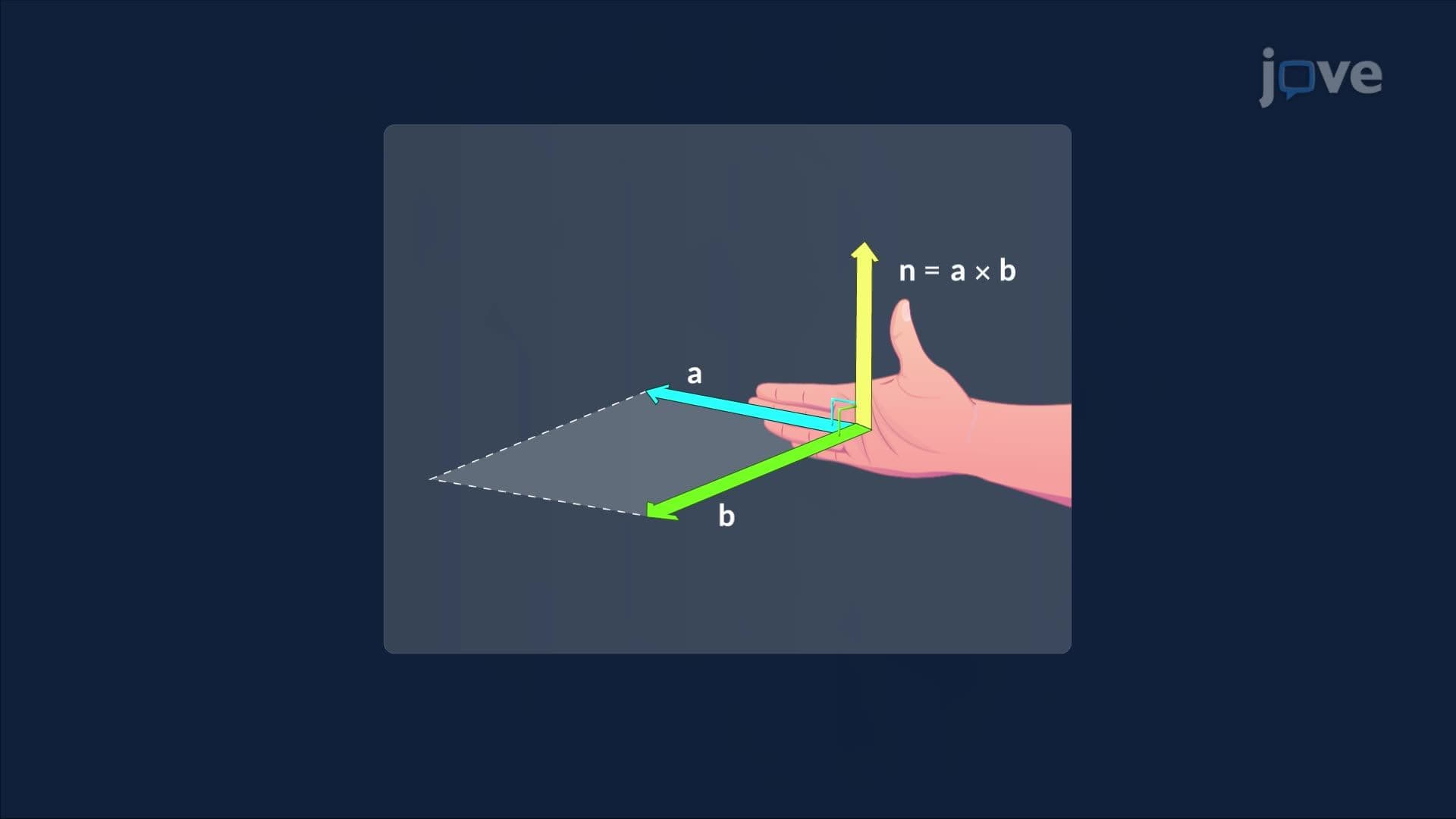

Video Summary: Cross Product and Its Geometry Explained
Ever wonder why a longer wrench makes it easier to loosen a stubborn bolt? The answer lies in cross product and its geometry basics. Cross product and its geometry reveals how two vectors in 3D space produce a third vector perpendicular to both, and its magnitude equals the area of the parallelogram they form. Torque in mechanical engineering is one powerful real-world example. Watch the full video on JoVE Coach to master this concept with expert-led visuals and step-by-step explanations.
The cross product and its geometry is one of the most visually rich ideas in vector mathematics. Unlike the dot product, which collapses two vectors into a single scalar, the cross product generates an entirely new vector. This new vector is always perpendicular to the plane containing the original two vectors, making it essential for solving problems in physics, engineering, and calculus. Students first encounter this in precalculus or Physics 1, and it reappears throughout AP Physics C, multivariable calculus, and college mechanics courses.
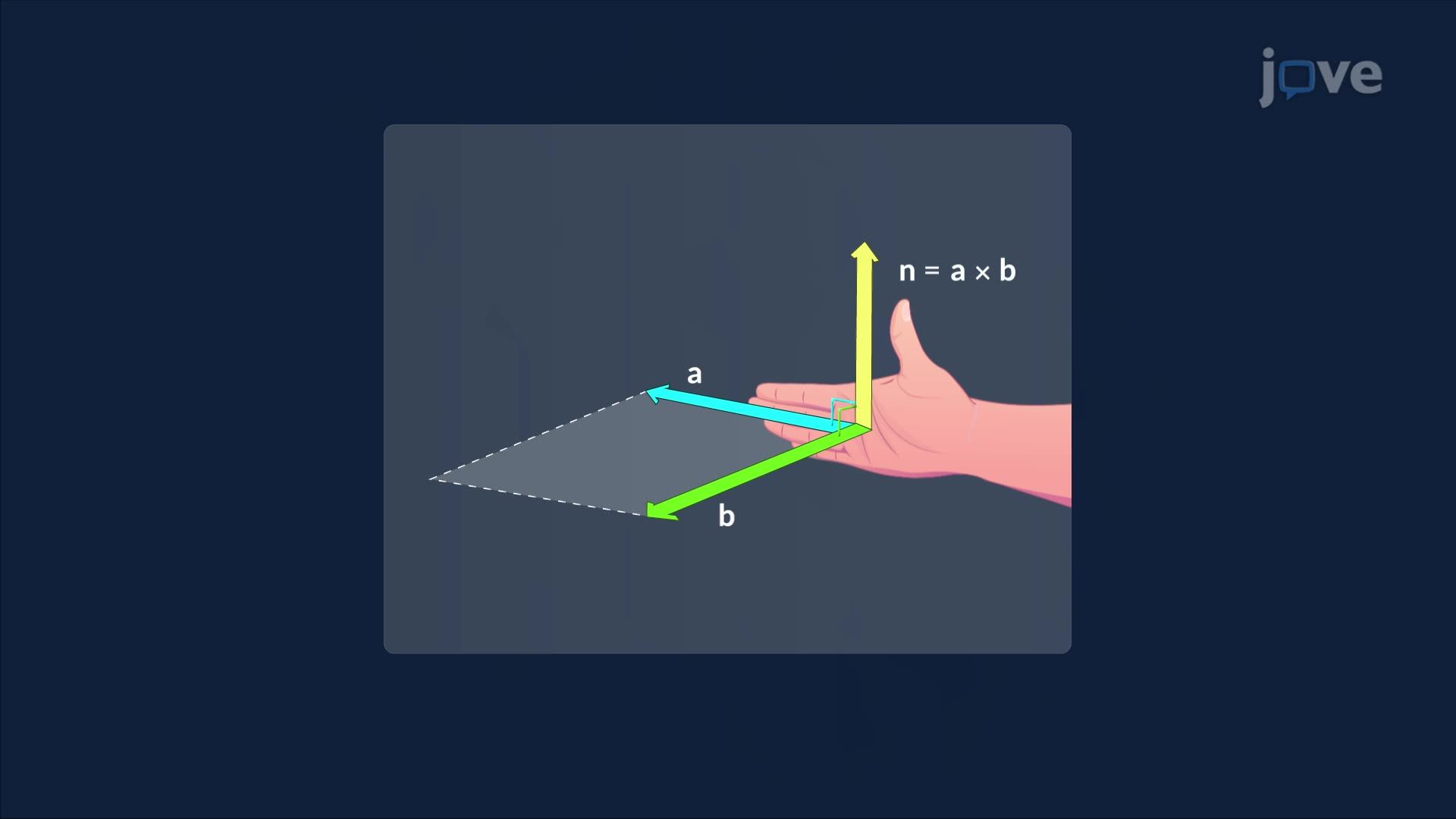
Given two non-zero, non-parallel vectors A and B, their cross product A × B produces a vector whose magnitude equals the area of the parallelogram formed by A and B. This area is calculated as:
|A × B| = |A| × |B| × sin(θ)
where θ is the angle between the two vectors. This geometric interpretation is powerful: it links abstract algebra directly to measurable physical area. When θ = 90°, sin(θ) = 1, and the area, and therefore the cross product's magnitude, reaches its maximum. When the vectors are parallel, θ = 0°, sin(θ) = 0, and the cross product vanishes entirely, meaning no parallelogram exists. This relationship also connects to how to find the angle between two vectors, since rearranging the formula allows you to solve for θ directly.
The direction of the cross product follows the Right-Hand Rule, a physical mnemonic that removes ambiguity from 3D problems. Point your fingers in the direction of the first vector A, curl them toward the second vector B, and your thumb points in the direction of A × B. This means the cross product is anti-commutative: A × B = −(B × A). This distinction is critically tested in AP Physics C: Mechanics and Electricity and Magnetism, where the direction of magnetic force on a moving charge, given by F = q(v × B), depends entirely on getting this orientation correct.
Torque is the most intuitive real-world illustration of cross product geometry. When a mechanic at an auto repair shop in Detroit applies force to a wrench to tighten a lug nut, the torque τ produced is:
τ = r × F
where r is the position vector from the bolt to the point of force application, and F is the applied force vector. The magnitude of torque is |r| × |F| × sin(θ), showing that the same force produces more torque when applied at a greater distance from the pivot (longer wrench) or at a 90° angle (perpendicular push). Applying force along the wrench handle, a 0° angle, produces zero torque regardless of how hard you push. This is why engineering design in fields from aerospace to civil construction prioritizes understanding vector cross products.
Understanding the cross product unlocks access to several advanced topics. The cross product is used to find normal vectors to planes, which feeds directly into writing equations of planes in 3D space. It also appears in calculating vector projections, determining the distance from a point to a plane, and setting up parametric equations of a line when a direction vector must be perpendicular to a given surface. In multivariable calculus, required at most US universities for STEM majors, the cross product is foundational for surface integrals, Stokes' theorem, and the curl of a vector field. For students preparing for standardized exams, this concept is high-yield on AP Physics C and relevant in the physics sections of the MCAT, where electromagnetic force problems require confident use of the Right-Hand Rule.
Related Micro-courses