Loading video…


 10 Concepts
 60 views

Video Summary: Dot Product of Two Vectors Explained
Did you know solar engineers use vector math to squeeze every watt of energy from sunlight? The dot product of two vectors is the key operation behind that optimization, and it's one of the most powerful tools in linear algebra. Dot product of two vectors basics connects algebra and geometry through a single scalar value that measures directional alignment. NASA engineers and US solar farms alike rely on this principle. Watch the full video on JoVE Coach to master this concept with expert-led visuals and step-by-step explanations.
The dot product of two vectors is a fundamental operation in linear algebra and vector calculus that takes two vectors and returns a single scalar value. Unlike addition or the cross product, which produce new vectors, the dot product collapses directional information into one number that tells you *how much* two vectors point in the same direction. This makes it uniquely powerful for measuring alignment, calculating work, and optimizing physical systems.
Given two vectors A = (A1, A2, A3) and B = (B1, B2, B3) in three-dimensional space, the dot product is calculated as:
A · B = (A1 × B1) + (A2 × B2) + (A3 × B3)
Each pair of corresponding components is multiplied, and the three products are summed. The result has no direction, it is purely a number. In two dimensions, the same logic applies with only two component pairs. This formula is straightforward to apply on homework, quizzes, and standardized exams, making it one of the most calculation-friendly operations in vector math.
The geometric form of the dot product reveals its deeper meaning:
A · B = |A| × |B| × cos(θ)
Here, |A| and |B| represent the magnitude of each vector, and θ is the angle between them. This equation directly answers the question: *how to find the angle between two vectors?* Rearranging gives:
cos(θ) = (A · B) / (|A| × |B|)
This ratio is exactly what engineers compute to measure how directly one vector aligns with another. When θ = 0°, cos(θ) = 1 and the vectors are perfectly parallel, maximum alignment. When θ = 90°, cos(θ) = 0 and the vectors are perpendicular, zero alignment. This is the geometric heart of direction cosines, which describe how a vector aligns with each coordinate axis individually.
Solar energy companies across California, Texas, and Arizona use the dot product to determine optimal panel tilt angles throughout the day and across seasons. A sunlight direction vector models incoming radiation in three dimensions. A second vector, the outward normal to the panel's surface, represents the panel's orientation. The dot product of these two vectors, divided by their magnitudes, yields the cosine of the angle between them. A larger cosine means sunlight hits the panel more directly, maximizing energy absorption. At 90 degrees, the dot product equals zero, the panel captures no direct solar energy at all.
This same logic extends to vector projection (finding how much of one vector lies along another), the equations of planes (where the normal vector plays a central role), and calculating the distance from a point to a plane, all concepts that build naturally from dot product mastery.
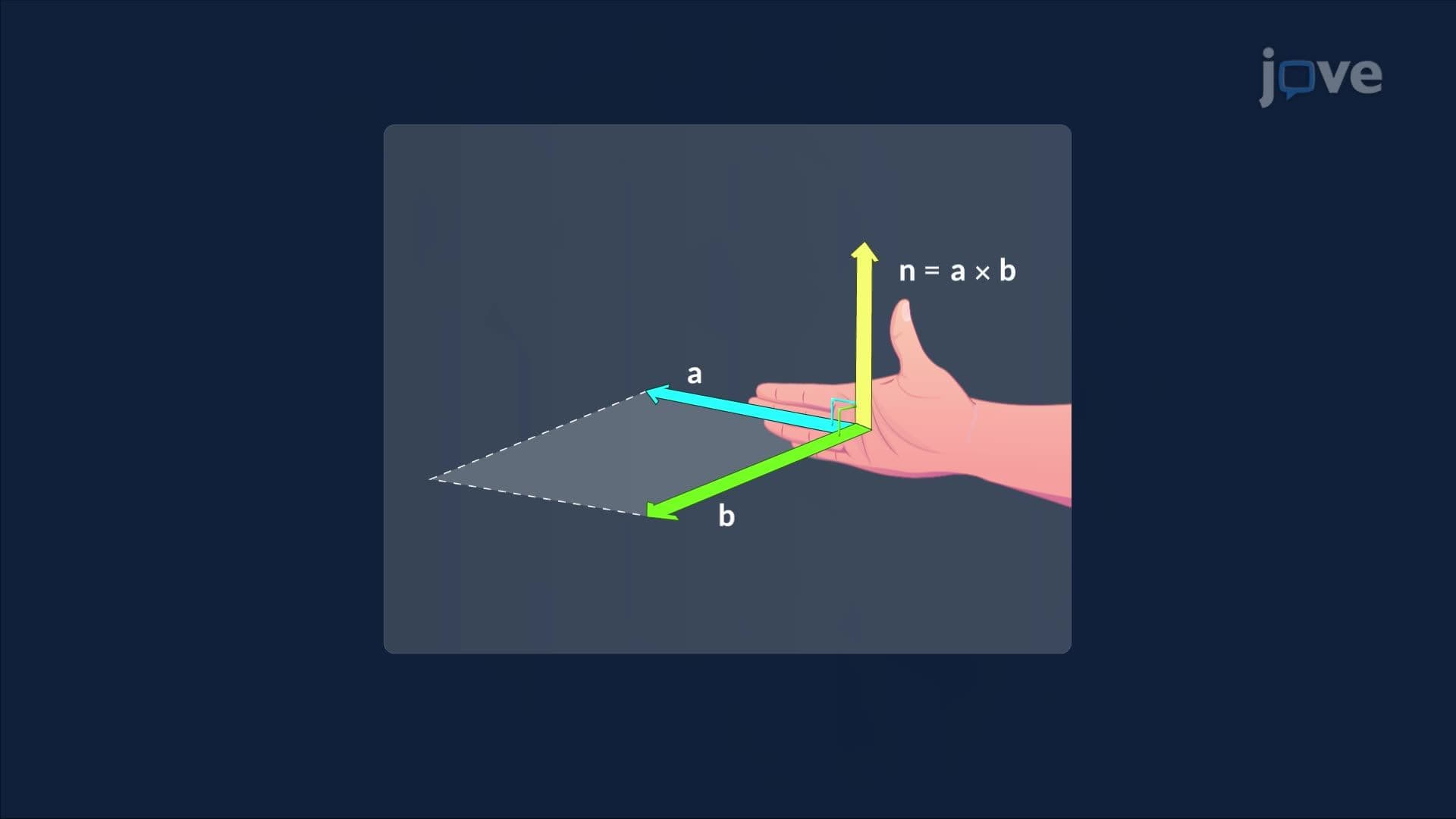
On the AP Physics C: Mechanics exam, the dot product defines work as W = F · d, where force and displacement are vectors. On AP Calculus BC and college multivariable calculus midterms, students use the dot product to find angles between curves, determine orthogonality, and set up parametric equations of a line. Understanding the dot product also prepares students for the cross product, whose geometric interpretation, a vector perpendicular to two given vectors with magnitude equal to the area of the parallelogram they form, is a natural next step in three-dimensional vector analysis.
Related Micro-courses