Loading video…


 10 Concepts
 60 views

Video Summary: Problem Solving with Vectors in Space
Ever wonder how an 800-pound chandelier stays perfectly still in a grand hotel lobby? Problem solving with vectors in space makes that possible. This concept, also called Problem Solving with Vectors in Space basics, uses 3D coordinate systems to find cable tensions keeping a chandelier in equilibrium, a real challenge in structural engineering. Watch the full video on JoVE Coach to master this concept with expert-led visuals and step-by-step explanations.
Problem Solving with Vectors in Space is one of the most practically powerful skills in mathematics and physics. Unlike 2D vector problems, 3D problems require tracking forces, directions, and magnitudes across three independent axes simultaneously. From suspension bridges in San Francisco to ceiling rigging systems in Broadway theaters in New York City, engineers rely on 3D vector analysis every single day. Mastering this skill means being able to model any real structure mathematically and solve for unknown forces with precision.
Every 3D vector problem begins with a clearly defined coordinate system. The object of interest, a chandelier, a structural joint, or a satellite, is typically placed at the origin. Anchor points, cable endpoints, or force application points are then assigned specific (x, y, z) coordinates. Position vectors are drawn from the origin to each of these points. These vectors define the direction each cable or rod pulls. Getting this setup right is the single most important step, and it directly connects to concepts like parametric equations of a line and equations of planes, both of which appear on AP Calculus BC and college-level multivariable calculus exams.
Once position vectors are established, each one is converted into a unit vector by dividing by its magnitude. This is where the magnitude of a vector becomes essential, it normalizes the direction without changing it. Direction cosines, which describe the angles a vector makes with each axis, emerge naturally from this process and are frequently tested in college physics and engineering statics courses. Each unit vector is then multiplied by an unknown scalar to form a tension vector. This scalar represents the actual tension magnitude in that cable, which is what engineers need to select appropriate materials and ensure safety.
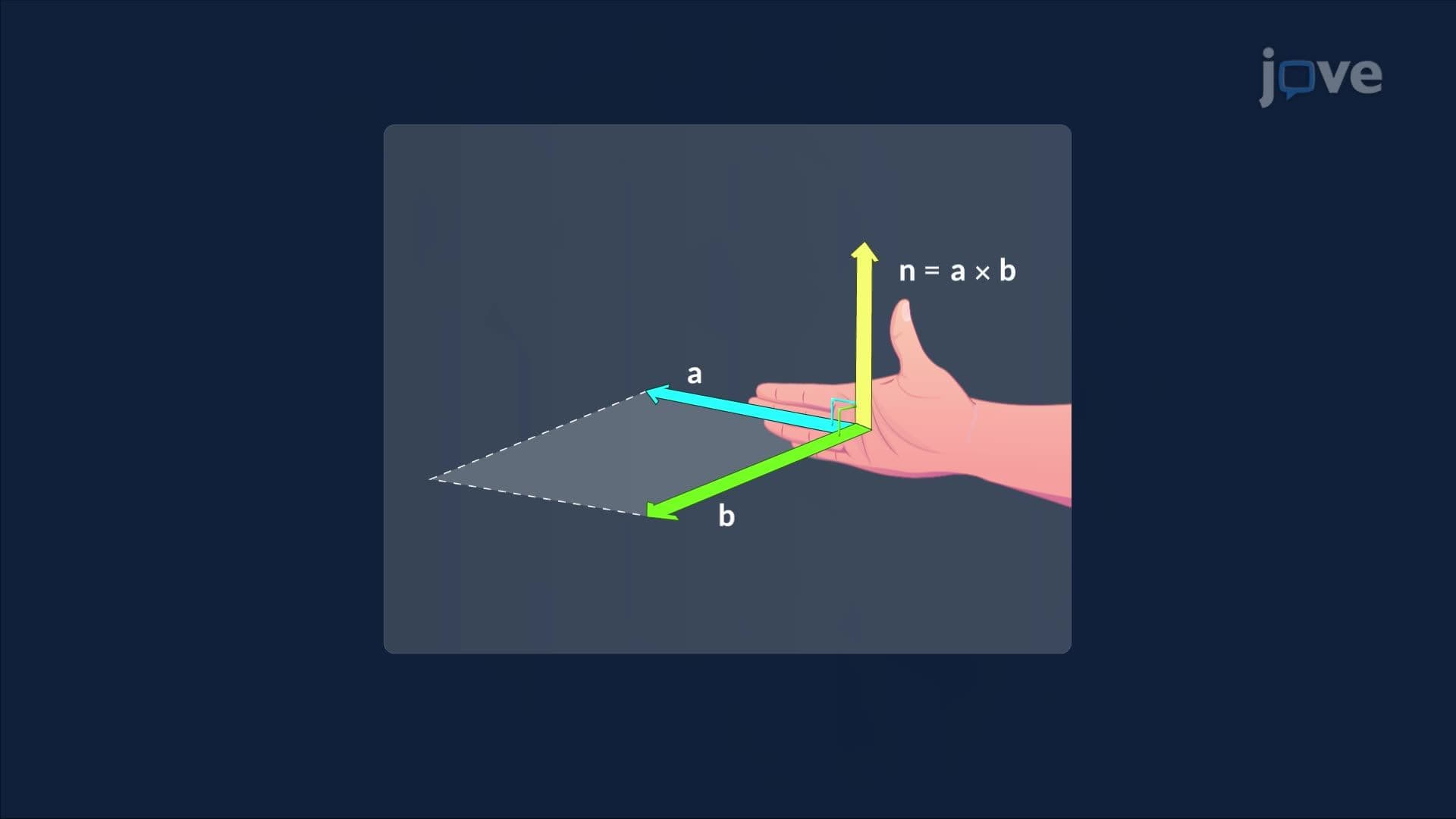
With tension vectors and the weight vector defined, the condition of static equilibrium states that all forces sum to zero. Separating this vector equation into its x, y, and z components produces three scalar equations, a linear system that can be solved using substitution or matrix methods. This approach mirrors techniques tested on AP Physics C and college engineering statics midterms. The dot product helps verify perpendicularity, while the cross product and its geometric interpretation, the magnitude equals the area of the parallelogram formed by two vectors, offer additional analytical tools. Vector projection further allows engineers to isolate how much of a force acts along a specific direction, a concept directly tested in AP Physics and introductory college mechanics courses.
Understanding how to find the angle between two vectors, calculate the distance from a point to a plane, and interpret cross products geometrically are not isolated skills. They interconnect throughout physics, engineering, computer graphics, and robotics. At universities like MIT and Stanford, introductory engineering courses use exactly these vector methods during the first semester. For high school students, this material appears in AP Physics C: Mechanics and forms the backbone of multivariable calculus. Building fluency now creates a strong foundation for every STEM course that follows.
Related Micro-courses