Loading video…


 10 Concepts
 60 views

Video Summary: What are Cylinders in Three Dimensional Space
Did you know the shape of a tunnel or a water pipe can be described by a single mathematical equation? Cylinders in three-dimensional space are surfaces formed when a 2D curve, called a profile curve, is extended along a straight line. A classic US engineering example is a highway tunnel modeled as a parabolic cylinder. Understanding cylinders in three-dimensional space basics unlocks powerful tools in multivariable calculus. Watch the full video on JoVE Coach to master this concept with expert-led visuals and step-by-step explanations.
A cylinder in everyday language brings to mind a soda can. But in multivariable calculus, cylinders in three-dimensional space have a much broader and more powerful meaning. Any surface formed by dragging a 2D curve, called a profile curve, along a fixed straight-line direction is classified as a cylindrical surface. The straight parallel lines that make up the surface are called rulings. This definition means that parabolas, ellipses, and even more complex curves can serve as the profile, generating a wide family of 3D surfaces.
One of the most practical skills in three-dimensional analytic geometry is spotting a cylindrical surface from its equation. In Cartesian coordinates, if one of the three variables, x, y, or z, is completely absent from the equation, the surface is cylindrical, and the missing variable indicates the direction of the rulings.
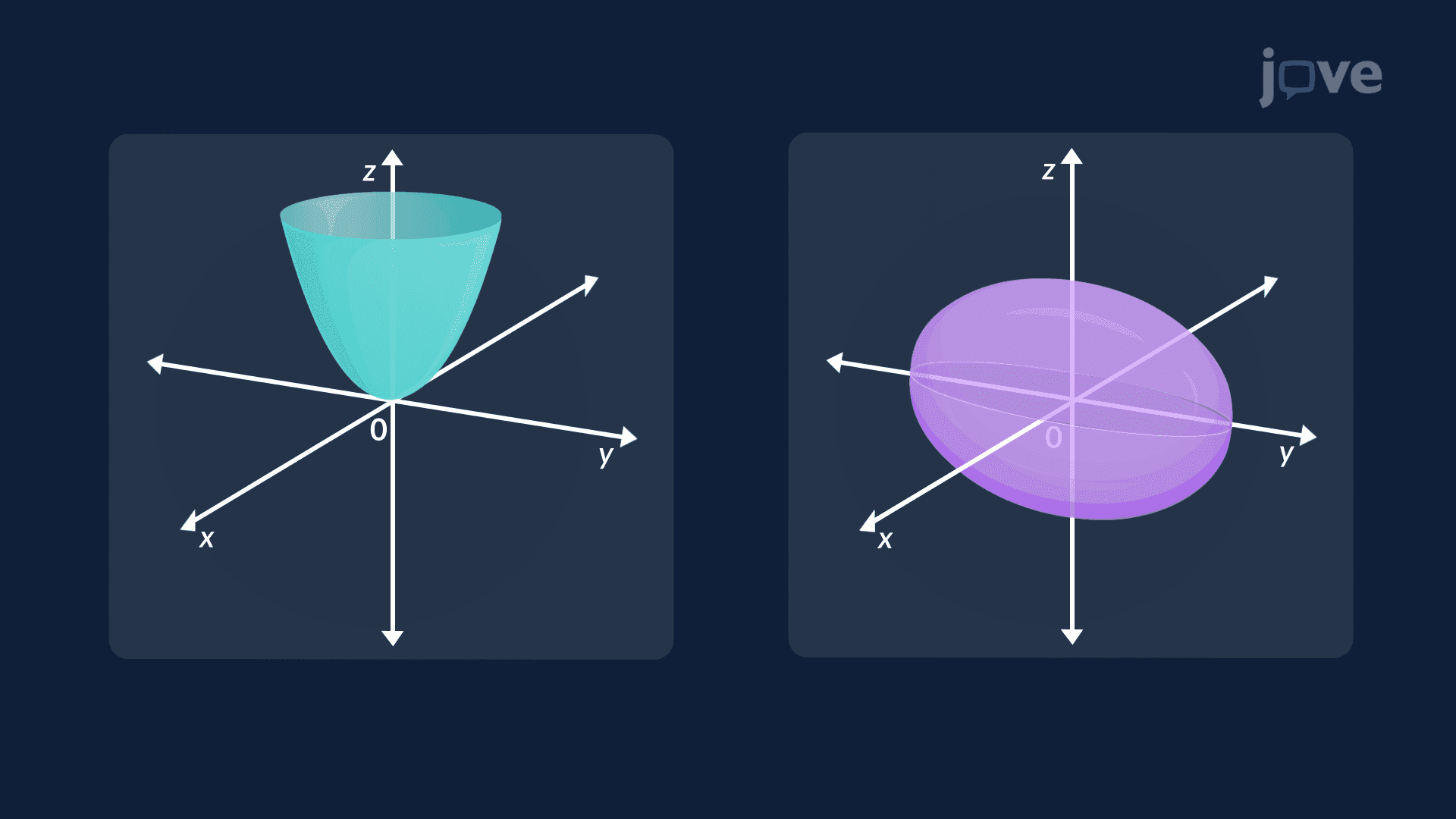
Consider the equation z = y². Since x does not appear, this describes a parabola in the yz-plane that extends infinitely in both the positive and negative x-directions, forming a parabolic cylinder. Similarly, the equation x² + y² = 9, with no z term, describes a circular cylinder whose axis runs along the z-axis. This "missing variable" shortcut is tested regularly in AP Calculus BC and college-level Calculus III courses, where students must classify and sketch surfaces quickly.
Different profile curves produce different families of cylindrical surfaces:
Each type shares the core property that parallel rulings extend infinitely in one direction, which is what makes them cylinders rather than closed surfaces.
US engineers and architects routinely use cylindrical surfaces in parametric modeling software like Revit and AutoCAD. When designing a tunnel for a highway project, such as those found in the Appalachian region of the US, engineers define a cross-sectional curve mathematically, then computationally "extrude" it along the tunnel's length. This is precisely the mathematical process of forming a cylindrical surface. Similarly, circular cylinders model water mains and gas pipes, while parabolic cylinders appear in solar concentrator designs used across the US Southwest.
Mastering cylindrical surfaces builds directly toward deeper topics in multivariable calculus. Understanding rulings connects to parametric equations of a line, since each ruling can be expressed parametrically. Setting up equations of planes that intersect cylindrical surfaces is a common exam task. Later, computing surface area or volume over a cylindrical region requires fluency with dot products, cross products, and eventually double and triple integrals. Students who solidify cylindrical surface concepts early find that topics like vector projection and direction cosines become significantly more intuitive in three-dimensional contexts.
Related Micro-courses