Loading video…


 22 Concepts
 13.3K views

Video Summary: Friedman Two Way Analysis of Explained
Did you know that 68% of Americans report sleep problems, yet traditional statistical tests can't properly analyze mattress preference rankings? Friedman two way analysis of variance offers a powerful solution for comparing related groups when data doesn't meet normal distribution requirements. This non-parametric test ranks responses within each condition, making it perfect for analyzing ordinal data like customer satisfaction ratings across different products. For instance, when sleep researchers at Stanford University compared three mattress brands using the same participants, they used this method to detect significant differences in sleep quality ratings. Watch the full video on JoVE Coach to master this concept with expert-led visuals and step-by-step explanations.
The Friedman Two Way Analysis of Explained serves as a cornerstone non-parametric statistical method for researchers who encounter ordinal data or violations of ANOVA assumptions. Unlike traditional Analysis of Variance, which requires normally distributed data and equal variances, the Friedman test operates on ranks rather than raw scores, making it exceptionally robust for real-world applications.
Consider a pharmaceutical company testing three pain medications using the same patients over different time periods. Patient pain ratings on a 1-10 scale represent ordinal data that rarely follows normal distribution patterns. Traditional ANOVA would be inappropriate here, potentially leading to incorrect conclusions about drug effectiveness. The Friedman test transforms these ratings into ranks within each patient, preserving the relative ordering while eliminating distribution concerns.
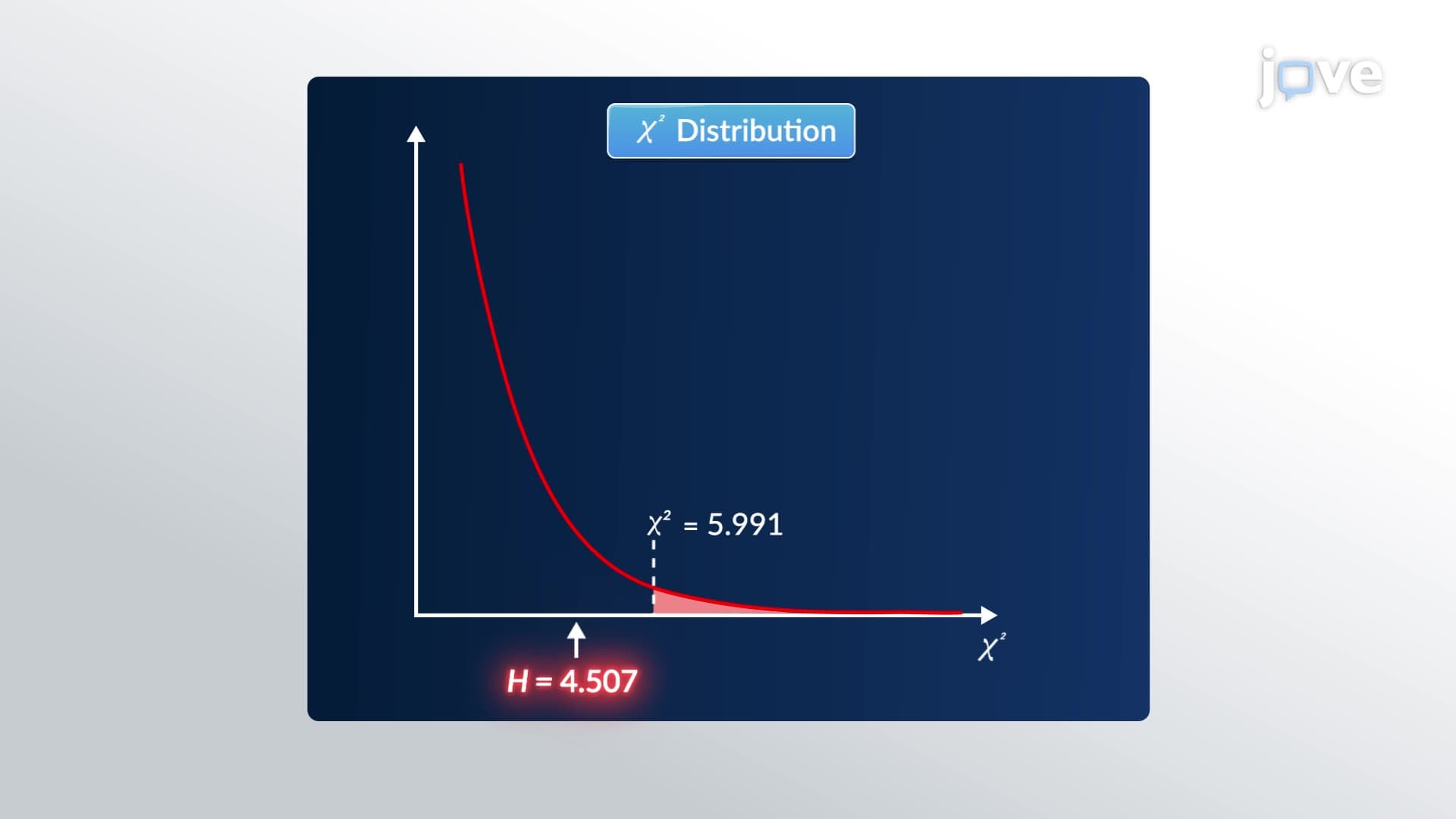
The test's power lies in its systematic ranking approach. For each participant (or block), responses across all conditions receive ranks from 1 to k (where k equals the number of conditions). These ranks then undergo statistical analysis using the Friedman test statistic: Chi-square = [12/(n×k×(k+1))] × Σ(Rank sums)² - 3×n×(k+1), where n represents the number of subjects and k represents the number of conditions.
Market research firms frequently employ this method when analyzing consumer preference rankings across multiple products. For instance, Nielsen Holdings uses similar approaches when evaluating television show preferences among demographic groups. In clinical settings, medical researchers at institutions like Mayo Clinic apply Friedman tests to analyze treatment effectiveness ratings across multiple time points, ensuring robust conclusions despite ordinal measurement scales.
Students preparing for AP Statistics or college-level research methods courses will encounter this test as a crucial alternative to parametric methods. The Friedman test appears regularly on MCAT psychology sections and forms essential knowledge for psychology majors planning graduate research. Understanding when and how to apply non-parametric tests demonstrates statistical sophistication that admissions committees and employers value highly.
Related Micro-courses