Loading video…

 16 Concepts
 3.1K views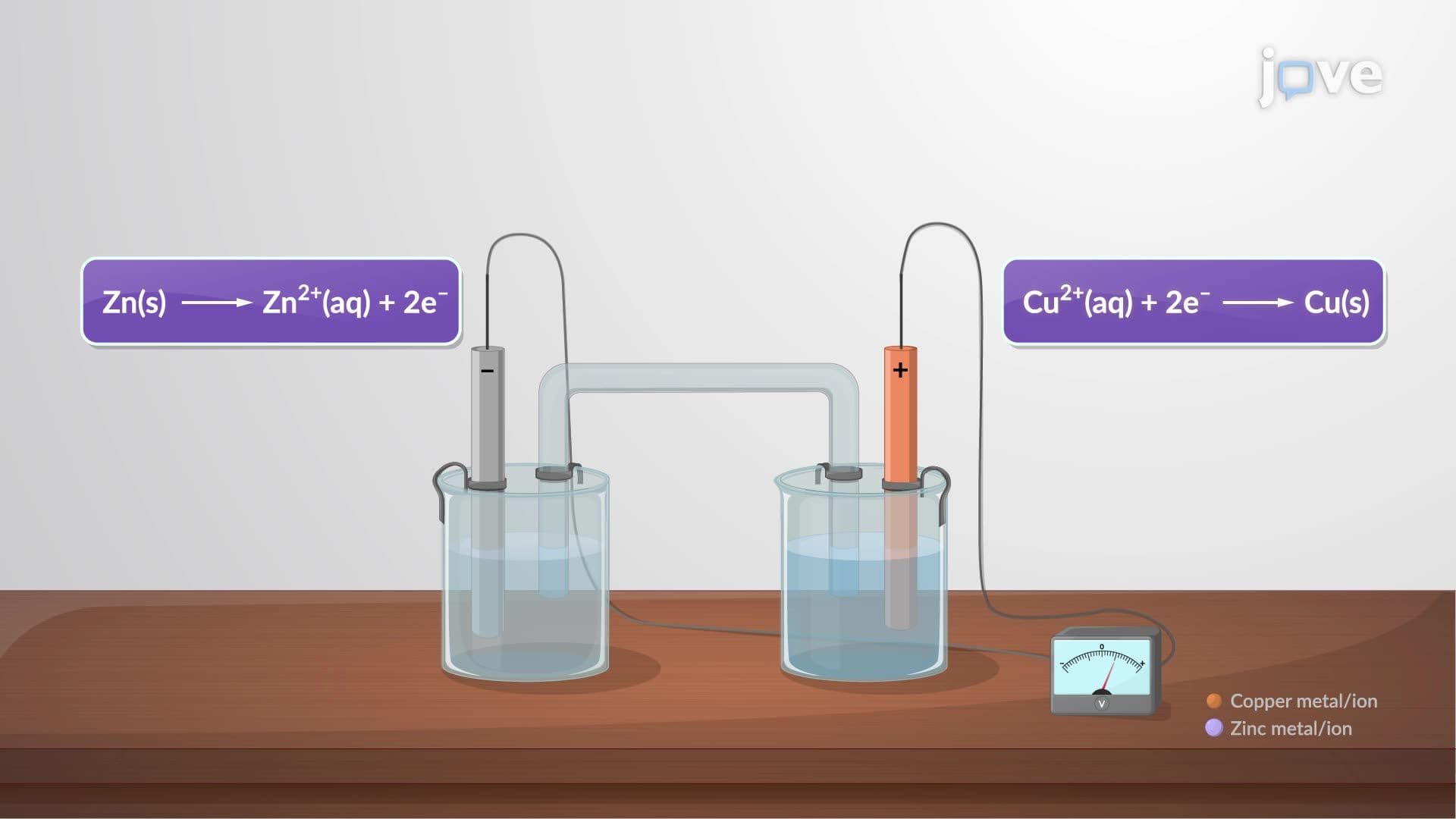

Video Summary: What are Processes at Electrodes
Every time a battery powers your phone or a car's catalytic converter cleans exhaust, processes at electrodes are happening at the atomic scale. Understanding what are processes at electrodes reveals how electrons transfer at solid-liquid interfaces, creating measurable voltages. US engineers designing fuel cells for NASA missions rely on these exact principles. Watch the full video on JoVE Coach to master this concept with expert-led visuals and step-by-step explanations.
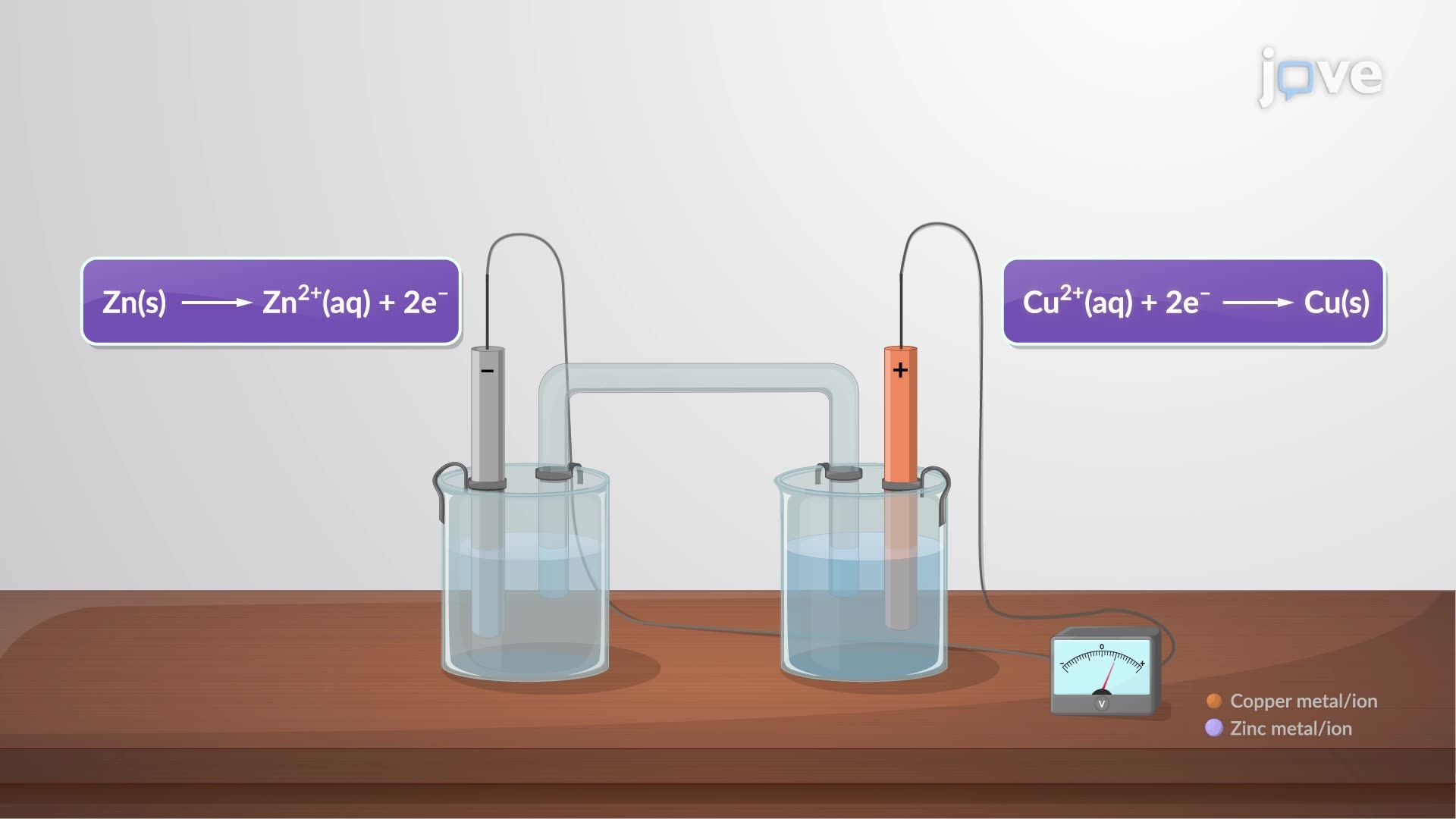
Electrochemical reactions don't happen randomly in a solution, they happen at a precise boundary: the electrode surface. Processes at electrodes describe the oxidation and reduction reactions that occur when a metal electrode contacts an electrolyte solution, transferring electrons and establishing a measurable voltage. Understanding this concept is essential for AP Chemistry students, college-level physical chemistry courses, and MCAT test-takers who encounter electrochemistry as a core topic.
When an electrode is submerged in an electrolyte, ions in solution don't distribute randomly, they organize into structured layers near the surface. The earliest model, the Helmholtz model, described a compact layer of solvated ions sitting just at the electrode surface, behaving like a parallel-plate capacitor. However, this model oversimplified reality.
The Gouy-Chapman model improved on this by introducing a *diffuse double layer*, a region where ion concentration gradually tapers off as distance from the electrode increases, influenced by thermal motion. Neither model was perfect alone. The Stern model unified both: it features a rigid inner layer (the Stern layer) of specifically adsorbed ions right at the surface, followed by the diffuse Gouy-Chapman layer extending into the bulk solution. This layered architecture directly relates to topics like adsorption isotherms and surface defects studied in surface chemistry and materials science courses across US universities.
The Galvani potential difference is the potential measured between the bulk metal electrode and the bulk electrolyte solution. At equilibrium, meaning no current is flowing, this value equals the electrode potential, E. This is the reference state you encounter when memorizing standard reduction potentials in AP Chemistry or on the MCAT electrochemistry section.
When an external voltage is applied and the system is pushed away from equilibrium, the Galvani potential no longer equals E. The difference is called the overpotential (η), defined as:
η = E(applied) − E(equilibrium)
A positive overpotential drives anodic (oxidation) reactions; a negative overpotential drives cathodic (reduction) reactions. In practical US applications, such as industrial electrolysis facilities in states like Texas and Louisiana that produce chlorine and hydrogen gas, minimizing overpotential is critical to reducing energy costs.
Current density (j) measures how fast electron transfer occurs per unit area of the electrode surface. It equals the difference between the anodic current density (j(a)) and the cathodic current density (j(c)):
j = j(a) − j(c)
When j(a) exceeds j(c), the net reaction is oxidation; when j(c) exceeds j(a), net reduction occurs. The Butler-Volmer equation mathematically captures this balance, relating j to η through exponential terms that account for the energy barriers of both forward and reverse electron transfer processes. This equation appears in college physical chemistry textbooks such as Atkins' *Physical Chemistry*, widely used at US institutions, and is a key concept for students pursuing materials science, chemical engineering, or biochemistry. Mastering it builds directly toward understanding more advanced topics like X-ray crystallography of electrode surfaces and crystal structure determination in solid-state chemistry.
Related Micro-courses