Loading video…

 22 Concepts
 8.4K views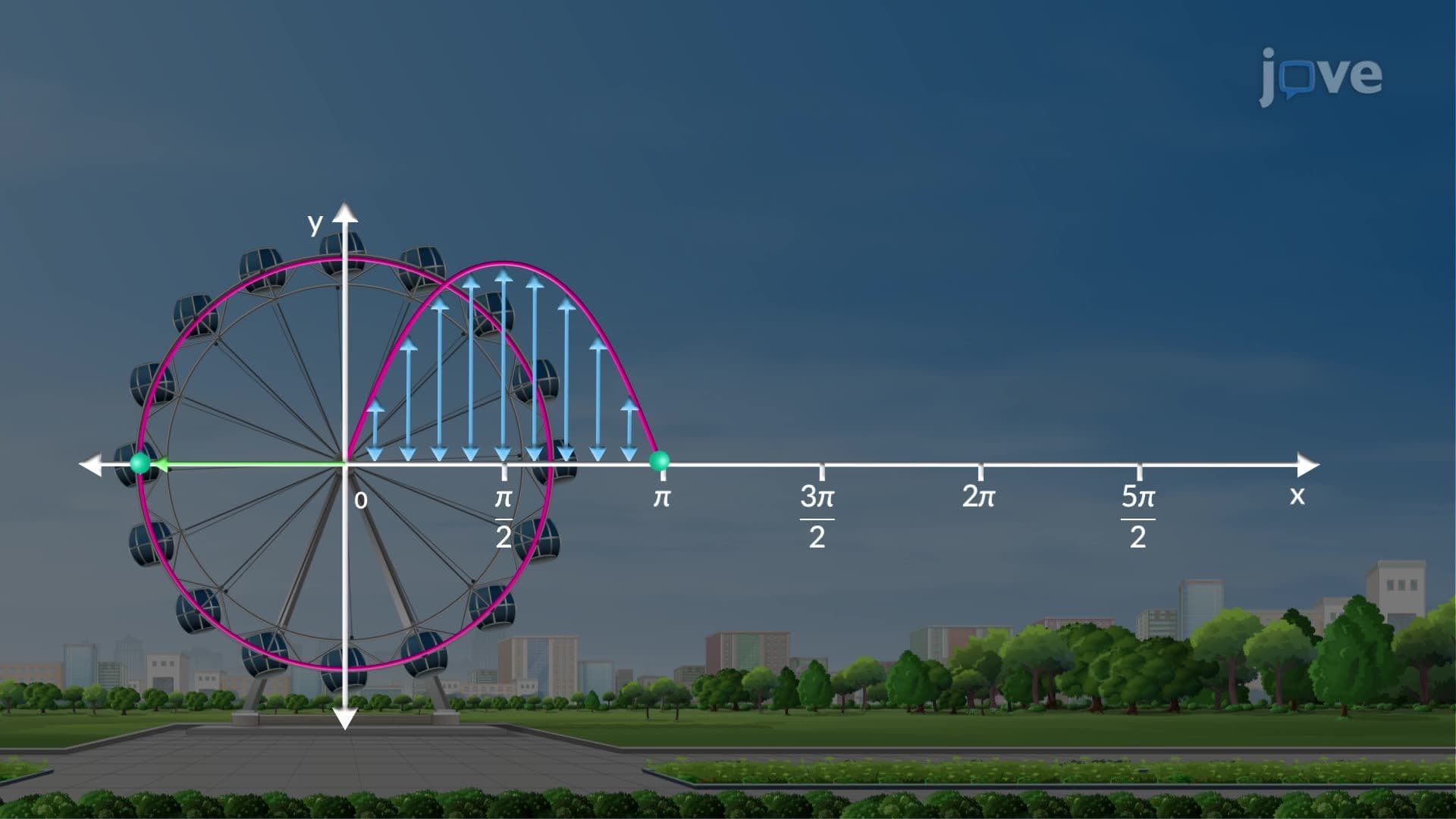

Video Summary: Derivatives of the Trigonometric Functions Explained
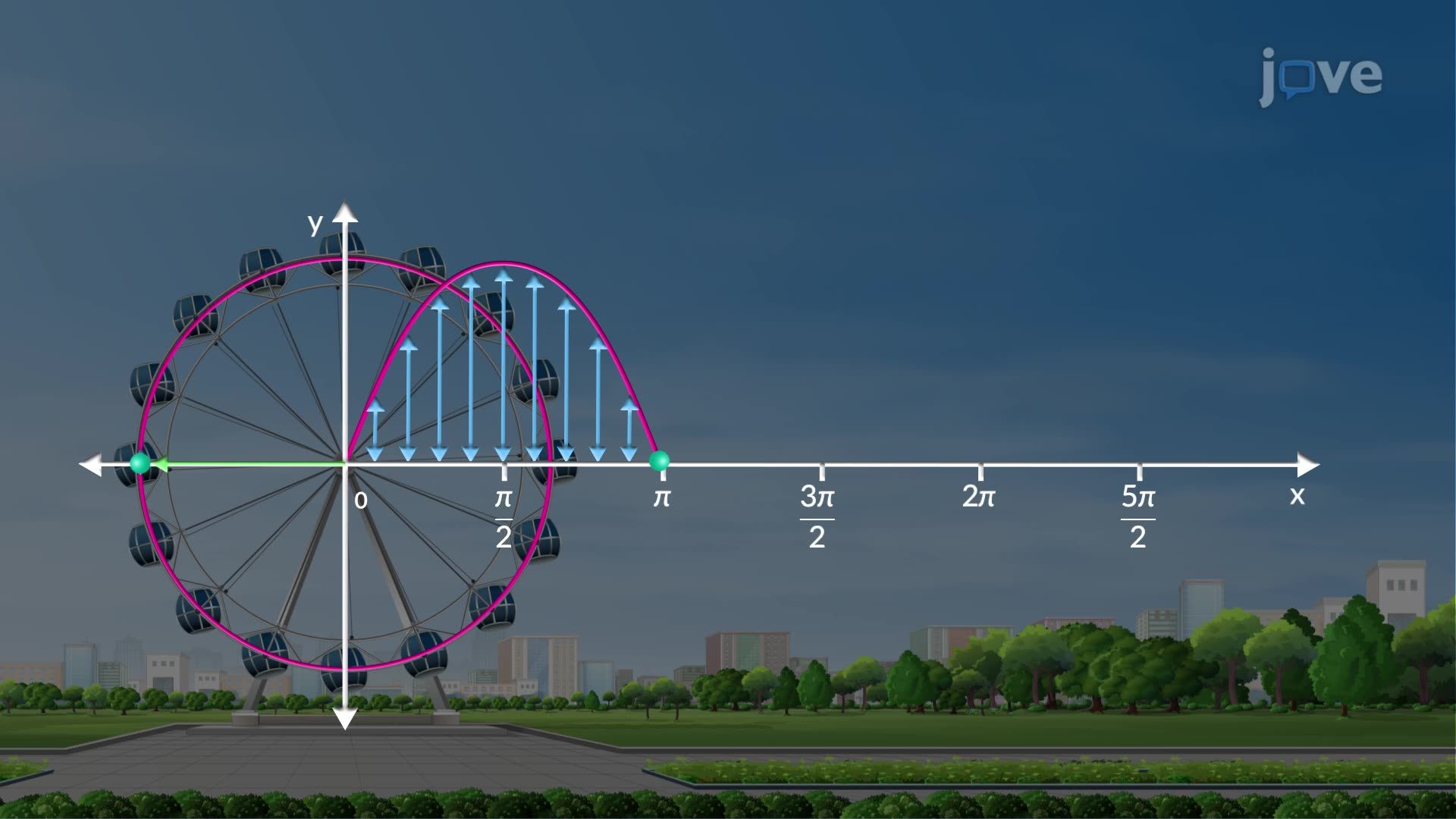
Did you know a Ferris wheel at Disney World mathematically models the derivative of sine? Understanding the derivatives of the trigonometric functions is essential for mastering calculus, from AP Calculus AB to college-level STEM courses. These derivatives, including d/dx(sin x) = cos x and d/dx(tan x) = sec²x, explain how oscillating systems change in real time. Watch the full video on JoVE Coach to master this concept with expert-led visuals and step-by-step explanations.
Trigonometric functions describe everything that repeats, heartbeats, alternating electrical current, ocean tides, and the swing of a pendulum. Once you move from simply evaluating these functions to differentiating them, you gain the mathematical power to describe *how fast* those repeating patterns change at any given moment. In AP Calculus AB and BC, college calculus (Calc 1 and Calc 2), and even physics-based courses at US universities, trig derivatives appear in virtually every unit on related rates, motion, and optimization.
The derivative of sin x is not just a memorized fact, it is a result that comes directly from the limit definition of the derivative. Starting with the expression [sin(x + h) − sin x] / h and expanding sin(x + h) using the angle addition identity gives:
[sin x · cos h + cos x · sin h − sin x] / h
Rearranging and grouping:
sin x · (cos h − 1)/h + cos x · (sin h)/h
As h → 0, two fundamental limits resolve the expression: (cos h − 1)/h approaches 0, and (sin h)/h approaches 1. The result is clean and powerful: d/dx(sin x) = cos x. Applying the same process to cosine yields d/dx(cos x) = −sin x. These two results form the foundation for all other trig derivatives and are frequently tested on AP Calculus free-response questions.
Because tan x = sin x / cos x, its derivative requires the quotient rule: d/dx [f/g] = (g · f' − f · g') / g². Plugging in f = sin x and g = cos x:
d/dx(tan x) = (cos x · cos x − sin x · (−sin x)) / cos²x = (cos²x + sin²x) / cos²x = 1 / cos²x = sec²x
This derivation uses the Pythagorean identity sin²x + cos²x = 1 and is a model example of how algebraic manipulation and trigonometric identities work together. Students often ask when to use the quotient rule vs. the product rule, the quotient rule applies directly to ratios, while rewriting the ratio as a product (sin x · (cos x)^(−1)) makes the product rule plus chain rule an equally valid strategy.
Once you have the basic six trig derivatives, the chain rule unlocks a much larger family of problems. For example, d/dx[sin(3x)] = cos(3x) · 3 = 3cos(3x), because the outer function is sin(u) and the inner function is u = 3x. The chain rule is indispensable for composite trig expressions that appear regularly on AP Calculus BC exams and college midterms.
Higher-order derivatives of sine and cosine follow a cyclical pattern every four steps:
This cycle is directly testable on AP exams, where students may be asked for the 47th or 100th derivative of sine. Recognizing the pattern (remainder when dividing the order by 4) turns a seemingly impossible problem into a straightforward one.
In US engineering and physics programs, trig derivatives model phenomena like simple harmonic motion, the position of a mass on a spring described by x(t) = A·sin(ωt) has velocity v(t) = Aω·cos(ωt), a direct application of differentiating sine with the chain rule.
Related Micro-courses