Loading video…

 22 Concepts
 8.4K views

Video Summary: What are Hyperbolic Functions
Did you know the graceful curve of a suspension bridge cable follows a precise mathematical equation? Hyperbolic functions are the key to describing that shape. These special combinations of exponential functions power real-world engineering designs across US infrastructure, from the Golden Gate Bridge to stadium roofs. Understanding What are Hyperbolic Functions? unlocks a powerful branch of calculus. Watch the full video on JoVE Coach to master this concept with expert-led visuals and step-by-step explanations.
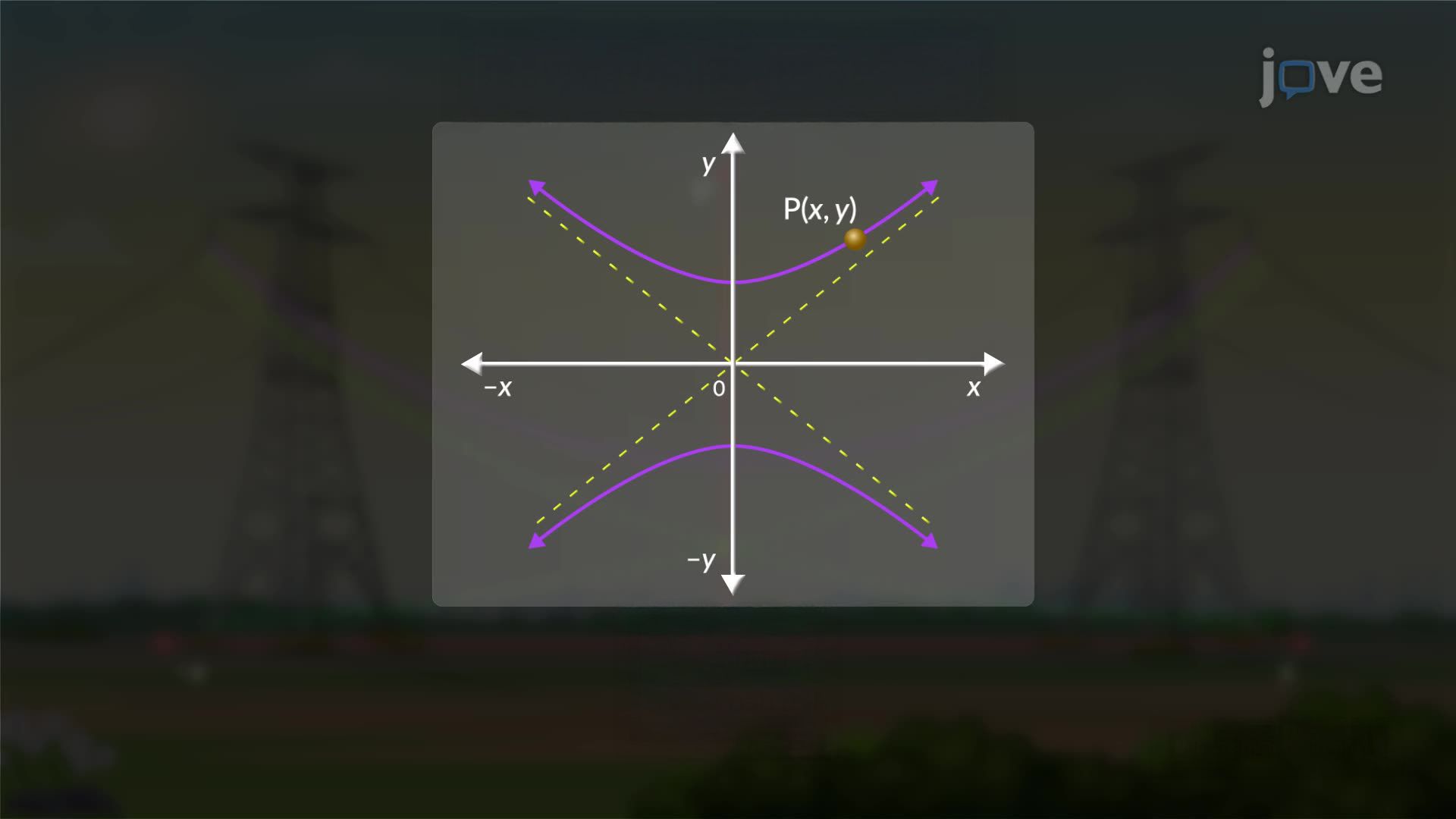
Hyperbolic functions are a family of functions built from combinations of the natural exponential functions eˣ and e⁻ˣ. They are named for their geometric relationship to the hyperbola, exactly as sine and cosine relate to the unit circle, sinh and cosh parametrize the unit hyperbola. This parallel structure is not just aesthetic; it produces a rich set of identities and calculus rules that mirror trigonometric behavior while revealing distinct properties. For students in AP Calculus BC or college-level Calculus II courses, hyperbolic functions frequently appear on exams and in real engineering contexts.
The three fundamental hyperbolic functions are defined using exponential expressions:
Notice that cosh(x) is an even function, its graph is symmetric about the y-axis and has a minimum value of 1 at x = 0. The sinh(x) function is odd, passing through the origin and growing steeply in both directions. The tanh(x) function produces a smooth S-shaped curve bounded between −1 and 1, approaching horizontal asymptotes at y = 1 and y = −1. These graph features are commonly tested on college midterms and AP Calculus BC free-response questions.
One of the most important reasons hyperbolic functions appear in calculus courses is because their derivatives follow clean, memorable patterns:
When hyperbolic functions are composed with other functions, for example, sinh(3x²), students must apply the chain rule: differentiate the outer hyperbolic function, then multiply by the derivative of the inner function. Similarly, expressions like sinh(x) · cosh(x) require the product rule, and ratios involving hyperbolic functions call for the quotient rule. Mastery of these derivative rules is essential for AP Calculus BC, college Calculus II, and engineering coursework at US universities.
The most iconic real-world example of hyperbolic functions is the catenary curve, the shape formed by a freely hanging cable or chain suspended at two endpoints. The catenary is described precisely by y = a · cosh(x/a), where the parameter *a* depends on the cable's weight and tension. Civil engineers at firms designing structures like the Verrazano-Narrows Bridge or electrical power lines across the US rely on this equation to calculate cable length, sag, and load distribution accurately.
Beyond engineering, hyperbolic functions appear in special relativity (describing relativistic velocity addition), heat transfer equations, and fluid dynamics, all topics encountered in advanced US university physics and engineering programs. Students preparing for the MCAT will also encounter hyperbolic-like exponential behavior in biochemistry and pharmacokinetics contexts, making this foundational knowledge broadly applicable.
Related Micro-courses