Loading video…


 22 Concepts
 8.4K views

Video Summary: Second Derivatives of Implicit Functions Explained
Did you know the graceful curve of a bridge arch can be described by an equation where height and width are inseparably linked? Understanding second derivatives of implicit functions unlocks how mathematicians measure curvature in these real-world structures. This concept, central to Second Derivatives of Implicit Functions Explained, builds on implicit differentiation to reveal whether a curve bends upward or downward at any point. Watch the full video on JoVE Coach to master this concept with expert-led visuals and step-by-step explanations.
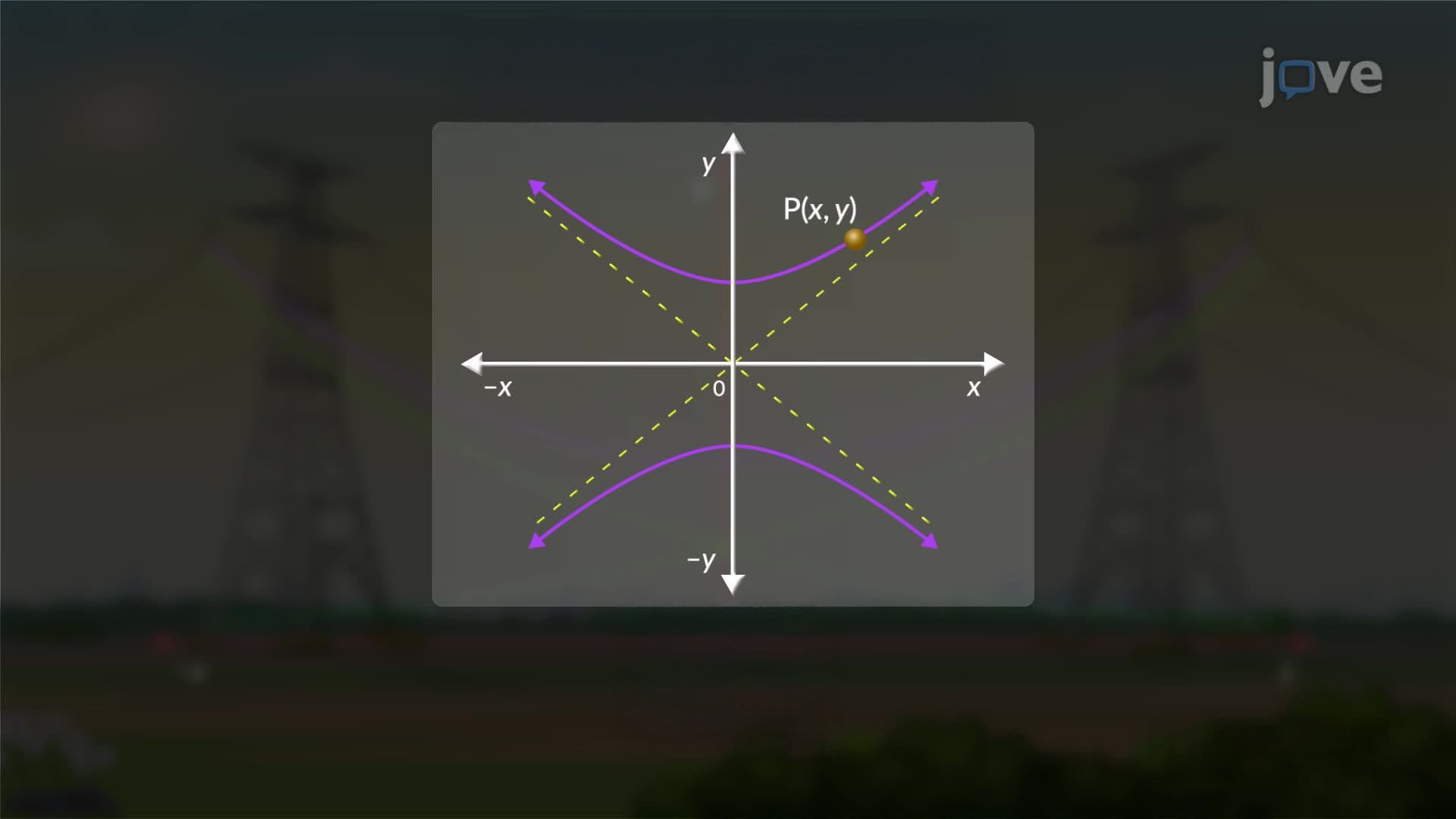
Most functions you encounter early in algebra are explicit, y is written directly in terms of x. But many real-world curves, including ellipses, circles, and certain engineering profiles, cannot be neatly separated that way. An ellipse used to model a pedestrian bridge arch, for example, mixes x and y in a single equation. This is where implicit differentiation becomes essential, and finding the second derivative of an implicit function takes that analysis one powerful step further.
When differentiating an implicit equation like an ellipse, y is treated as a function of x even though it is never isolated. The chain rule must be applied every time y appears, because y depends on x. The result is an expression for dy/dx, the first derivative, that contains both x and y. This is normal and expected. On the AP Calculus AB and BC exams, students are regularly asked to find dy/dx through implicit differentiation, making fluency with this step critical for exam success.
To find d²y/dx², differentiate the first derivative expression once more with respect to x. Since dy/dx is typically a fraction with expressions involving x and y in both the numerator and denominator, the quotient rule is the appropriate tool here. This process produces a new expression that still contains dy/dx inside it. Many students find this the trickiest step, because the result looks unfinished, and that is intentional. The next step resolves it.
Once the raw second derivative expression is written, substitute the full dy/dx expression back in to eliminate it. This transforms the second derivative into terms of x and y only. Then, use the original implicit equation as an algebraic identity. For the ellipse, rearranging the ellipse equation provides a substitution that dramatically simplifies the numerator. This technique, leveraging the original constraint equation, is a hallmark of implicit differentiation problems and appears frequently in college-level Calculus II courses across US universities.
A positive second derivative indicates concave-up curvature, while a negative second derivative signals concave-down curvature. For a bridge arch modeled as an ellipse, engineers at firms like AECOM or in civil engineering programs at universities such as MIT and Georgia Tech use this kind of curvature analysis to assess how load forces distribute along a structure. On the AP Calculus BC exam and college midterms, interpreting concavity from the second derivative is a core skill. Understanding whether a curve is bending toward or away from a reference axis has direct implications in physics, structural mechanics, and optimization problems. Mastering this concept also builds a strong foundation for exploring higher-order derivatives and advanced topics like curvature formulas and differential equations.
Related Micro-courses