Loading video…

 17 Concepts
 107 views

Video Summary: Triple Integrals in Rectangular Coordinates Explained
How do engineers calculate the total mass of a complex metal component used in aerospace manufacturing? Triple integrals in rectangular coordinates basics make this possible by accumulating a three-variable function across an entire three-dimensional region. NASA engineers, for instance, use this concept to model mass distribution in structural components. Watch the full video on JoVE Coach to master this concept with expert-led visuals and step-by-step explanations.
A triple integral extends the logic of single and double integrals into three dimensions. Just as a definite integral sums infinitely thin slices along one axis, and a double integral accumulates values across a flat region, a triple integral accumulates a function f(x, y, z) across a full three-dimensional solid. The result can represent physical quantities like total mass, electric charge density, or probability across a 3D space, depending on what the function describes. This concept is a cornerstone of Calculus III, taught at colleges and universities across the United States, and forms the mathematical backbone of many engineering and physics applications.
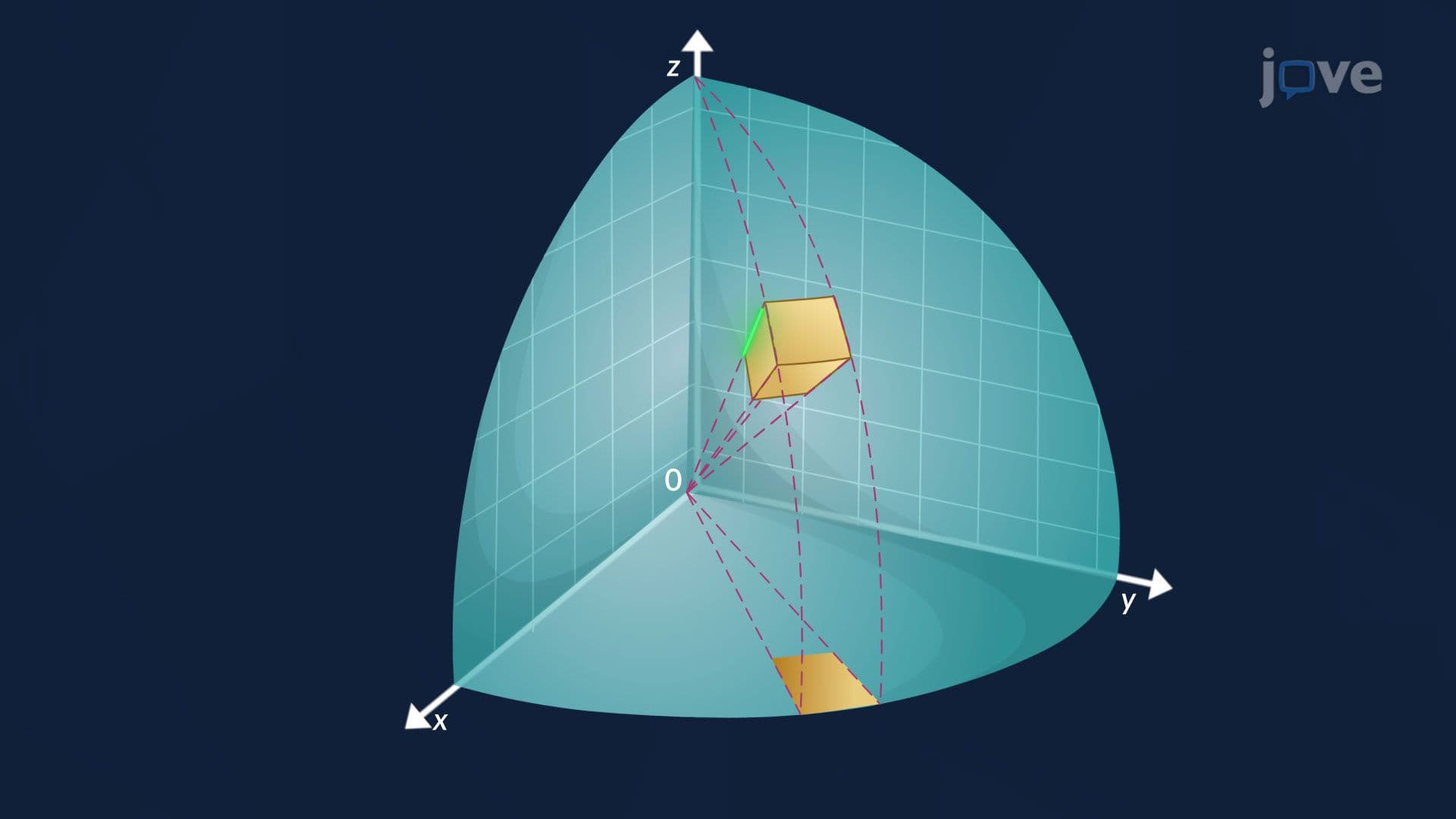
The formal definition of a triple integral begins with partitioning. Imagine slicing a rectangular solid region into many small boxes. Each tiny box has dimensions Δx, Δy, and Δz, giving it a volume ΔV = Δx · Δy · Δz. Choose a sample point (x*, y*, z*) inside each box, evaluate f(x*, y*, z*) there, and multiply by ΔV. Summing these products across all sub-boxes produces a triple Riemann sum. As the number of sub-boxes increases and each box shrinks toward zero, this sum converges to the triple integral, written as the integral of f(x, y, z) dV over the region R. This limiting process mirrors how scientists model continuous physical distributions from discrete measurements.
Computing a triple integral directly from its limit definition is impractical. Instead, it is evaluated as an iterated integral, three successive single-variable integrations performed from the inside out. For a rectangular box where x runs from a to b, y from c to d, and z from e to f, the triple integral becomes: integrate from a to b, integrate from c to d, integrate from e to f of f(x, y, z) dz dy dx.
Fubini's Theorem guarantees that for a continuous function over a well-defined bounded region, any of the six possible orders of integration (dz dy dx, dx dz dy, dy dx dz, and so on) will yield the same numerical result. This flexibility is enormously useful, students can choose the order that makes the algebra cleanest. This theorem is heavily tested in college Calculus III courses, appears in AP Calculus BC preparatory work at advanced levels, and is essential knowledge for STEM majors at US universities such as MIT, UCLA, and Georgia Tech.
Triple integrals in rectangular coordinates appear across multiple professional fields. In mechanical engineering, calculating the center of mass of a solid object, critical for designing stable aircraft or spacecraft at companies like Boeing or SpaceX, requires a triple integral of density over the object's volume. In medical physics, radiation dose calculations across a three-dimensional tissue region rely on integrating a dose-distribution function over volume. In data science and probability, triple integrals compute joint probabilities for three continuous random variables, a technique used in actuarial science programs at US universities. Even environmental engineers use volume integrals to model pollutant concentrations distributed through soil or groundwater in three dimensions. Mastering this concept in rectangular coordinates first builds the intuition needed to later tackle the same problems in cylindrical and spherical coordinates, which often simplify integration over curved regions.
Related Micro-courses