Loading video…

 17 Concepts
 107 views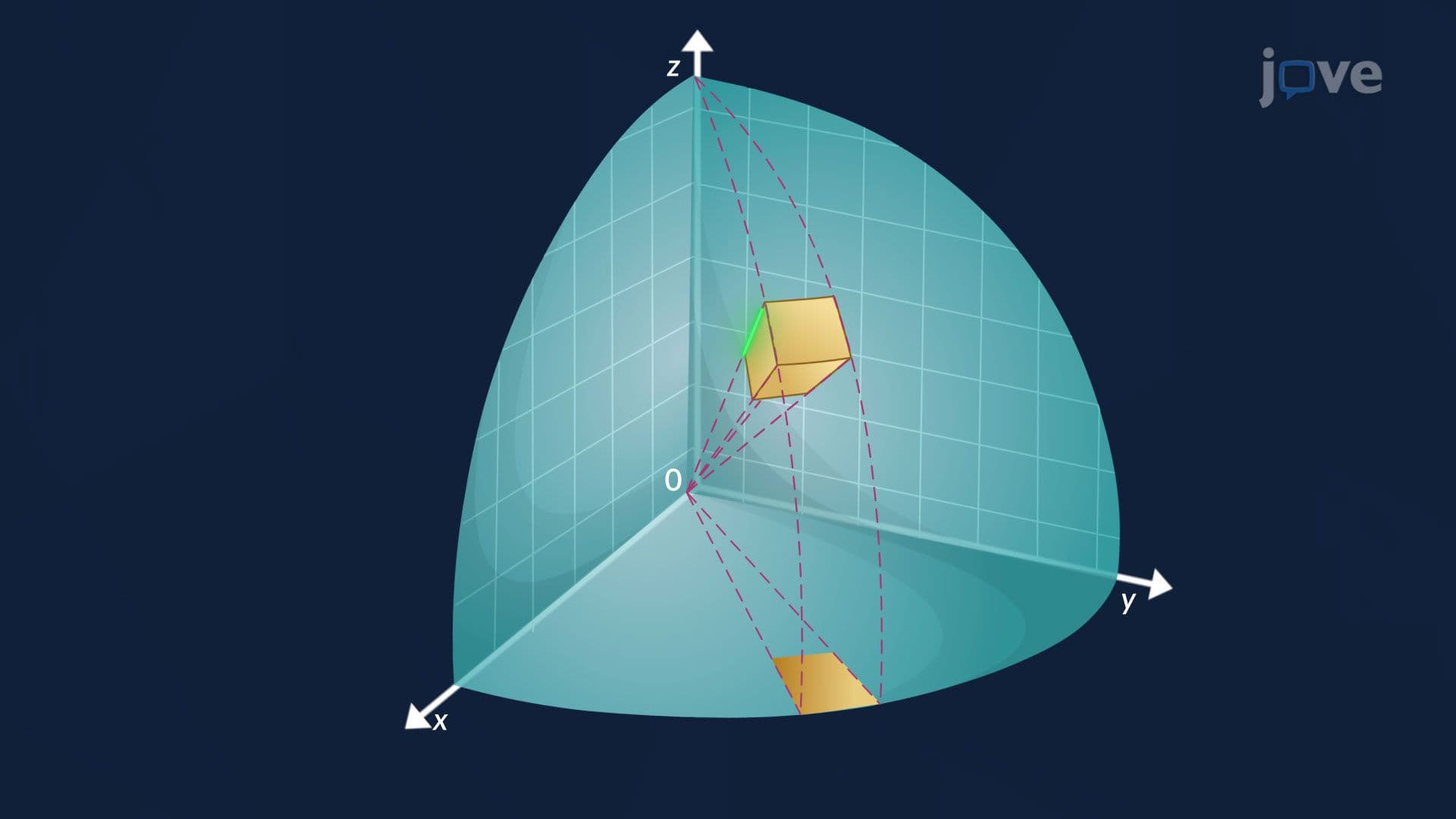

Video Summary: Triple Integrals in Spherical Coordinates Explained
Ever wonder how NASA engineers calculate the volume of a spherical fuel tank or how physicists model gravitational fields around a planet? Triple integrals in spherical coordinates make these calculations possible. This technique describes every point in 3D space using distance (rho), polar angle (theta), and vertical angle (phi), elegantly handling objects with central symmetry. Watch the full video on JoVE Coach to master this concept with expert-led visuals and step-by-step explanations.
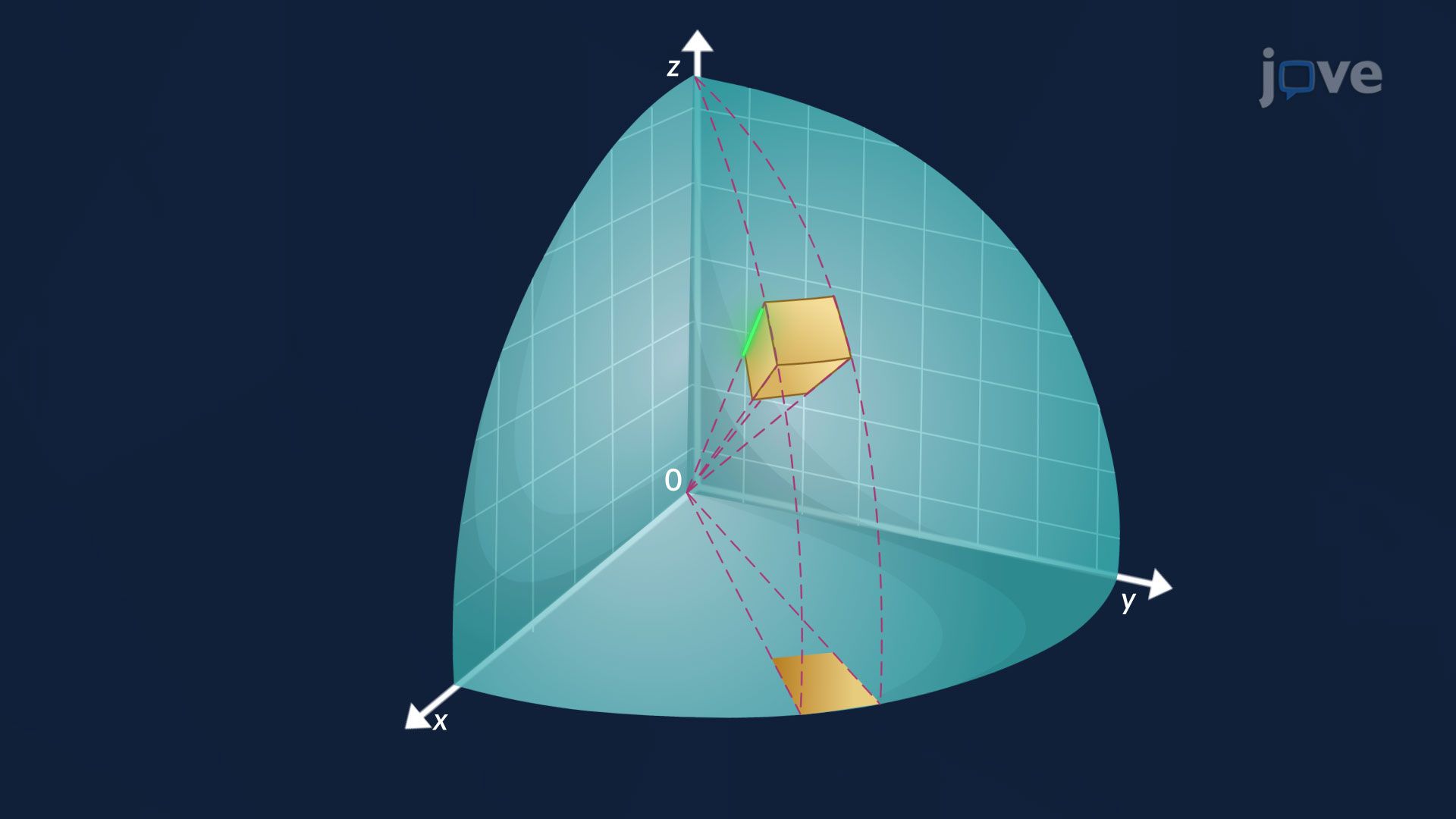
When a 3D object has central symmetry, meaning it looks the same from every direction around a central point, setting up a triple integral in Cartesian coordinates becomes unnecessarily complicated. Spherical coordinates simplify the problem dramatically. Instead of using x, y, and z, every point in space is located using three values: rho (radial distance from the origin), theta (rotation angle in the xy-plane measured from the positive x-axis), and phi (angle measured downward from the positive z-axis). This system mirrors how radar stations at US Air Force bases track aircraft, measuring distance and two angles to pinpoint any object in 3D space.
One of the most important steps when working with triple integrals in spherical coordinates is correctly writing the volume element. In Cartesian coordinates, the tiny volume piece is simply dx dy dz. In spherical coordinates, this element becomes rho-squared times sin(phi) times d(rho) d(phi) d(theta). This conversion factor, rho-squared times sin(phi), is the Jacobian of the coordinate transformation. The Jacobian accounts for the fact that spherical coordinate "boxes" are not uniform in size; they stretch and compress depending on their position. Forgetting the Jacobian is one of the most common errors students make on college calculus midterms, so building the habit of writing it every time is critical.
Getting the limits right is where most students invest the most effort. For a complete sphere of radius R centered at the origin, rho runs from 0 to R, phi sweeps from 0 to pi (top to bottom of the sphere), and theta completes a full rotation from 0 to 2pi. For a hemisphere, phi only runs from 0 to pi/2. For a spherical shell, like the outer layer of a planet's atmosphere modeled by US meteorologists, rho runs between two positive values, say R1 to R2, while phi and theta keep their full ranges. Visualizing the sweep of each variable separately before writing the integral helps prevent limit errors.
Triple integrals in spherical coordinates appear throughout college-level STEM curricula. In Calculus III courses at universities across the US, students use this technique to compute volumes, masses, and centers of mass for spherically symmetric objects. In physics, the same integrals calculate electric field strengths inside charged spheres, a direct application of Gauss's Law taught in AP Physics C and university physics courses. Engineers modeling heat transfer through spherical reactor cores at facilities like Oak Ridge National Laboratory in Tennessee rely on the same mathematical framework. On AP Calculus BC, students encounter related ideas through polar coordinates integration, building the intuition they need before tackling full spherical coordinate problems in college. For students heading into STEM majors, mastering this topic also lays the groundwork for understanding iterated integrals, calculating volume with multiple integrals, and eventually tackling more advanced topics like center of mass using multiple integrals or charge density distributions in electromagnetism.
Related Micro-courses