Loading video…

 16 Concepts
 51 views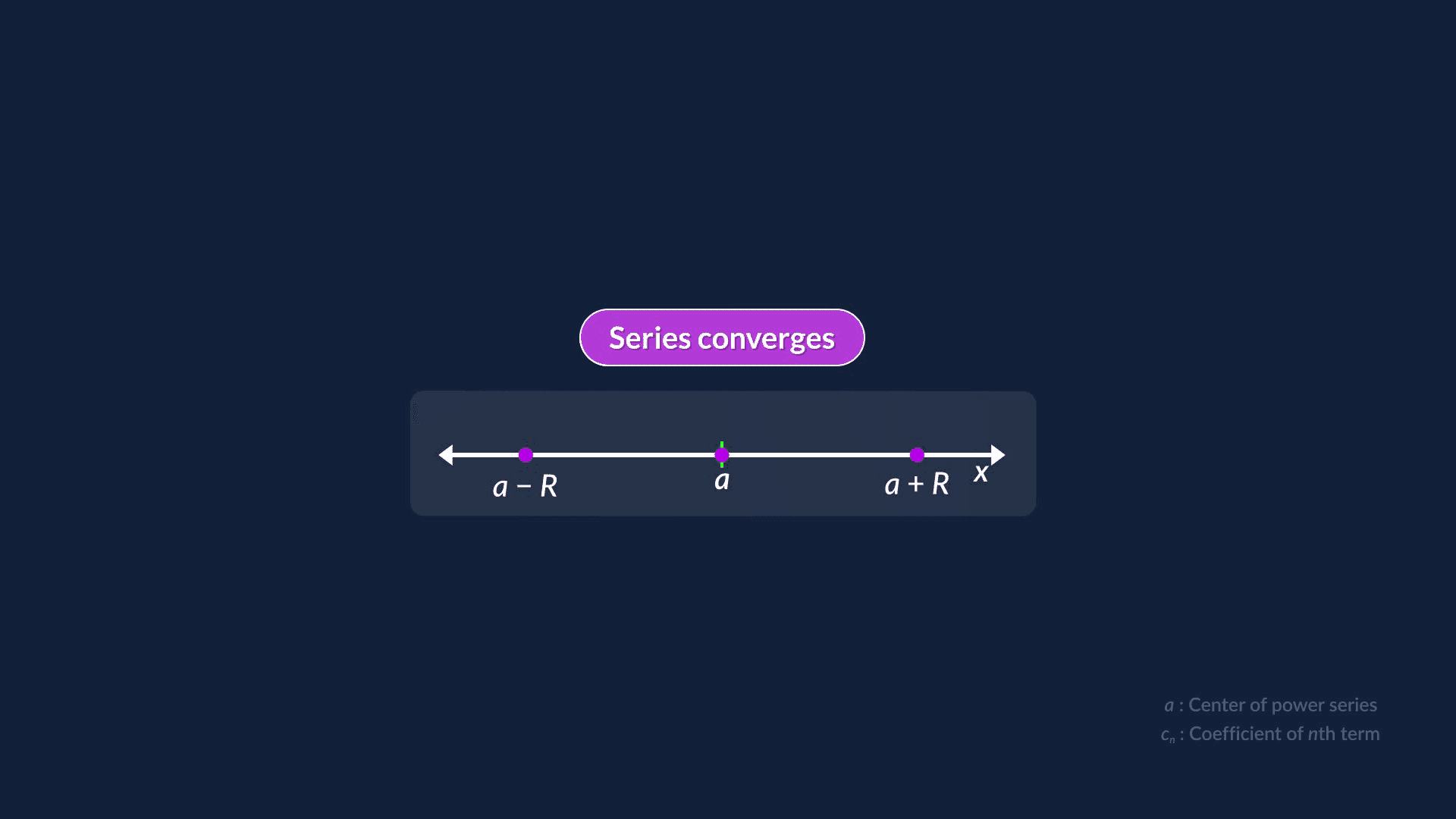

Video Summary: Interval and Radius of Convergence Explained
Did you know that not every mathematical series works for all values of x, only a specific range keeps it valid? Understanding interval and radius of convergence is essential for working with power series in calculus. Engineers at NASA, for example, use convergent series approximations in trajectory calculations. Interval and Radius of Convergence Explained breaks down exactly how to find that valid range and its distance from center. Watch the full video on JoVE Coach to master this concept with expert-led visuals and step-by-step explanations.
A power series is a powerful mathematical tool that rewrites functions as infinite sums of terms involving powers of (x − c), where c is the center. But unlike polynomials, a power series does not automatically work for every value of x. The interval and radius of convergence define exactly where the series behaves reliably, producing a finite, meaningful result, and where it breaks down entirely.
This concept is a cornerstone of Calculus BC, college Calculus II courses, and appears frequently on AP exams and university midterms across the United States.
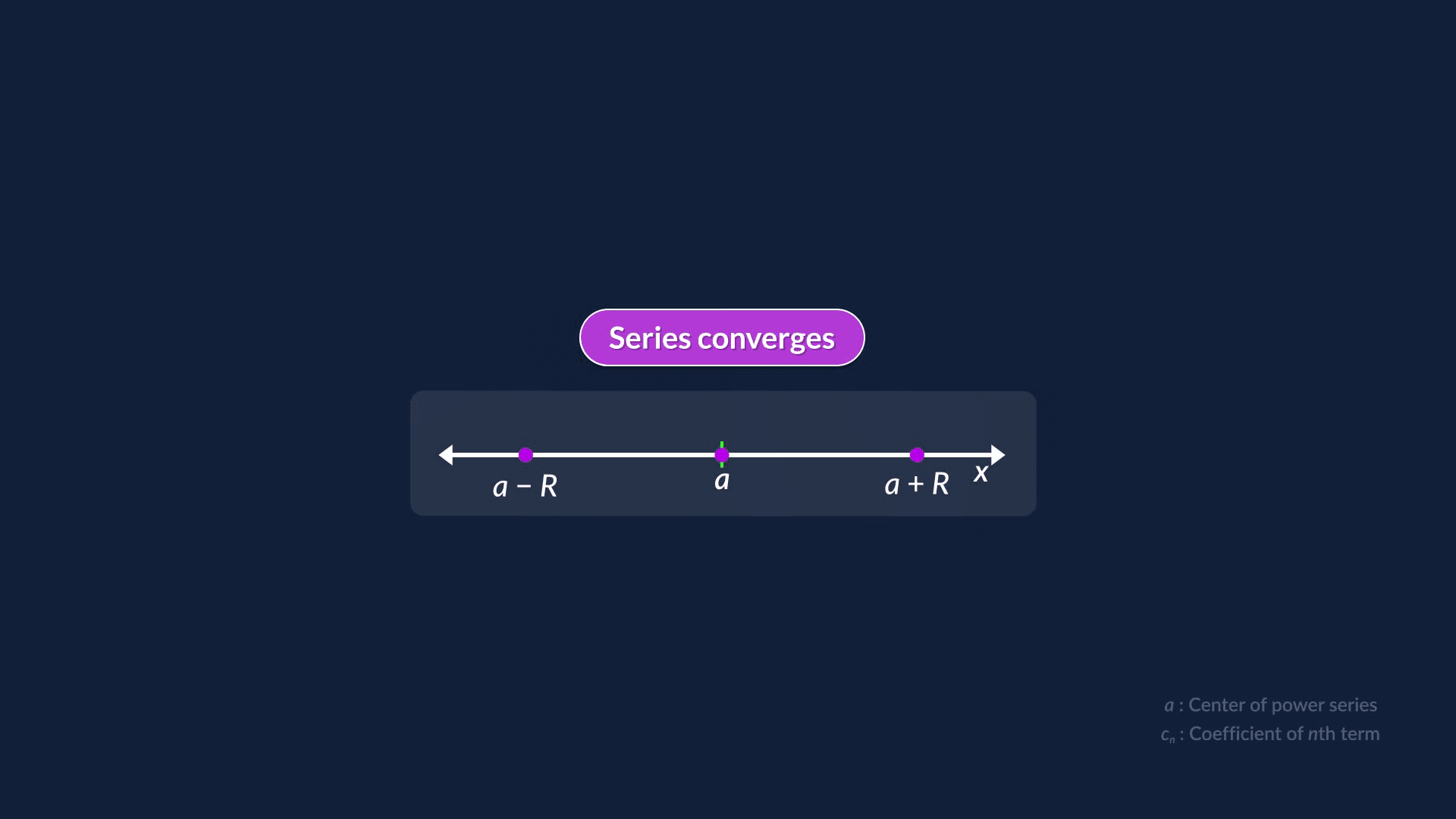
Every power series falls into one of three convergence scenarios:
1. Converges only at the center (x = c): The series collapses to a single point and is practically useless as a function approximation. The radius of convergence here is R = 0. 2. Converges for all real numbers: The series works for every value of x, giving an interval of convergence of (−∞, +∞). The radius of convergence is R = ∞. The Taylor series for sin(x) and e^x are classic examples. 3. Converges on a finite interval: The series only works within a bounded range centered at c. This is the most common exam scenario and requires careful analysis of both the interval and its endpoints.
Understanding which case applies is the first step in any convergence problem.
The Ratio Test is the standard method for determining the radius of convergence. You compute the limit of the absolute value of the ratio of consecutive terms: lim(n → ∞) |a(n+1) / a(n)|. If this limit equals L · |x − c|, you set L · |x − c| < 1 and solve for |x − c| < 1/L. The value R = 1/L is the radius of convergence.
For the geometric series representation of 1/(1 − x) centered at zero, this process yields R = 1, meaning the series converges on the open interval (−1, 1).
The Root Test offers an alternative approach when terms involve nth powers, and it produces the same radius. AP Calculus BC students are expected to know both methods.
Here is where many students lose points on exams: the Ratio Test is inconclusive when the limit equals exactly 1, which happens precisely at the endpoints of the convergence interval. Each endpoint must be substituted individually into the series and tested using an appropriate method:
For 1/(1 − x), substituting x = 1 gives the divergent harmonic-like series 1 + 1 + 1 + …, and x = −1 gives an oscillating series that never settles. Both endpoints are excluded, so the final interval of convergence is the open interval (−1, 1).
Beyond the classroom, convergence analysis appears in signal processing, physics simulations, and financial modeling. Computer science programs at universities like MIT and Stanford use series approximations in algorithm design, where knowing the valid input range prevents computational errors. In AP Calculus BC and college Calculus II, interval of convergence questions are among the most frequently tested free-response topics. Mastering this concept also builds directly toward understanding Taylor and Maclaurin series, which approximate complex functions used in engineering and physics.
Related Micro-courses