Loading video…


 16 Concepts
 51 views

Video Summary: Partial Sums and Series Convergence Explained
Did you know that a bouncing ball mathematically proves infinity can have a finite sum? Partial sums and series convergence describe how adding infinitely many terms can still produce a definite, measurable total. In US calculus classrooms from AP Calculus BC to college Calculus II, this concept unlocks how infinite processes behave. Partial Sums and Series Convergence Explained shows exactly why some infinite series settle at a limit while others spiral endlessly. Watch the full video on JoVE Coach to master this concept with expert-led visuals and step-by-step explanations.
At its core, partial sums and series convergence answer one of mathematics' most profound questions: can you add infinitely many numbers and still get a finite answer? The answer is sometimes yes, and understanding when and why is central to calculus. A series is the sum of the terms of a sequence. A partial sum is a running total, you stop after a finite number of terms and record the result. As you add more and more terms, you watch whether that running total settles down near a fixed value or keeps growing forever.
A sequence is simply an ordered list of numbers: 1, 1/2, 1/4, 1/8, … A series is what you get when you add those numbers together: 1 + 1/2 + 1/4 + 1/8 + … This distinction is tested directly on the AP Calculus BC exam and appears regularly in college Calculus II courses across the US. The partial sums of a series form their own sequence. If that sequence of partial sums approaches a specific finite number, called the limit, the series is called convergent. If the partial sums grow without bound or oscillate unpredictably, the series is divergent.
The bouncing ball problem is a perfect geometric series. A geometric series has the form: a + ar + ar² + ar³ + …, where a is the first term and r is the common ratio. When the absolute value of r is less than 1, the series converges to the sum S = a / (1 - r). In the ball example, a = 1 and r = 1/2, giving S = 1 / (1 - 1/2) = 2 meters. This formula is widely used in US finance courses to calculate the present value of perpetuities, a fixed payment made forever, because each future payment shrinks in present-day value, just like the ball's bounce heights shrink.
Several convergence tests appear on AP Calculus BC exams and college Calculus II midterms:
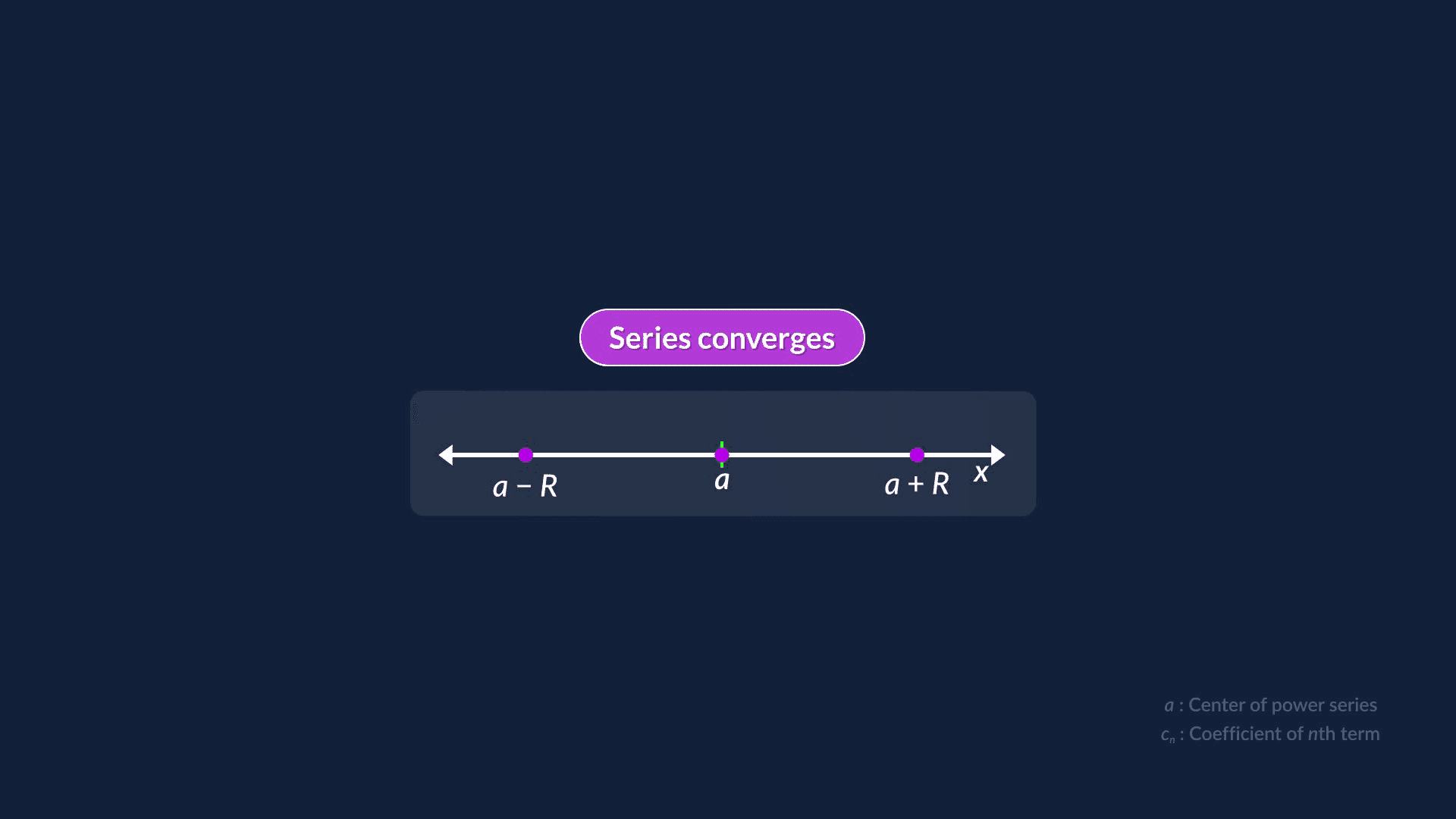
A power series is an infinite series built around powers of (x - c), often written as: sum of a(n) * (x - c)^n. It only converges for certain values of x. To find the interval of convergence, apply the Ratio Test to the general term and solve the resulting inequality for x. Don't forget to manually test the endpoints, they can converge or diverge independently. Taylor series and Maclaurin series (a Taylor series centered at zero) express familiar functions like e^x, sin(x), and cos(x) as power series. These appear in AP Physics C, college-level differential equations, and engineering courses at universities across the US, making interval of convergence one of the most practically important skills in calculus.
Related Micro-courses