Loading video…


 16 Concepts
 51 views

Video Summary: What Is Binomial Series
Ever wonder how Einstein's relativity connects to a simple math formula? The binomial series, the core concept behind binomial series basics, is a powerful infinite series expansion that unlocks approximations of complex real-world functions. Used in special relativity to derive classical kinetic energy from total energy equations, this tool is essential in physics and engineering. Watch the full video on JoVE Coach to master this concept with expert-led visuals and step-by-step explanations.
The binomial series is a special case of the Maclaurin series, a Taylor series centered at zero, that expands the function f(x) = (1 + x)^m into an infinite sum of terms involving increasing powers of x. The general form is:
(1 + x)^m = 1 + mx + [m(m−1)/2!]x² + [m(m−1)(m−2)/3!]x³ + …
When m is a positive integer, this series is finite and produces the familiar binomial theorem from algebra. However, when m is any other real number, a fraction, a negative number, or an irrational value, the series becomes infinite because the numerator coefficients never reduce to zero. Understanding this distinction is foundational for students in AP Calculus BC and college-level Calculus II courses across the United States.
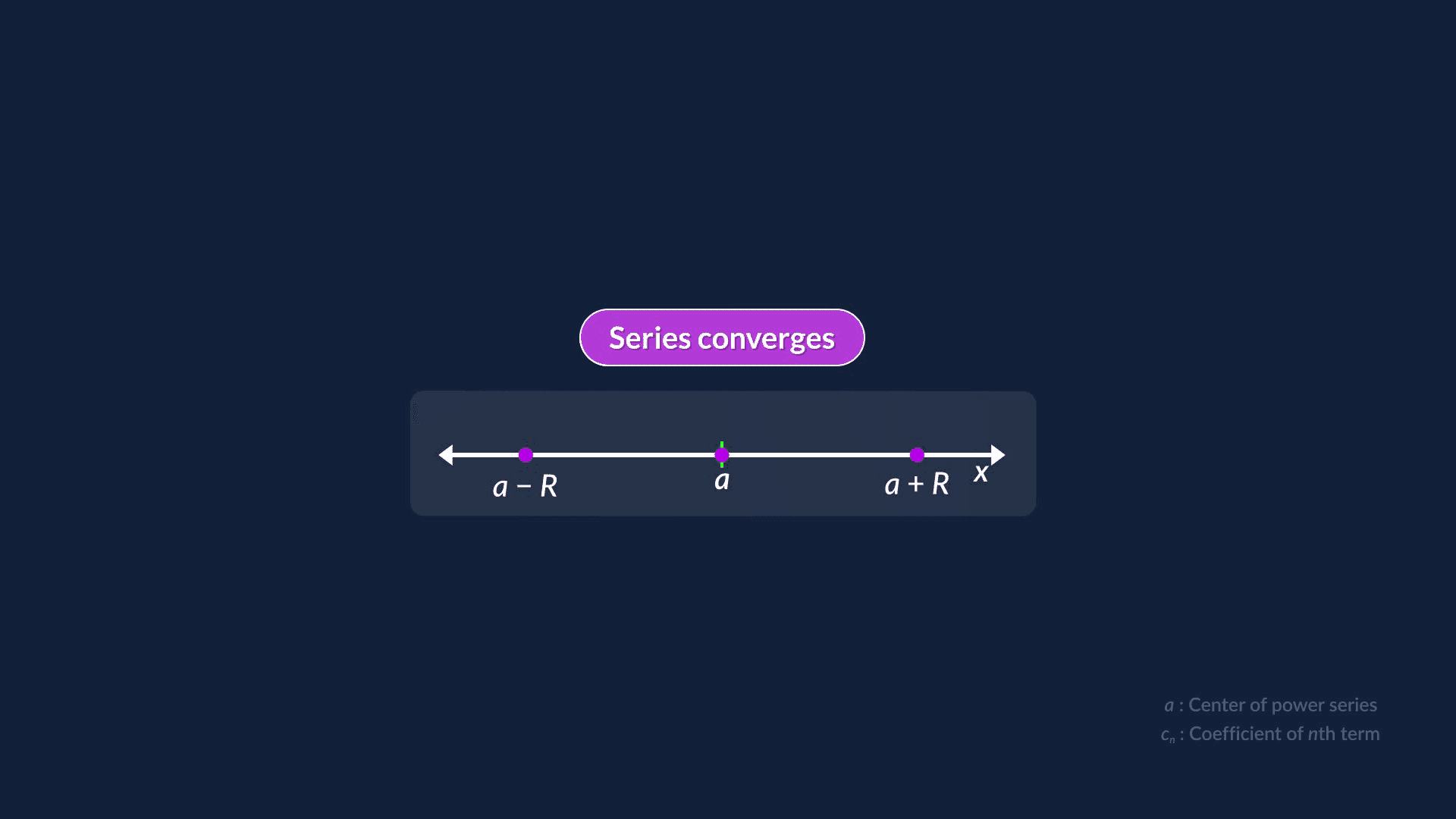
One of the most important questions in any series problem is: *how to tell if a series converges?* For the binomial series, convergence is governed by a clean rule, the series converges when the absolute value of x is strictly less than 1 (|x| < 1). This is the interval of convergence for the binomial series.
Students learning how to find the interval of convergence of a power series will recognize this as a classic application of the ratio test or root test. At the boundary values x = 1 and x = −1, convergence depends on the value of m and requires more careful analysis using tools like the alternating series test. This nuance often appears on AP Calculus BC free-response questions and college midterms.
It helps to understand where the binomial series fits within the broader family of series. A geometric series is actually a special case of the binomial series when m = −1 and the common ratio falls within the convergence interval. The Taylor series is the general framework for expanding functions as infinite polynomials around any point, while the Maclaurin series is the specific version centered at x = 0, and the binomial series is one of the most useful Maclaurin series in applied mathematics.
Knowing the difference between a sequence and a series is also essential here: a sequence is an ordered list of numbers, while a series is the sum of the terms of a sequence. The binomial series is specifically about summing an infinite sequence of coefficient-weighted power terms.
One of the most compelling real-world applications of the binomial series appears in special relativity. Einstein's formula for the total energy of a moving object includes a term that involves the square root of a quantity, specifically, (1 − v²/c²)^(−1/2), where v is velocity and c is the speed of light. This expression fits perfectly into the binomial series framework.
When an object moves much slower than the speed of light (as virtually all everyday objects in the US and elsewhere do), the ratio v²/c² is extremely small, keeping the magnitude of the expansion term well below 1 and satisfying the convergence condition. Expanding and retaining just the first two terms yields an approximation whose second term is exactly (1/2) m v², the classical kinetic energy formula from Newtonian mechanics. This elegant result demonstrates that classical physics is simply a limiting case of relativity, and it shows students why the binomial series is far more than an abstract exercise.
Related Micro-courses