Loading video…


 16 Concepts
 51 views

Video Summary: What Is Infinite Series
Could adding infinitely many numbers actually produce a finite answer? Infinite series makes that possible. An infinite series is the sum of endlessly continuing terms, governed by whether its partial sums settle toward a fixed value. Think of a draining water tank that releases half its contents every minute, the amounts keep shrinking toward zero, yet their total approaches a definite number. Watch the full video on JoVE Coach to master this concept with expert-led visuals and step-by-step explanations.
An infinite series is the sum of an infinite sequence of terms added together one after another without end. Because you cannot literally add infinitely many numbers by hand, mathematicians define the value of an infinite series through a process called a limit. Specifically, you calculate partial sums, the sum of the first term, then the first two terms, then the first three, and so on, and observe whether those running totals approach a fixed number. If they do, the series converges. If the totals grow without bound or fluctuate endlessly, the series diverges. This distinction is one of the most fundamental ideas in calculus and appears throughout AP Calculus BC, college-level Calculus II, and even engineering coursework.
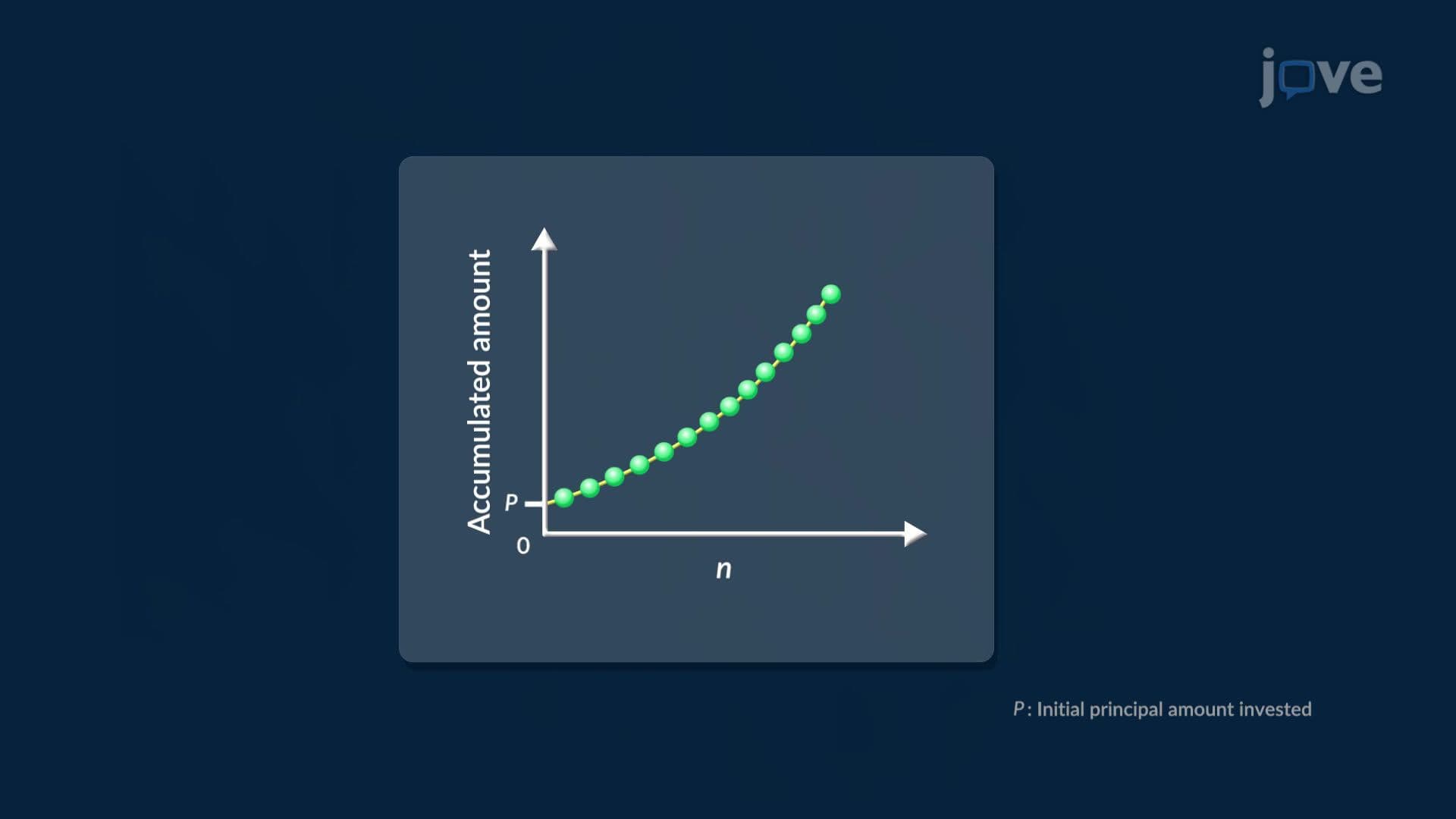
The central challenge with any infinite series is determining whether its partial sums stabilize. A geometric series, one where each term is multiplied by a fixed ratio, is the most teachable model. When the absolute value of the common ratio is less than 1, the terms shrink fast enough that the total settles at a finite number. For example, the series 1 + 1/2 + 1/4 + 1/8 + … converges to exactly 2. But when the ratio is 1 or greater, such as in a compound interest scenario where a balance grows by a fixed percentage every period, the total expands forever, a classic divergent series. Understanding this distinction is essential for AP Calculus BC free-response questions and college midterms nationwide.
Several formal tests help determine whether a series converges or diverges. The ratio test compares consecutive terms by computing the limit of the ratio a(n+1) / a(n) as n approaches infinity, if that limit is less than 1, the series converges. The root test takes the nth root of the absolute value of the nth term and evaluates its limit similarly. For series whose terms alternate in sign, the alternating series test offers a more direct approach: if the absolute values of the terms decrease monotonically toward zero, the series converges. Knowing when and how to apply each test is a core skill tested in both AP Calculus BC and university-level Calculus II exams across the US.
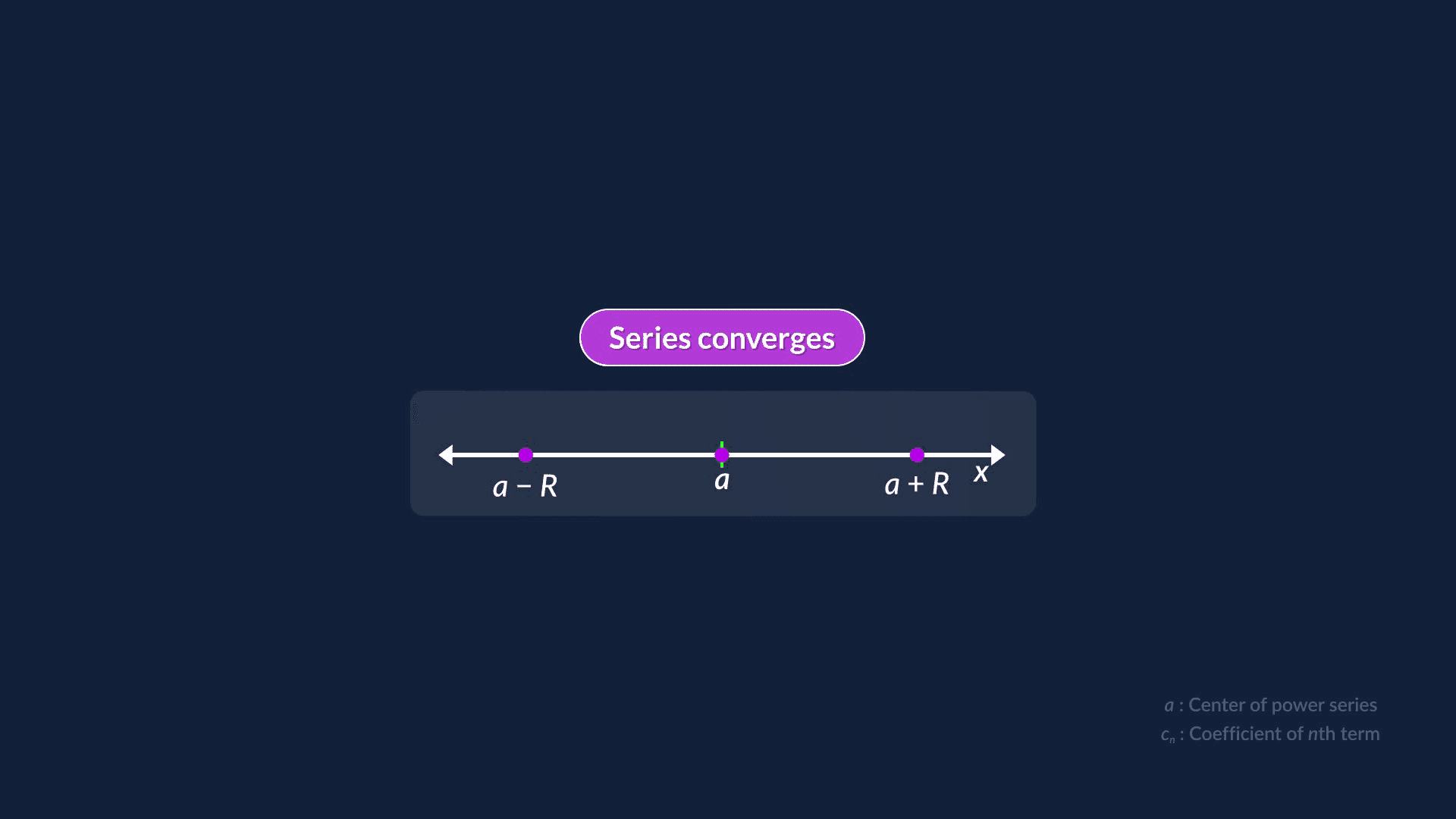
A power series is a special type of infinite series built from powers of a variable, typically centered at a specific point. When that center is zero, the result is a Maclaurin series; when centered at any point a, it becomes a Taylor series. These representations let mathematicians and scientists approximate complex functions, like sin(x), cos(x), or e^x, using polynomials, which computers can calculate efficiently. In practice, NASA engineers, financial modelers, and signal processing systems at US tech companies all rely on series approximations. A critical skill associated with power series is finding the interval of convergence, the range of x-values for which the series produces valid, finite results, typically found using the ratio test. This topic is heavily tested in AP Calculus BC and is foundational to courses in differential equations and numerical analysis.
Related Micro-courses