Loading video…

 19 Concepts
 95 views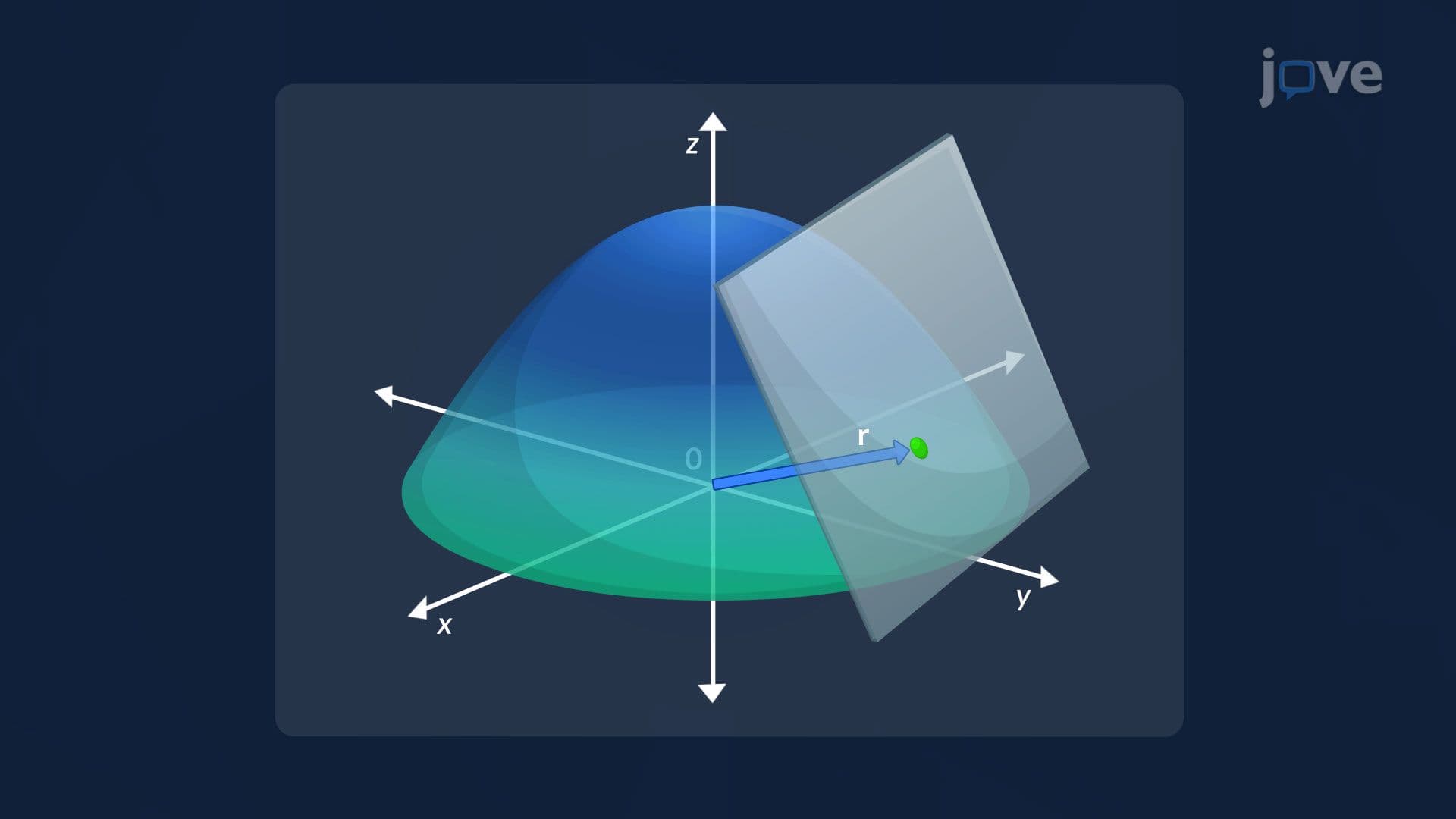

Video Summary: Tangent Planes to a Parametric Surface Explained
Ever wondered how engineers at NASA calculate the exact angle of a rocket's curved heat shield at any given point? Understanding tangent planes to a parametric surface unlocks this kind of precise geometric reasoning. This concept from Tangent Planes to a Parametric Surface Explained shows how a flat plane "kisses" a curved surface at exactly one point using partial derivatives and cross products. Watch the full video on JoVE Coach to master this concept with expert-led visuals and step-by-step explanations.
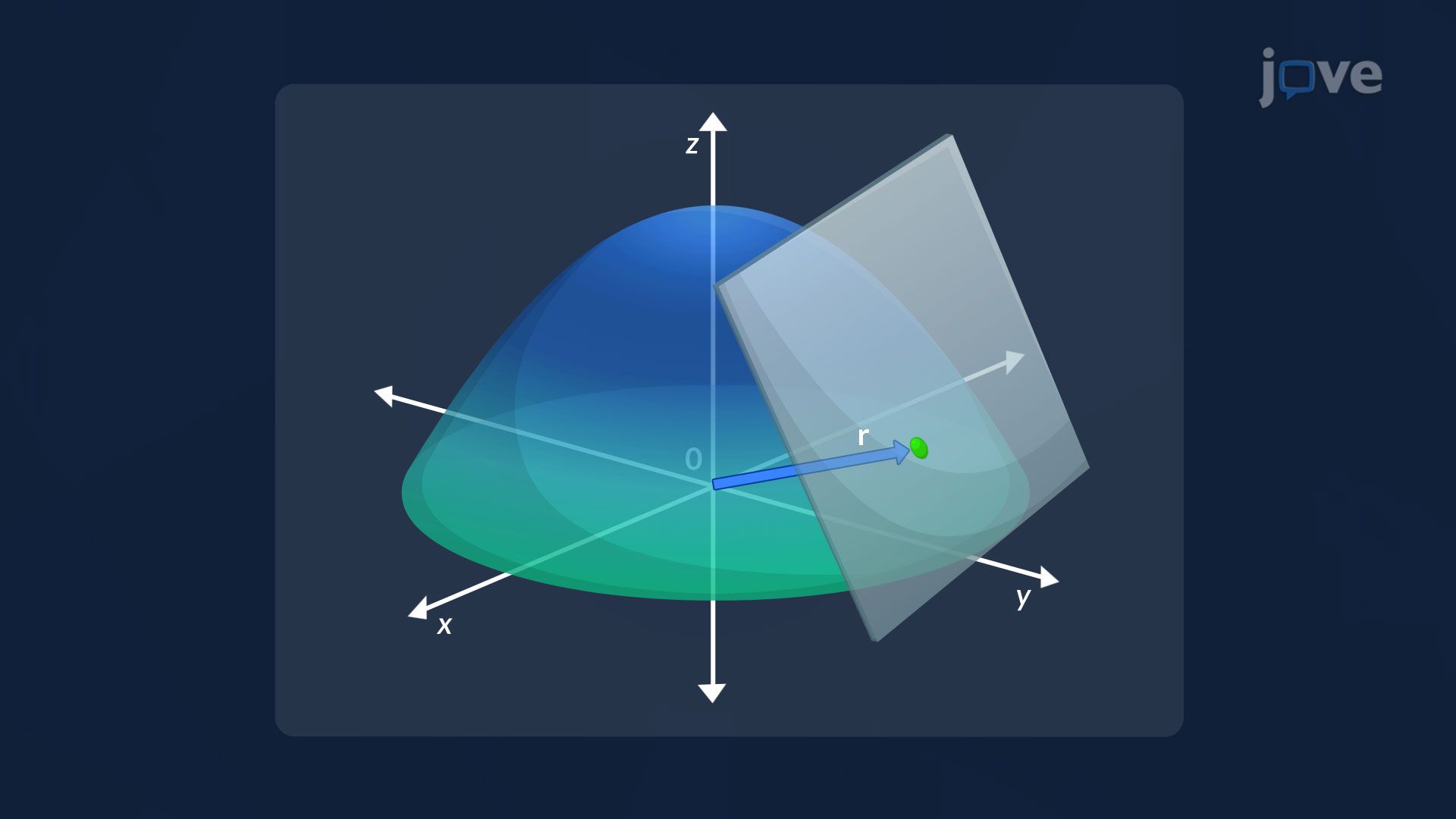
A tangent plane to a parametric surface is the flat, two-dimensional plane that best approximates a curved three-dimensional surface at a single specific point. Just as a tangent line touches a curve at one point in two dimensions, a tangent plane "just touches" a surface at one point in three dimensions, matching the surface's slope and orientation at that exact location. This idea is foundational in multivariable calculus and appears in college courses such as Calculus III (MATH 2415 or equivalent) across US universities.
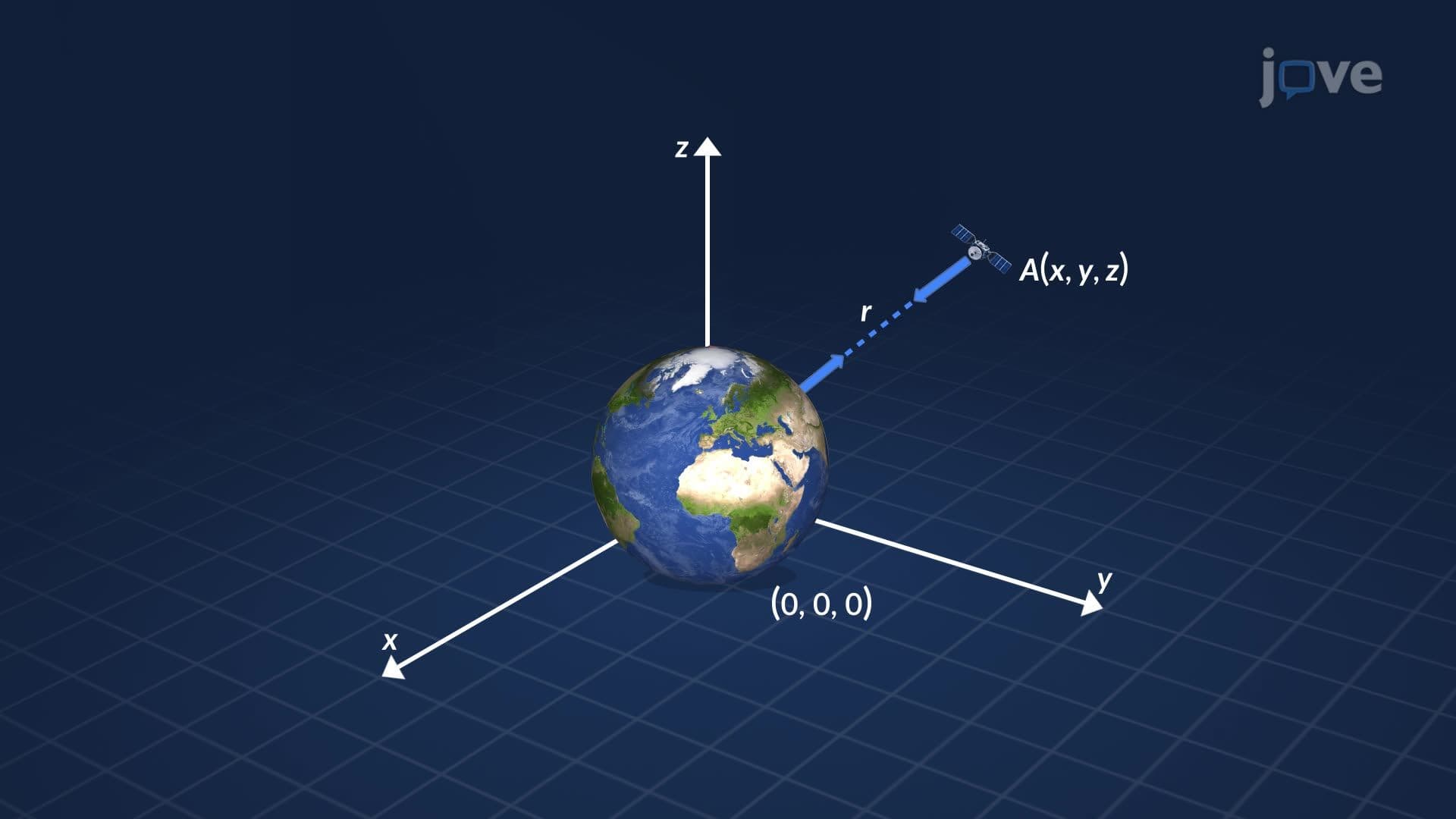
A surface is described parametrically when the position of every point is expressed as a vector function r(x, y) = ⟨f(x,y), g(x,y), h(x,y)⟩, using two independent parameters, typically x and y. A classic example is a paraboloid, like the curved dish of a satellite antenna used by the Jet Propulsion Laboratory in Pasadena, California. Each point on that dish can be mapped by a parametric equation, making it possible to perform geometric and physical calculations at any specific location on the surface.
To define the tangent plane at a point A on the surface, two partial derivative vectors are computed:
Both vectors lie within the tangent plane. Their cross product, n = r_x × r_y, produces a normal vector perpendicular to the tangent plane. This normal vector is the critical geometric ingredient, it tells you exactly which direction the plane "faces" at point A. This process mirrors how surface integrals are set up in physics, where the orientation of a surface element matters for calculating flux.
Once the normal vector n = ⟨a, b, c⟩ and the point A = (x0, y0, z0) are known, the tangent plane equation follows from a simple perpendicularity condition. For any point P = (x, y, z) on the plane, the vector v from A to P must satisfy:
n · v = 0
Expanding this gives: a(x − x0) + b(y − y0) + c(z − z0) = 0
This is the standard scalar equation of the tangent plane. This formula appears frequently in AP Calculus BC extensions, college Calculus III midterms, and standardized graduate-level assessments.
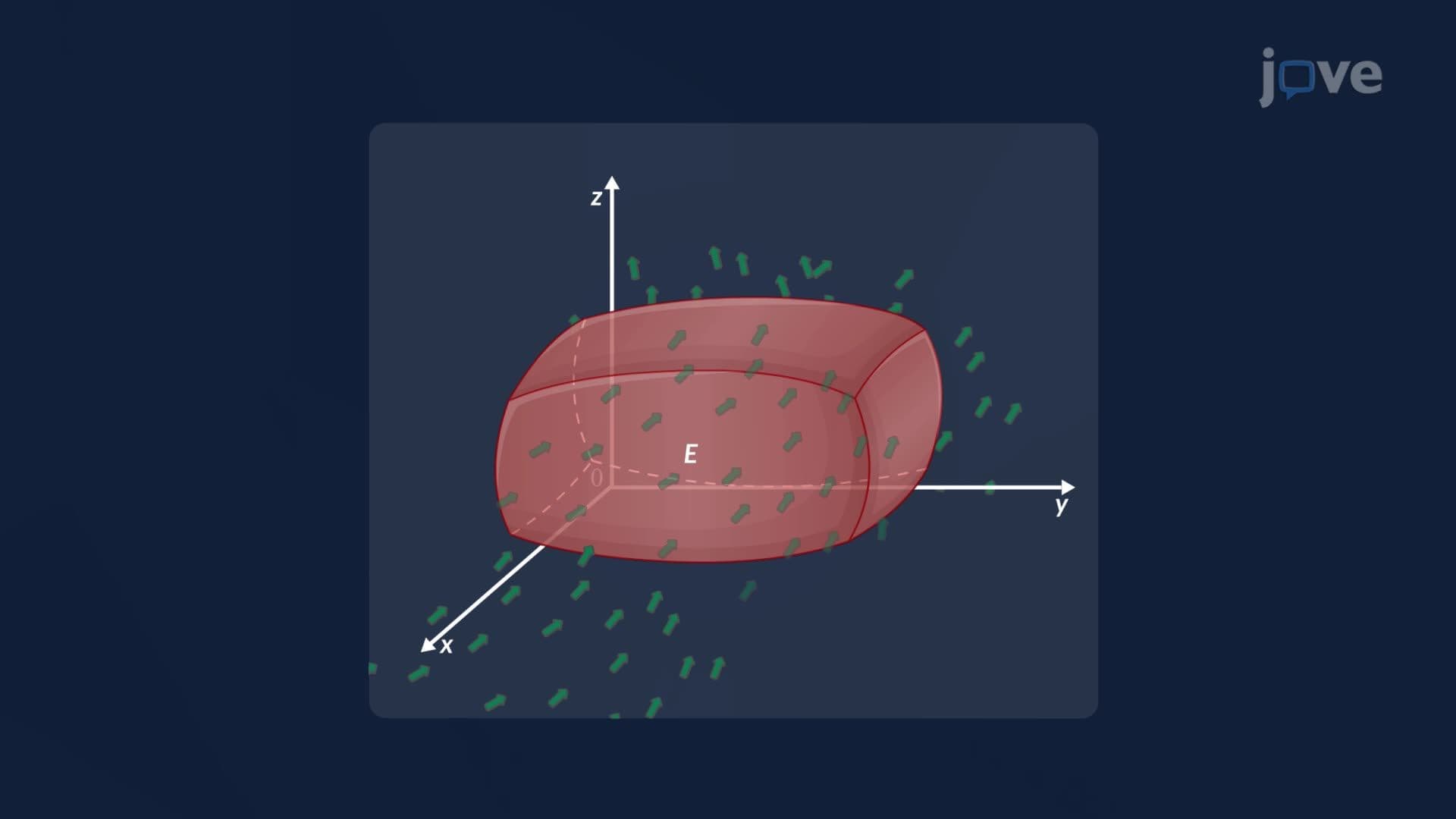
Tangent planes are not an isolated topic, they are the geometric backbone of several advanced ideas. Surface integrals integrate a function over a curved surface and rely on tangent plane orientation. The divergence theorem and Stokes' theorem both require properly oriented surface normals, which come directly from the cross product of tangent vectors. Understanding curl and divergence of vector fields also builds on the ability to reason about directions perpendicular to a surface. In US undergraduate physics and engineering programs, this concept bridges pure mathematics and applied problem-solving in electromagnetism, fluid dynamics, and computer-aided design (CAD).
Related Micro-courses