Loading video…


 35 Concepts
 5.1K views

Video Summary: What Is Degenerative Disc Disease I
Did you know that by age 50, most Americans show some signs of disc degeneration, even without back pain? Degenerative disc disease I covers the foundational biology behind one of the most common spinal conditions in the US. The intervertebral discs lose hydration, structural integrity, and shock-absorbing capacity over time due to genetics, aging, and workplace stress like repetitive heavy lifting. Watch the full video on JoVE Coach to master this concept with expert-led visuals and step-by-step explanations.
Degenerative disc disease I introduces one of the most clinically significant topics in musculoskeletal biology. Despite its name, degenerative disc disease (DDD) is not a single disease with a predictable course, it is a progressive, multifactorial process of structural and biochemical breakdown within the intervertebral discs. According to the American Academy of Orthopaedic Surgeons, DDD is among the leading causes of chronic low back pain in the United States, affecting millions of working-age adults and costing the healthcare system billions annually in treatment and lost productivity.
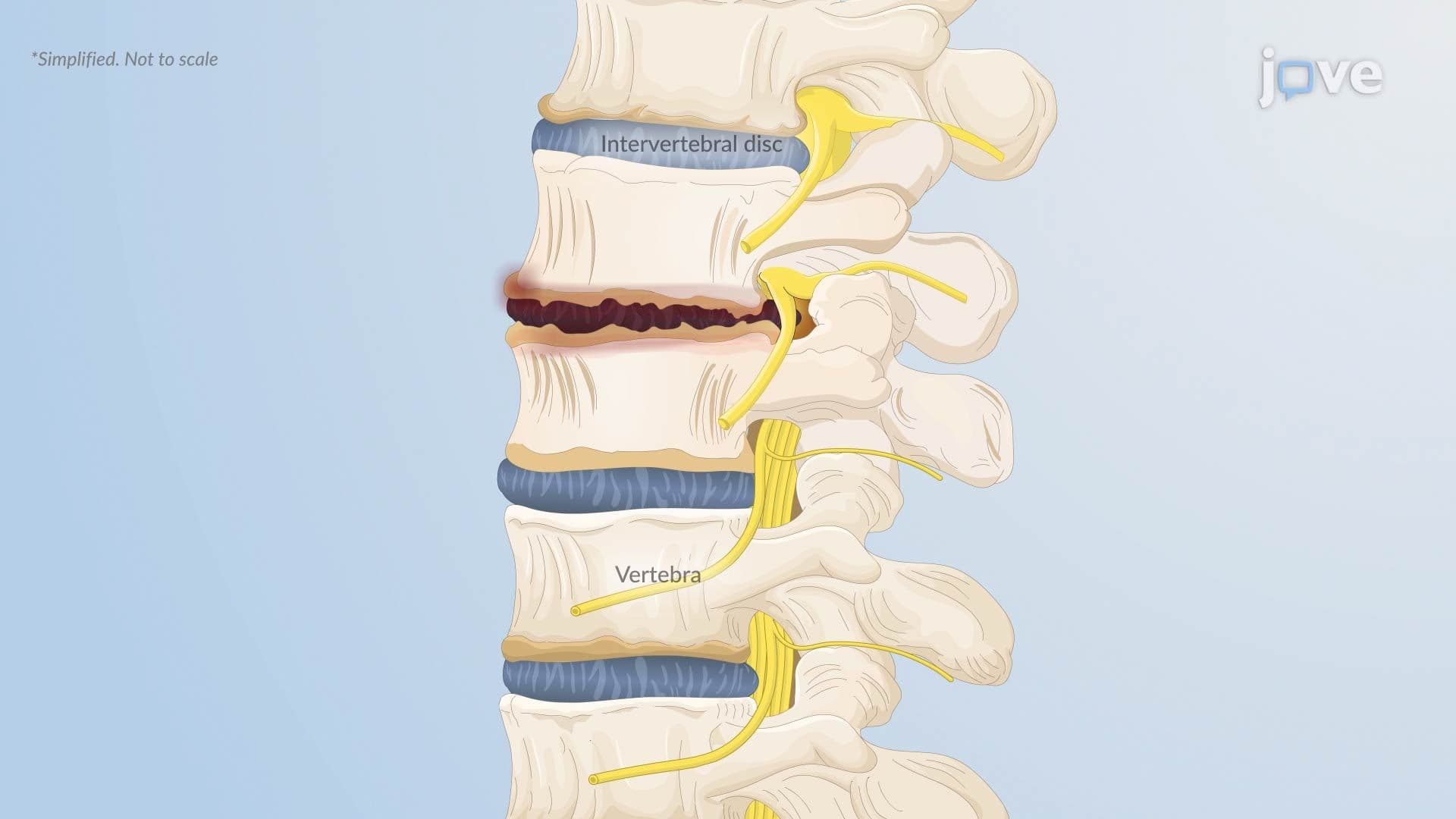
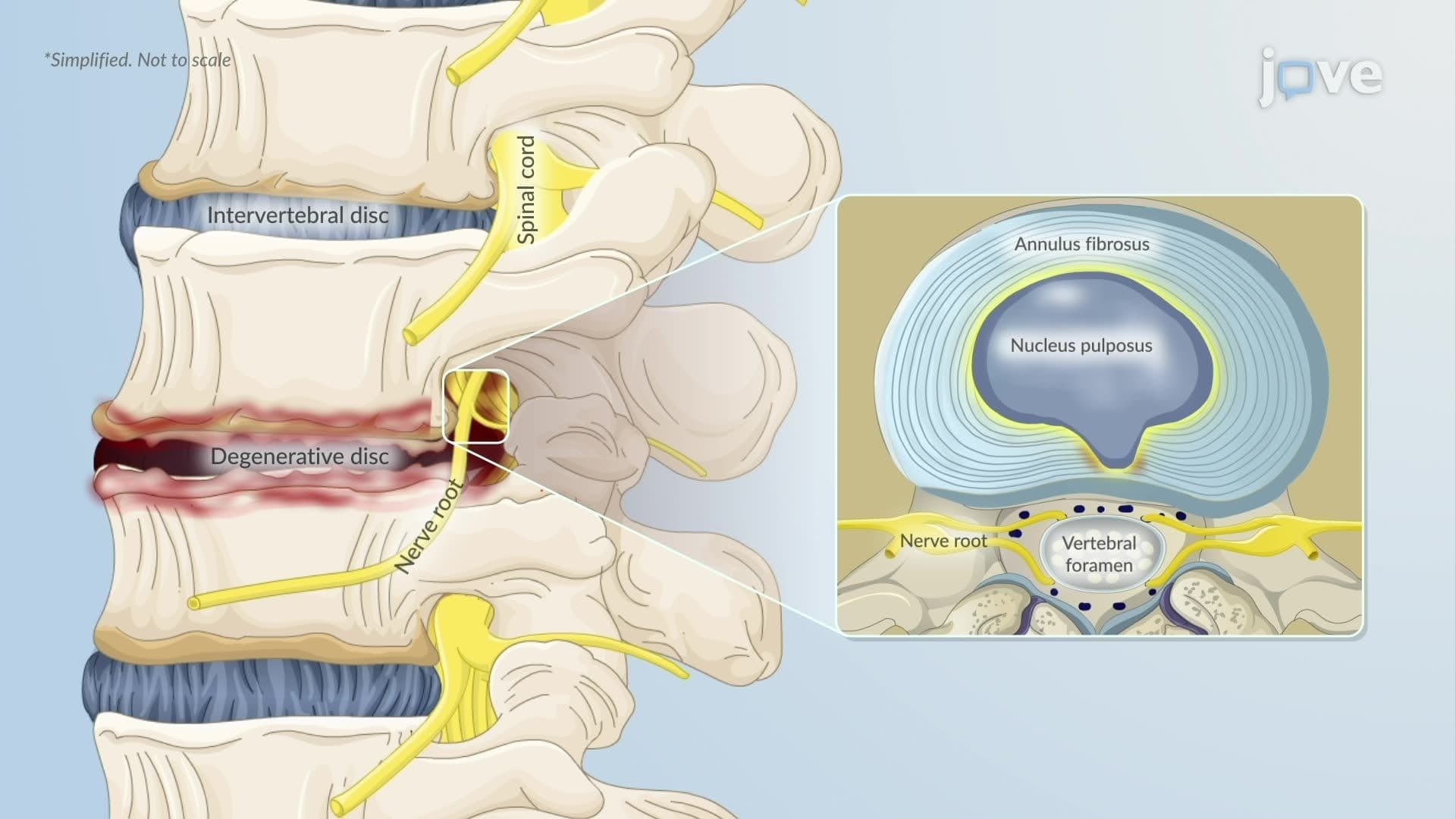
To understand degeneration, you must first understand normal disc anatomy. Each intervertebral disc acts as a biological shock absorber between the vertebral bodies of the spine. It has two structurally distinct regions working in concert.
The nucleus pulposus forms the gel-like inner core. It is rich in proteoglycans, large molecules that attract and retain water, giving the nucleus its characteristic ability to distribute compressive forces in all directions. This hydrophilic property allows healthy discs to maintain height and absorb the mechanical demands of everyday movement, from walking to lifting groceries.
Surrounding the nucleus is the annulus fibrosus, a multilayered ring of fibrocartilage composed of concentric collagen lamellae. Its higher collagen-to-water ratio compared to the nucleus gives it superior tensile strength, it resists the outward bulging of the pressurized nucleus and holds the disc structure together under load. Think of the nucleus as the pressurized filling inside a tire and the annulus as the tire wall containing it.
One of the most critical and frequently tested concepts in disc biology is that intervertebral discs are avascular, they have no direct blood supply. Both the nucleus and annulus rely entirely on passive diffusion of oxygen, glucose, and other nutrients through the vertebral endplates. This is a slow, limited process, and any disruption, such as endplate calcification, smoking, or cardiovascular disease that reduces circulatory efficiency, directly impairs the disc's ability to maintain its extracellular matrix.
When cells within the disc cannot receive adequate nutrition or remove waste products efficiently, matrix-degrading enzymes become more active than matrix-building processes. Proteoglycan content falls, water retention decreases, and the disc begins to lose its height and mechanical resilience. This cascade is a central feature of degenerative disc disease I and explains why even young adults in physically demanding occupations, such as construction workers or military personnel, can develop early DDD.
Research, including large-scale twin studies conducted at US institutions such as the University of California and Johns Hopkins, confirms that genetic predisposition is a major driver of DDD, in some studies accounting for up to 74% of variance in disc degeneration. However, environmental and mechanical factors significantly accelerate the process. Repetitive axial loading, heavy lifting with poor biomechanics, and sustained vibration (common in truck drivers and warehouse workers) place cyclic stress on already vulnerable tissue.
Age-related changes compound the problem. As the body ages, the nucleus pulposus loses its proteoglycan density naturally, and the annulus becomes stiffer and more prone to fissuring. The interplay of these factors, genetics, age, nutrition, and mechanical load, makes degenerative disc disease a model topic for understanding multifactorial disease in any biology, anatomy, or pre-health curriculum.
This concept appears across multiple educational contexts. In AP Biology and AP Environmental Science, disc biology connects to topics on connective tissue, cell signaling, and homeostasis. In college-level Anatomy & Physiology courses, a core requirement at most US universities for pre-nursing, pre-med, and kinesiology majors, disc structure and function are standard exam material. For students preparing for the MCAT, understanding the biochemistry of proteoglycans and collagen, the mechanics of avascular tissue maintenance, and the pathophysiology of degenerative processes is directly relevant to the Biological and Biochemical Foundations section.
Related Micro-courses